The Ultimate Guide to Making Your First 6 Figures
Short answer: to make your first 6 figures, start with the maths: $100,000 is 100 sales of a $997 offer, and at a 3% average conversion that's about 3,300 leads over the year. Then choose one ideal client and one offer, price it inside a simple low, mid and high product suite, and get visible every day with Build Borrow Buy. Bring in your first clients fast with DMs, free audits and offer parties, then build a Freedom Funnel that sells every day and run a 5 Day Experience launch every few months. Add recurring revenue, plan 90 days at a time, and follow the 12 month roadmap in this guide.
I started my business in January 2020. The same month I found out I was pregnant, and six weeks later the whole country went into lockdown. I had no team, no ads budget, no audience and nobody had any idea who Laurie Burrows was. That first year I made nearly $200,000 in sales as a brand new mum. By May 2021 I celebrated my first six figure month.
I'm not telling you that to show off. I'm telling you because I know exactly what it's like to start with nothing but a laptop, a lot of determination and very limited time. I couldn't work 12 hour days. I had a newborn. So I had to get really clear on what actually made money, and do only that. Everything in this guide is what I did then, what I still do now, and what I teach my clients when they want their first 6 figures.
Every step below links to a deeper post if you want more, but everything you need to get to your first $100,000 is on this page.
Free 5 day event · 12th to 16th October
The 6 Figure Game Plan
Want to do this guide with me instead of on your own? Join The 6 Figure Game Plan, my free 5 day event. You'll map your strategy to your first 6 figures and get the plan, the content and the pages created for you.
Who is this guide for, and what will you have by the end?
This guide is for coaches, consultants and online service providers who are somewhere between zero and $5,000 months. Whether you've just started or you've had great months followed by very quiet ones, this works from where you are. By the end you'll have your 6 figure numbers, one offer and a product suite that adds up, a visibility plan, six ways to get clients this month, your Freedom Funnel and 5 Day Experience mapped out, a weekly content plan, a 12 month roadmap and a 90 day start plan. Bookmark it. This is a playbook, not a one time read.
How does making your first 6 figures actually work?
One person tells you to post every day, another says run ads, another says launches are dead. The truth? It all works. What matters is that your business covers three stages, every single month: Attract Nurture Convert. People need to find you, trust you and then buy from you.
Inside that, there's one chain I want you to remember: visibility leads to leads, leads lead to conversations, conversations lead to sales. If you're not making the money you want, one of those links is missing. Usually it's more than one.
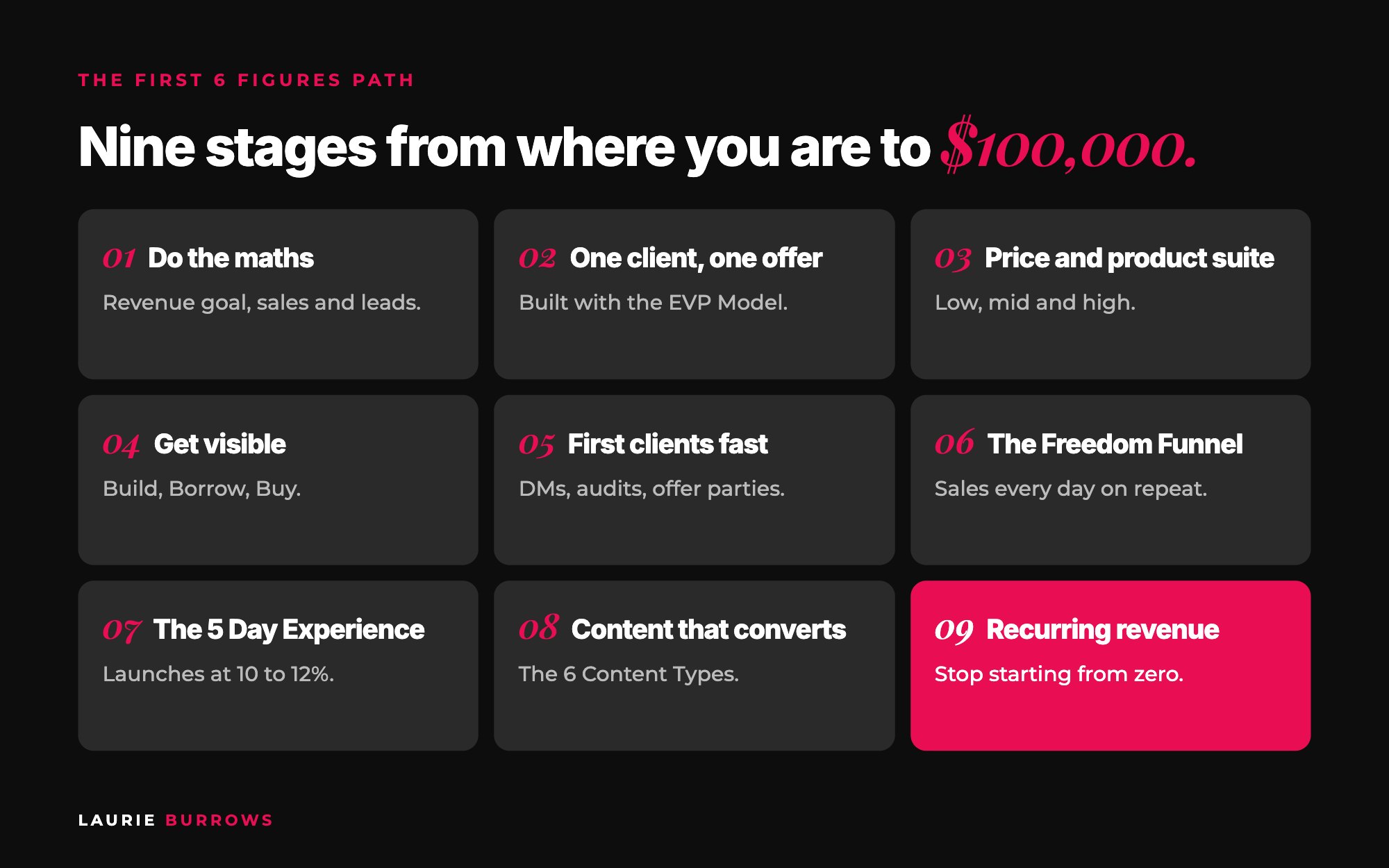
So I've broken the whole thing into nine stages. I call it The First 6 Figures Path. You do them roughly in order, but once a stage is set up it keeps running in the background while you build the next one.
Every morning, before anything else, I still ask myself two questions: what can I do today to generate a lead? and what can I do today to bring in a sale? If you only take one thing from this guide, take those two questions.
Stage 1: Do the maths (your revenue goal and Lead Map)
Guessing and hoping isn't a strategy. Most people say "I want to make six figures" and then go and post some content. They never work out what six figures actually means in sales, in leads and in daily actions. So that's where we start. It takes about an hour, and it changes everything, because once you know your numbers you stop wondering why it isn't working. You can see exactly why.
Step 1: Set a revenue goal, not an income goal
Your revenue goal is what the business needs to bring in. Your income goal is what you want to pay yourself. They are not the same number. The business has to cover your pay plus expenses, tax and some profit. For most people starting out, $100,000 in sales is a brilliant first revenue goal, and that's the number this guide uses.
Split it so it feels real: $100,000 a year is about $8,333 a month, or $1,923 a week. I go deeper on this in why you need a revenue goal, not an income goal.
Time: 30 minutes with your bank statements open. Done when: you have one revenue number for the next 12 months written somewhere you'll see every day.
Step 2: Work out how many sales you need
Divide your revenue goal by your offer price. That's it. $100,000 divided by $997 is about 100 sales. Now ask honestly: can my audience deliver 100 sales of this in a year? Your price decides your strategy, which is why we do the maths before we build anything.
| Offer price | Sales for $100,000 | Leads at 3% | Leads at 10% |
|---|---|---|---|
| $27 (+ $11 bump = $38) | About 2,632 | About 87,700 | About 26,300 |
| $497 | About 202 | About 6,700 | About 2,010 |
| $997 | About 100 | About 3,300 | About 1,000 |
| $1,997 | About 50 | About 1,670 | About 500 |
| $5,000 | 20 | About 670 | 200 |
Look at that top row. Low priced offers are brilliant stepping stones, but building your whole business on a $27 offer needs huge volume.
Step 3: Work out how many leads you need
A lead is anyone who shows interest in something you have to offer: they opt in, comment, vote on a poll, DM you, join your event or ask a question. The industry average is that around 3% of leads buy. So divide your sales by 0.03. For 100 sales of a $997 offer, that's 100 divided by 0.03, which is about 3,333 leads. Call it 3,300 a year, roughly 278 a month or 64 a week.
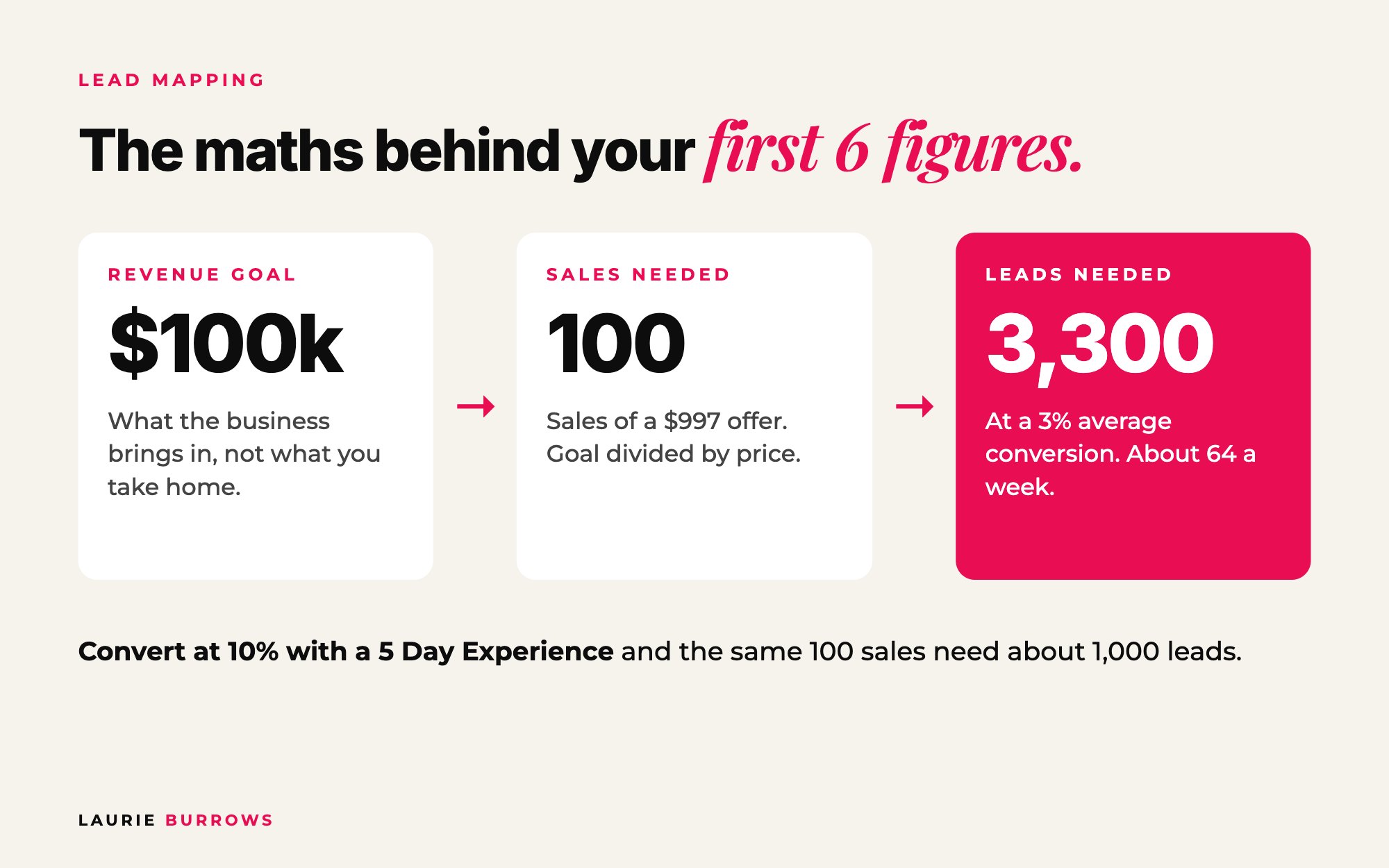
Now here's the bit that gets me excited. My own launches convert at 10 to 12%, when the industry average sits at 1 to 3%. At 10%, those same 100 sales only need about 1,000 leads. Same offer, same price, a third of the leads. Conversion rate is the lever most people ignore, and conversations, live attendance and following up are what move it.
Step 4: Build your Lead Map
Knowing your leads number is step one. Lead Mapping is step two: you list every place your leads will come from and put a realistic number next to each one until it adds up. This is where most plans fall apart.
Copy and paste: Lead Mapping calculator
Revenue goal (12 months): $[goal]
Core offer price: $[price]. Sales needed = goal ÷ price = [sales]
Leads needed = sales ÷ 0.03 = [leads] (use your own conversion rate once you have one)
Per month = leads ÷ 12 = [monthly leads]. Per week = leads ÷ 52 = [weekly leads]
My Lead Map this month: email list [number], social media [number], guest spots [number] x [people per spot], collaborations [number], free audits [number], ads [number]. Total: [must equal monthly leads]
Then track it weekly, so if you're behind by week two you know now, not at the end of the month. My full walkthrough is in how many leads do I need?, and I share the tracker I use in how to track your leads.
If spreadsheets make you want to cry, the Strategist inside Ascendia OS does this part for you: it learns your business, sets the goal and maps what to sell, when, and how many sales and leads you need.
Time: 30 minutes. Done when: you have a sales number, a leads number, a weekly leads target and a Lead Map that adds up.
Stage 2: Pick one ideal client and one offer
When I started, I had ideas for five different offers. What actually got me to six figures was the opposite: one ideal client, one core offer, one strategy I could rinse and repeat. Every time you launch a new offer with a new strategy, nothing gets long enough to work, your delivery doubles and you burn out. Perfect selling one offer first. I explain why in why you should perfect one offer first.
Step 1: Choose one ideal client (and get specific)
Knowing your ideal client isn't about their age and their favourite coffee. It's about where they are right now compared with where they want to be, what they've already tried, and why they would buy. Answer these in writing:
- Where are they now? In their words, not yours. ("I'm posting every day and nobody's buying.")
- Where do they want to be? The specific result. ("Five new clients a month without living on Instagram.")
- What have they already tried? And why didn't it work?
- What's stopping them buying? Time, money, "will it work for me", trust.
Ask past clients or people in your DMs. Their exact words become your content and your pitch. If your offer and your audience don't match, nothing else in this guide will fix it, so read the ideal client and offer mismatch if you're not sure.
Time: 45 minutes. Done when: you can describe one person, where they are, where they want to be and what they've tried, in a paragraph.
Step 2: Build your offer with the EVP Model
I build every offer with my EVP Model. Nail all three parts and your offer becomes a hell yes offer, the kind people buy without needing to be convinced.
- E is the End Result. The specific transformation your client gets. It has to be worth more to them than the price. "Feel more confident" is not an end result. "Sign your first five clients in 60 days" is.
- V is Value Stacked. Everything they get: the training, the support, the templates, the calls, the community, the bonuses. Stack it so the value clearly outweighs what they pay.
- P is Point of Difference. Why this, and why you, rather than everything else they could buy or have already tried. Your method, your story, your way of doing it.
People need to know three things before they buy: what's different about this, why it's for them, and why now. That's my Different You Now check. Run your offer through it before you sell a single spot. The full framework, with a scoring sheet, is in the EVP Model, and the deep dive is the ultimate guide to creating an offer that sells.
Copy and paste: offer statement
I help [one ideal client] get [specific end result] in [timeframe] without [the thing they hate or have already tried], using my [named method].
Example: I help new business coaches sign their first five paying clients in 60 days without posting every day and hoping, using my Conversation First method.
Then sell it before you build it. A case study round (a small group at a lower price, delivered live) gets you results and testimonials while you create the programme.
Time: 60 minutes. Done when: you can say your offer in one breath and a stranger knows exactly who it's for and what they'll get.
Stage 3: Price it and build a simple product suite
Your product suite is the set of offers in your business at different price points, arranged so people can step from one to the next. You don't need ten offers. For your first 6 figures you need three levels, and you build them one at a time.
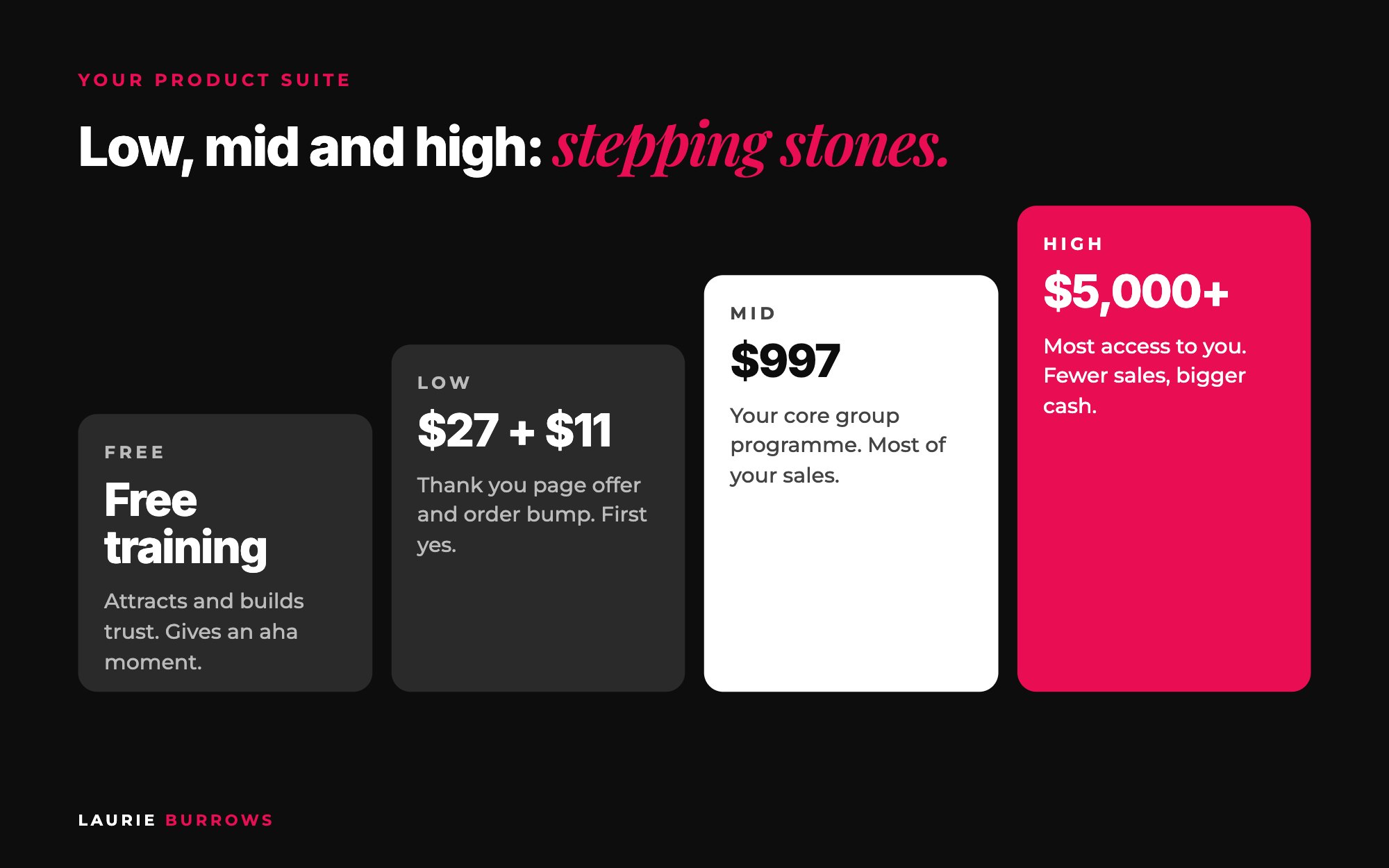
- Free: a short free training, guide or event that gives an aha moment. It attracts people and builds trust.
- Low ($27 plus an $11 order bump = $38): the first time someone pays you. It turns a cold lead into a buyer, and buyers are far more likely to buy again.
- Mid (around $997): your core offer, usually a group programme. This is where most of your first 6 figures comes from. In my experience, offers from $997 up to around $1,997 tend to be the easiest to sell.
- High ($5,000 or more): the most access to you, such as one to one or a small mastermind. Fewer sales, bigger cash, and often recurring revenue.
To price your core offer, start from your goal, check the end result is worth more than the price, start a little lower if the offer is new and raise it each time you sell it, and offer a payment plan. More detail in how to price a coaching programme and how to build a low, mid and high product suite. If you're torn on whether to give something away or charge for it, read free resource or $27 offer.
Worked example: a product suite that adds up to $100,000
Example (illustrative): a business coach with a $27 thank you page offer and an $11 order bump, a $997 group programme and a $5,000 one to one VIP package.
| Offer | Price | Sales in 12 months | Revenue |
|---|---|---|---|
| Low: $27 offer + $11 bump | $38 | 220 | $8,360 |
| Mid: group programme | $997 | 62 | $61,814 |
| High: one to one VIP | $5,000 | 6 | $30,000 |
| Total | $100,174 |
Look at what that means week to week: about one core programme sale a week, one high ticket client every two months, and four or five low priced offers a week. That's a lot less scary than "six figures", isn't it?
Stage 4: Get visible with Build Borrow Buy
If nobody knows who you are, you have nobody to sell to. It's not about being the best anymore, it's about being the best known. The gap between where you are and where you want to be might not be more expertise. It might be visibility.
Most people's visibility plan is "posting content", which means relying on an algorithm you have zero control over. I see content as a nurture piece for your current audience. To reach a new audience you need to think outside the box, and that's Build Borrow Buy.
Build: grow your own audience (about 20 to 30 minutes a day)
- Engage with ideal clients for 20 minutes a day. Keep a list of 30 ideal clients and show up for them every day. I once nearly joined someone's mastermind purely because she engaged with everything I posted until I got curious about who she was.
- Be a useful member of communities where your ideal clients already are (groups, memberships, programmes). Answer three questions a day. When I started, I did this in the evenings while everyone else was watching Netflix.
- Post content with one clear call to action every day (more on that in Stage 8).
Borrow: get in front of other people's audiences (one spot a week)
This grew my business fastest when I started, because I had no ads budget and no team. When someone brings you in front of their audience, their audience trusts you straight away: trust by association. Think guest spots in groups, programmes and masterminds, podcasts, summits and joint trainings.
Copy and paste: guest spot pitch
Hey [name], I love what you're doing with [their community or show]. I help [ideal client] get [end result], and I think your audience would get a lot from a 20 minute session on [specific topic], with one action they can take the same day.
Happy to share it with my audience too, or return the favour with a spot in my community. Would that be useful for you this month or next?
More on finding and landing these in guest speaking: how to use other people's audiences.
Buy: small, smart ads (once money is coming in)
You don't need ads to make your first sales. When a little cash is coming in, start with the $5 a Day Ads Strategy: small engagement ads on your best talking head videos to warm up cold audiences, then retarget the people who watched. Don't send cold ads straight to your offer. It wastes money. The full set up is in the $5 a day ads strategy.
Your weekly rhythm: 30 minutes of build every weekday, one borrowed audience a week (and three more pitched), and one free event or training a month. Visibility without ads has the full plan, and the ultimate guide to getting coaching clients from zero goes deeper on this stage.
Time: 30 minutes a day, plus one borrowed audience a week. Done when: your daily, weekly and monthly visibility actions are blocked out in your diary.
Do this now: open your diary now and block 30 minutes every weekday for visibility, then send the guest spot pitch above to three people who serve your ideal client.
Stage 5: Get your first clients fast
Here's where the money starts. You don't need a funnel, a website or a big audience to get your first clients. You need conversations. These are my Quick Cash Systems: the methods I use whenever I want sales this week, not next quarter. Pick two or three and do them every day for 30 days. And track every lead (name, source, where they are, stage, next follow up date), because the fortune really is in the follow up.
1. DM conversations from engagement
Everyone who likes, comments, follows, replies to a story or votes on a poll is showing interest. Start a conversation, not a pitch. I grew my business mostly through DM conversations because, as a new mum, I didn't have time for lots of sales calls, and my conversion rate went up the moment I opened my DMs.
Copy and paste: engagement DM
Hey [name], thanks so much for [commenting on / voting on / sharing] my post about [topic]! Can I ask, what made it stand out for you?
Then: Where are you at right now with [the problem]? And where would you love to be in the next 90 days?
When they've told you: From what you've said, [their words back to them]. That's exactly what I help people with inside [offer]. Would it be helpful if I sent you the details?
Target: five new conversations a day. Read getting in the DMs without being salesy for the full conversation and follow up.
2. Lead generation stories
Post three to five stories about the problem your offer solves, then a poll with two positive answers, for example "Details please" and "Hell yes". Everyone who votes is a lead. DM every single one of them.
Copy and paste: lead generation story
Story 1: "Most [ideal clients] I talk to are [the problem]."
Story 2: "Here's what's actually going on: [the real reason]."
Story 3: "This is exactly what I help with inside [offer]. I've got [number] spots this month."
Story 4 (poll): "Want the details?" Options: "Details please" / "Hell yes"
3. Free audits
Offer a free audit of something related to your paid offer: their content, their funnel, their offer, their website. Qualify people in the DMs, send a short form, then record a 10 minute video with three key points and one action step. End the video with a tailored pitch and a 48 hour bonus.
Copy and paste: free audit post
I'm doing 5 free [content / funnel / offer] audits this week for [ideal client] who [situation].
Comment AUDIT and I'll send you the details.
Full steps and scripts: the free audit strategy.
4. Case study spots
If you don't have many results yet, offer three to five case study spots at a lower price in exchange for feedback and a testimonial. You get your first clients and your first evidence at the same time, and that evidence sells your next round at full price.
5. An offer party
An offer party is a one to three day event where you release several offers at different price points, each discounted or packed with extra value for a limited time. Think of it as your own mini Black Friday: mix low and high prices, choose offers that are easy to deliver, and share each one across your group, stories and emails. Run one once or twice a year. The full plan is in how to host an offer party.
6. Your existing network
Tell everyone you know what you do, with a personal message, not a mass broadcast.
Copy and paste: network message
Hey [name], I hope you're well! I wanted to let you know I've started helping [ideal client] [end result]. Do you know anyone who's struggling with [problem] right now? I'd really appreciate an introduction.
Want more? how to make money this week (ethically) has the quick cash plays with their scripts, and the ultimate guide to making sales every single day covers the daily rhythm.
The conversation that turns a lead into a client
- Open with what they did (commented, voted, opted in). Not a pitch.
- Ask where they are now and where they want to be. Then shut up and listen.
- Tailor the pitch using their words. "You said X. This is how [offer] helps with exactly that."
- Ask if they're ready. Then handle the answer. "Yes, but" is an objection, not a no.
- Follow up at least five times: day 2, 4, 7, 10 and 30. You will make most of your sales by following up.
Time: 60 minutes a day for 30 days. Done when: every lead is on your tracker with a next follow up date, and you're having five new conversations a day.
Stage 6: Build the Freedom Funnel (your evergreen sales system)
Quick cash gets you started. But if every sale depends on you being in the DMs, you've built yourself a job. You need a system that sells every day, whether you show up or not. Mine is the Freedom Funnel. It's the reason I can take every school holiday off and still see sales come in.
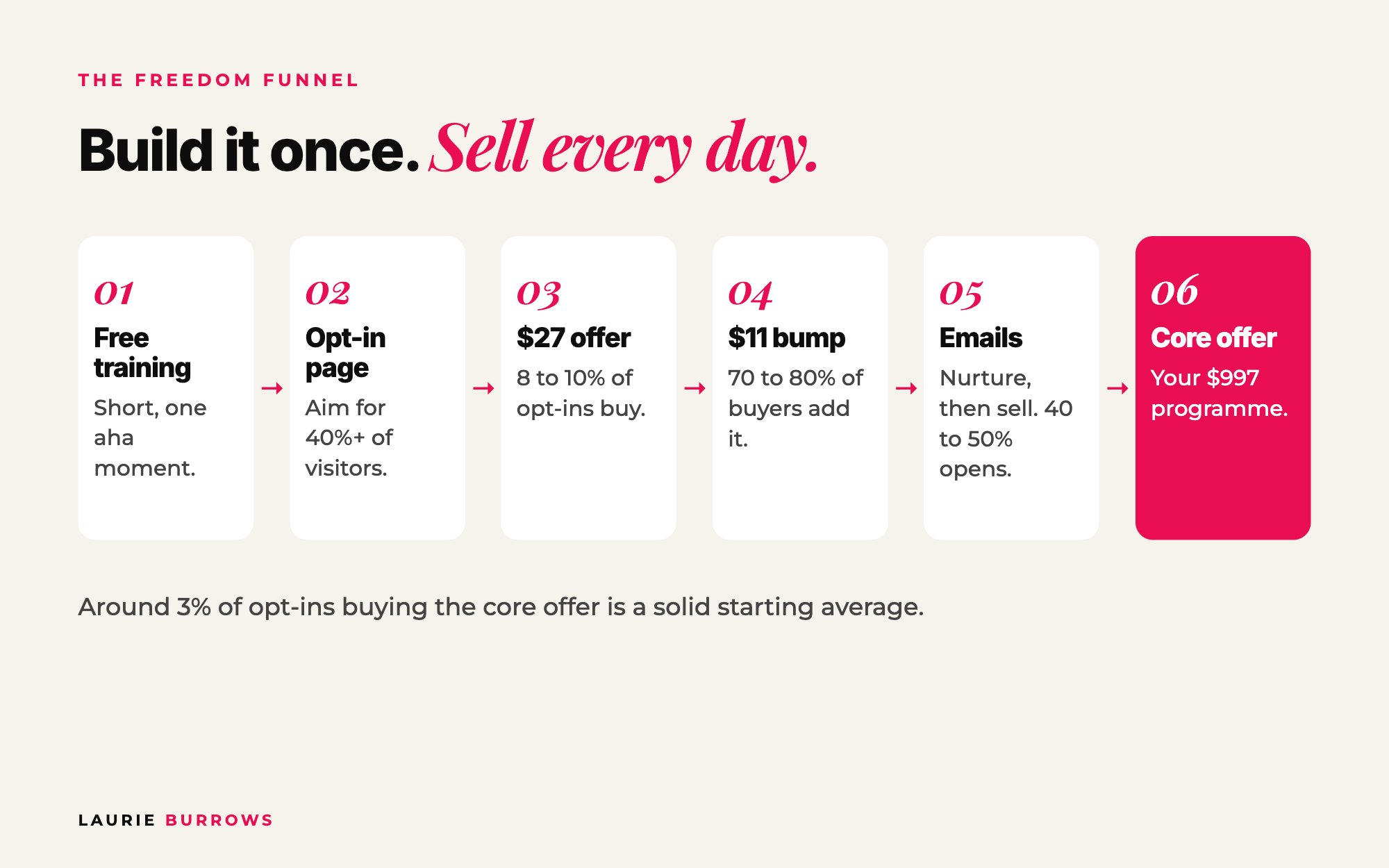
- A short free training (pre-recorded, around 20 minutes) with one aha moment.
- An opt-in page with a bold headline about the end result. Aim for 40% or more of visitors to opt in.
- A $27 offer on the thank you page: a no brainer even for someone who's never heard of you. Aim for 8 to 10% of opt-ins to buy.
- An $11 order bump at checkout, which takes the average order from $27 to $38. Often 70 to 80% of buyers add it.
- A nurture sequence of five or six emails: your story, more value, client results, the mistakes they're making.
- A sales sequence that invites them into your core offer, with a reason to decide now. Aim for 40 to 50% open rates.
- Personal outreach: a DM or voice note to every new opt-in that fits your ideal client.
Then drive traffic to it every day: your content, your stories, your guest spots and later your $5 a day ads all point to the free training, and improve one number at a time.
The techy bit is where most people stall. If you'd rather not build it yourself, the Funnel Builder inside Ascendia OS builds your opt-in page, thank you page offer and checkout (with the order bump) inside your account, ready to go live, and the Email Marketer writes the nurture and sales sequences.
The full build, page by page and email by email, is in the ultimate guide to evergreen funnels. Or go straight to the thank you page offer and the 5 email nurture sequence.
Time: Two to four weeks, a few hours a week. Done when: someone can opt in, buy the $27 offer and bump, and receive every email without you touching anything.
Stage 7: Run a 5 Day Experience launch
The Freedom Funnel sells every day. A launch brings in a big chunk of sales in one go. In my first year, almost all my energy went into one signature programme sold through free five day challenges. Today I run The 5 Day Experience: five short days, created once, run on repeat. My launches convert at 10 to 12% of sign-ups.
Why does it convert so well? Five days gives people time to go from brand new to you to trusting you. And live attendees buy far more: around 25% of live attendees can convert, compared with 2.5% overall. Read why live attendees buy 10 times more.
How to run it, step by step
- Set one promise that's a smaller version of your paid offer's end result.
- Know your numbers. Sales target ÷ conversion rate = sign-ups needed. Plan with 3% for your first one, even if you hope for more.
- Build your Lead Map for sign-ups and promote for one to two weeks with posts, stories, emails and DMs.
- Open the community with a kickoff party so people show up on day one.
- Deliver five short sessions (around 20 minutes), each with one aha moment and one action step.
- Pitch on day three with a fast action bonus, then keep teaching on days four and five.
- Follow up personally with everyone who engaged, close the cart with a clear deadline, then offer a low priced option to everyone who didn't buy.
Copy and paste: day three pitch
Over the last three days you've [what they've done]. Imagine where you'll be when you've [end result].
That's exactly what we do inside [offer]. Over [timeframe] you'll get [value stack]. It's [price], or [payment plan].
Join before [time tomorrow] and you'll also get [fast action bonus]. Comment YES or click the link and I'll see you inside.
Worked example (illustrative): a coach selling a $997 programme gets 160 sign-ups. At 10% that's 16 sales, or $15,952 from one launch. At 3% it's still about 5 sales and $4,985, and everyone who didn't buy is now a warm lead for the funnel and the next launch.
The Launch Manager inside Ascendia OS plans your challenges, webinars and launches from first email to cart close, then sets them up to run again on repeat. For the full playbook, read the ultimate guide to a 6 figure course launch and how to run a 5 day challenge that sells. If pitching makes you cringe, start with how to pitch without feeling icky.
Time: Three to four weeks from planning to cart close. Done when: you have a date, a promise, a sign-up target, a Lead Map and your day three pitch written.
Stage 8: Create content that converts
Content is how you attract, nurture and convert. But posting for the sake of it won't get you to six figures. Every piece needs a job, and over a week your content needs to cover all of the jobs. That's what The 6 Content Types are for.
| Content type | Its job | Example |
|---|---|---|
| 1. Educational | Builds trust and shows how you think | "Do this one thing to bring in a sale in the next 24 hours" |
| 2. Story | Builds connection | How you started, a hard week, a lesson from a client conversation |
| 3. Evidence based | Proves it works | Your own results, documenting your journey, client wins (with permission) |
| 4. Lead generation | Turns followers into leads | Comment below posts, polls, "DM me the word PLAN" |
| 5. Sales or promo | Converts | Your offer, who it's for, what's inside, the deadline |
| 6. Entertainment and inspirational | Engagement and reach | Relatable behind the scenes, a funny moment, a belief shift |
When I started, I didn't have screenshots of client results. So I became my own evidence. I documented growing my business, people saw I was getting results fast, and they wanted to know how. If I was starting again, I would document the whole road to my first 6 figures.
Keep your content under four or five content pillars (key themes), and treat your best educational posts like a mini masterclass with one clear call to action.
Copy and paste: weekly content plan
Monday: educational post (a step by step on your topic) + lead generation story with a poll.
Tuesday: story post (why you do what you do, or a lesson from this week).
Wednesday: evidence based post (a result, a behind the scenes number, a client win) + comment below post.
Thursday: educational post + "DM me the word [WORD]" call to action.
Friday: sales post for your core offer or your next 5 Day Experience.
Weekend: one entertainment or inspirational post.
If you don't have time to create all of this, the Content Creator in Ascendia OS plans your month, writes the posts in your voice and schedules them straight to Instagram, Facebook, LinkedIn and more. To go deeper, read the 6 types of content every coach needs, how to find your content pillars and the ultimate guide to turning content into clients.
Want my full system for turning content into clients?
Content To Clients® is the course where I teach the whole thing: the content, the lead generation, the DM conversations and the funnel behind it, with every tool and template I use to turn posts into repeat sales.
Stage 9: Add recurring revenue
The hardest part of your first 6 figures isn't making the money, it's starting every month from zero. Recurring revenue (payment plans, memberships, retainers, masterminds) fixes that.
- Offer payment plans on your core and high ticket offers. That's money you already know is coming next month.
- Add an ongoing next step for people who finish your core programme: a membership, a mastermind or a monthly support option. Current clients are the easiest people to sell to.
- Track when it ends. This is the recurring revenue mistake: if several payment plans end in the same month, your cash drops overnight. Keep a month by month spreadsheet of every recurring payment.
- Plan the renewal or relaunch one to two months before each drop off.
- Look after retention. Results, check-ins and celebrating wins keep people paying.
More in the recurring revenue mistake and, for later, how to scale without more hours.
Worked example: from zero to $100,000 in 12 months
Example (illustrative): a business coach starting with a small audience and about 15 hours a week. She uses the product suite from Stage 3: a $27 offer with an $11 bump ($38), a $997 group programme and a $5,000 VIP package.
| Quarter | What she does | Sales | Revenue |
|---|---|---|---|
| Months 1 to 3 | Maths, offer, daily visibility, DMs, free audits and a case study round. Builds the Freedom Funnel in month 3. | 10 x $997, 1 x $5,000 | $14,970 |
| Months 4 to 6 | Funnel live. First 5 Day Experience: 160 sign-ups at 10%. Posts the 6 Content Types weekly. | 16 x $997, 1 x $5,000, 60 x $38 | $23,232 |
| Months 7 to 9 | Second 5 Day Experience: 170 sign-ups. Adds payment plans and a VIP next step for finishing clients. | 17 x $997, 2 x $5,000, 70 x $38 | $29,609 |
| Months 10 to 12 | Third 5 Day Experience: 190 sign-ups. Adds $5 a day ads to warm new people into the funnel. | 19 x $997, 2 x $5,000, 90 x $38 | $32,363 |
| Year | 62 core, 6 VIP, 220 low | $100,174 |
Notice that each launch only needs 160 to 190 sign-ups, the funnel fills every launch with warm buyers, and every quarter is bigger than the last because the systems keep running while she builds the next one.
And if her launches convert at 3% instead of 10%? She'd need around three times the sign-ups, or a higher priced offer. That's why we do the maths first.
Your 12 month roadmap to 6 figures (quarter by quarter)
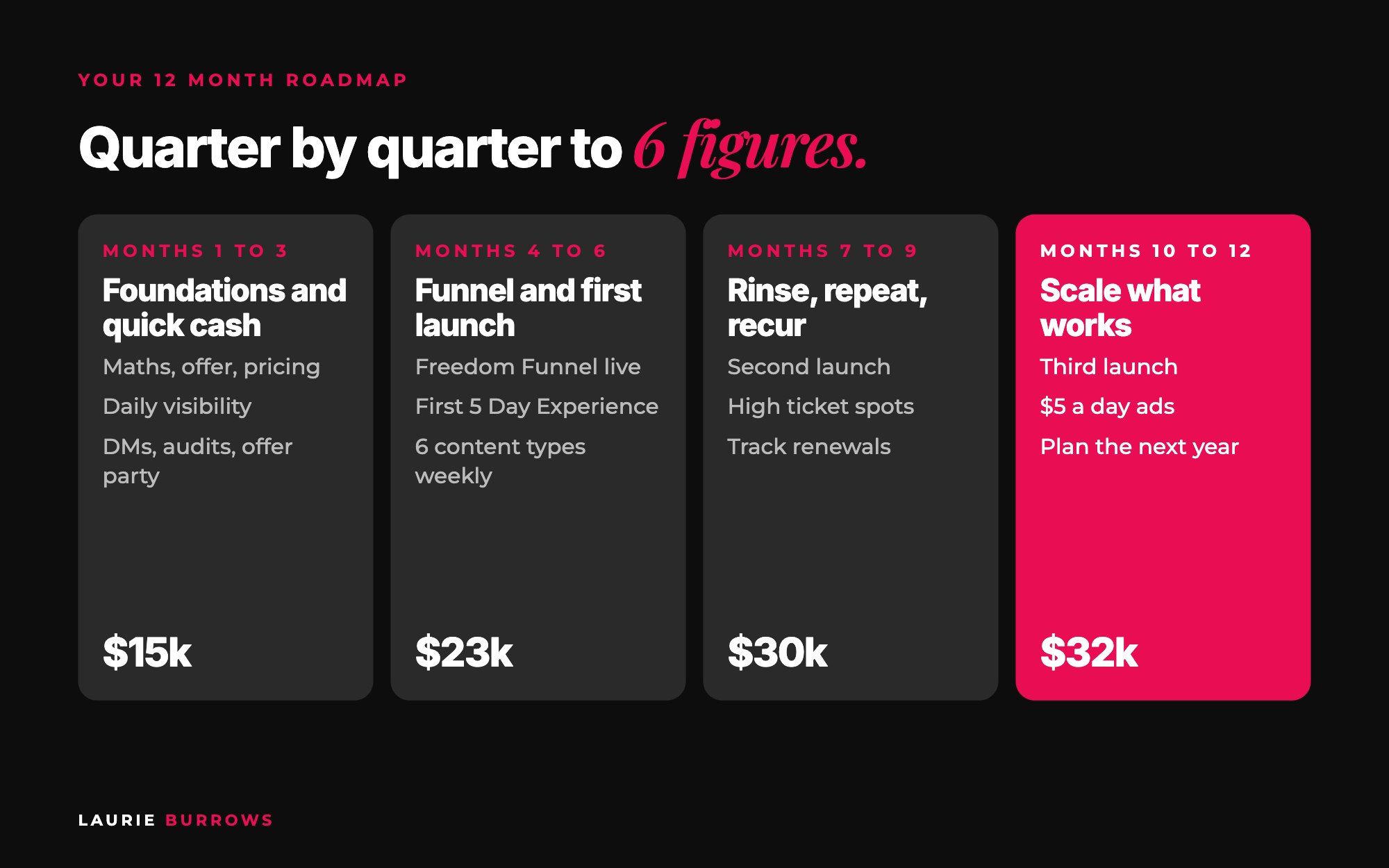
I plan my year in quarters, and each quarter has one main focus so you're not trying to do everything at once.
| Quarter | Focus | Key actions | Target |
|---|---|---|---|
| Q1: months 1 to 3 | Foundations and quick cash | Lead Map, EVP offer, tracker. Daily Build Borrow Buy. DMs, audits, case study spots, an offer party. Build the Freedom Funnel. | About $15,000 |
| Q2: months 4 to 6 | Funnel and first launch | Freedom Funnel live with daily traffic. First 5 Day Experience. The 6 Content Types every week. Raise your price if you sold out. | About $23,000 |
| Q3: months 7 to 9 | Rinse, repeat, recur | Second launch. Payment plans and a high ticket next step. Recurring revenue tracker. | About $30,000 |
| Q4: months 10 to 12 | Scale what works | Third launch. $5 a day ads to warm audiences. Double the lead source that worked best. Review the year and plan the next. | About $32,000 |
Quarter one is always about quick cash. Cash gives you choices. From quarter two it's about systems and recurring revenue. For the full planning process, read the ultimate guide to a 6 figure year.
Your 90 day start plan
Here's how to turn quarter one into weekly actions. I break 90 days into months, then weeks, then days. Give each thing a proper chance: if you jump strategy every two weeks, nothing gets long enough to work.
| Week | Focus | Actions | Target |
|---|---|---|---|
| 1 | The maths | Set your revenue goal, sales and leads numbers. Build your Lead Map. Set up your lead tracker. | Numbers written down |
| 2 | Ideal client and offer | Answer the ideal client questions. Build your EVP offer and offer statement. Ask ten people what they'd need. | Offer statement done |
| 3 | Price and profile | Set your price and payment plan. Fix your bio, link and three pinned posts. Start 30 minutes of daily visibility. | 5 conversations a day |
| 4 | First clients | Message 50 people in your network (10 a day). Post a lead generation story. Pitch three guest spots. | First sale |
| 5 | Free audits | Offer five free audits. Record the videos. Pitch and follow up. | 2 to 3 sales |
| 6 | Case study round | Open three to five case study spots. Post evidence based content from your audits. | Round filled |
| 7 | Offer party | Run a two day offer party with three offers at different prices. | Quick cash week |
| 8 | Funnel part one | Record your 20 minute free training. Write and build your opt-in page. | Opt-in page live |
| 9 | Funnel part two | Build the $27 thank you page offer and $11 bump. Write the nurture and sales emails. | Funnel live |
| 10 | Funnel traffic | Point every post, story and guest spot at your free training. | Daily opt-ins |
| 11 | Plan the launch | Set your 5 Day Experience promise, numbers, Lead Map and a date in month four. | Launch date set |
| 12 | Create the launch | Record five short sessions. Write the promo posts, emails and day three pitch. | Launch ready |
| 13 | Review and open | Review every number, double what worked, open sign-ups and plan the next 90 days. | Next plan written |
I walk through how I plan every 90 days in how to plan your next 90 days.
How do I fit all of this in?
I built my first year around a newborn, so I didn't have four hours a day. I had a plan, and I protected the time that made money. Here's the daily hour:
- 20 minutes: visibility.
- 15 minutes: one lead generation action.
- 20 minutes: conversations and follow ups from your tracker.
- 5 minutes: update your numbers: leads, conversations, sales.
Then one bigger block a week for building your funnel, your launch or a batch of content. More on how I did it in how I made nearly $200k in my first year as a new mum.
What mistakes should I avoid on the way to 6 figures?
- Setting an income goal and calling it a plan. Fix: work out your revenue goal, sales and leads, and track them weekly.
- Offer hopping. Fix: one offer, one strategy, rinse and repeat until it sells predictably.
- Relying only on posting content. Fix: add one borrowed audience a week and one lead generation action a day.
- Not following up. Fix: a tracker, and at least five follow ups per lead.
- A low priced offer with no next step. Fix: every $27 offer leads into your core offer through emails and DMs.
- Ignoring recurring revenue. Fix: payment plans, a next step for finishing clients, and a tracker for when payments end.
Troubleshooting: if it's not working, check this
| If this is happening | Check this |
|---|---|
| Nobody new is finding you | Your Build Borrow Buy. Are you engaging daily and getting in front of one new audience a week, or only posting? |
| People see you but don't become leads | Your calls to action. Does every post and story ask for one specific action? |
| Conversations but no sales | Your offer. Is the end result clear, different and worth more than the price? Read why is no one buying my offer. |
| Launch sign-ups but low sales | Live attendance and follow up. Add reminder emails, DMs the day before, a kickoff party, and pitch on day three. |
| Good months then quiet months | Recurring revenue and your funnel. Track when payments end and plan the relaunch one to two months before. |
| You're behind on your goal | Your Lead Map. Are you short on leads, or on conversion? More leads needs more visibility. Better conversion needs more conversations. |
| You're exhausted | Your plan. Drop back to two client getting methods you enjoy, time block an hour a day and automate the rest. |
Your action plan
Today
- Write your revenue goal, the sales you need and the leads you need.
- Set up your lead tracker and add everyone who has ever shown interest.
- Write your one sentence offer statement.
- Send five engagement DMs.
This week
- Build your Lead Map so it adds up to your monthly leads number.
- Run your offer through the EVP Model and the Different You Now check.
- Block 30 minutes of visibility every weekday in your diary.
- Message 50 people in your network, 10 a day.
Next 30 days
- Run weeks one to four of the 90 day start plan.
- Offer five free audits and open your case study round.
- Follow up every lead at least five times.
- Start recording your free training for the Freedom Funnel.
If you'd like help with the first part, mapping your strategy and getting the plan, content and pages created, that's exactly what we're doing inside The 6 Figure Game Plan, my free 5 day event. And if you'd rather have me in your corner for the whole 90 days, have a look at the 90 Day Revenue Growth Accelerator.
Rather have it done for you?
Let Ascendia OS plan, create and build your path to 6 figures
The Strategist maps your revenue goal, what to sell and how many leads you need. The Funnel Builder builds your Freedom Funnel. The Launch Manager plans your 5 Day Experience from first email to cart close, and the Content Creator writes and schedules your posts in your voice. You approve the work and get back to your clients. 14 days free, no tech skills needed.
Frequently asked questions
How long does it take to make your first 6 figures?
With a clear offer, daily visibility and a launch every quarter, 12 months is realistic for a lot of coaches, and the roadmap in this guide is built around that. I made nearly $200,000 in my first year while pregnant and then with a newborn. It depends on your audience, your price and how consistently you take action.
How many leads do I need to make $100,000?
Divide $100,000 by your offer price, then divide that by your conversion rate. With a $997 offer you need about 100 sales, which is about 3,300 leads at a 3% average, or about 1,000 at 10%. Then map where every one of those leads will come from.
What should I charge to hit 6 figures?
Price from your goal and your audience size. A $997 core offer needs about 100 sales a year, a $5,000 offer needs 20. Offers from around $997 to $1,997 tend to be the easiest to sell, and a simple low, mid and high product suite gets you there fastest.
Should I launch or build an evergreen funnel?
Both, in that order of priority for most people: get your first clients with conversations, build the Freedom Funnel so you sell every day, then run a 5 Day Experience each quarter for bulk sales. The funnel fills your launches with warm buyers and your launches feed the funnel.
Do I need to do sales calls?
No. I grew my business without sales calls, mostly through DM conversations, because I didn't have time for them as a new mum. Calls work well for high ticket offers if you enjoy them, but they aren't required.
What if I've already had good months but can't make it consistent?
That's usually missing recurring revenue and a system that sells when you're not showing up. Add the Freedom Funnel, put payment plans and a next step in place, track when payments end, and plan launches by quarter instead of when the money runs low.
Laurie Burrows is a revenue growth strategist for coaches, consultants and online service providers, with 15 years of experience in marketing and sales and a business that's generated multi-seven figures in sales. She's the founder of Ascendia OS.
Do you want to scale your business to 10K months in the next 90 days? I am looking for 10 people for my new case study program. DM me the word CASE STUDY on Instagram (@_laurieburrows) to learn more.