The Ultimate Guide to Creating an Offer That Sells
Short answer: to create an offer that sells, start with research, not your idea. Find a painful, urgent and specific problem your ideal client wants solved right now, then build the offer with the EVP Model: a clear End Result that's worth more than the price, a Value Stacked package that outweighs what they pay, and a real Point of Difference. Map the journey with your A to B Method, price it from your revenue goal, write a one sentence offer statement, build a simple sales page and test it with your warmest people before you scale it.
Who this guide is for: coaches, consultants and online service providers who either have an offer that isn't selling the way it should, or who are about to build one and don't want to waste six months finding out nobody wants it.
What you'll have by the end: your market research done (with the exact questions to ask), your end result written in one sentence, a named framework, a value stack with numbers next to it, a price you've worked out from your goal, a simple product suite around it, an offer statement, a sales page outline and a plan to test it in the next 30 days.
How many of you have an offer that genuinely changes lives, and yet when you put it out there you hear nothing back? You're amazing at what you do. You're also the best kept secret in your industry. I see this every single week, and it's rarely because someone is bad at business. It's because the offer is built wrong, packaged wrong or talked about wrong.
So you jump from course to course and mentor to mentor looking for the secret strategy. None of it works, because if the offer itself isn't a hell yes offer, no strategy on earth will sell it. Fix the offer first, then reverse engineer the strategy. I've spent 15 years in marketing and sales and built a business that's generated multi-seven figures in sales off offers built exactly this way. Grab a notepad. You're going to be doing, not just reading.
What is a core offer?
Your core offer is the main thing you want to sell into. Everything else in your strategy (free content, free resources, low priced offers, launches) exists to lead people towards it. It could be a course, programme, mastermind, membership or done for you service. The format matters far less than whether your ideal client thinks, "Yes, that's exactly what I need."
If you only take one thing from this guide, take this: people don't buy your offer. They buy what your offer does for them. And there's one more test I want you to hold in your head the whole way through: would you buy this offer yourself? If the honest answer is no, your ideal clients won't either. You have to be sold on your own offer first.
Free 5 day event · 12th to 16th October
The 6 Figure Game Plan
Want your offer mapped into a full plan to 6 figures? In my free 5 day event you'll map your strategy, work out how many sales you need, and get the plan, content and pages created for you.
The framework: how an offer that sells gets built
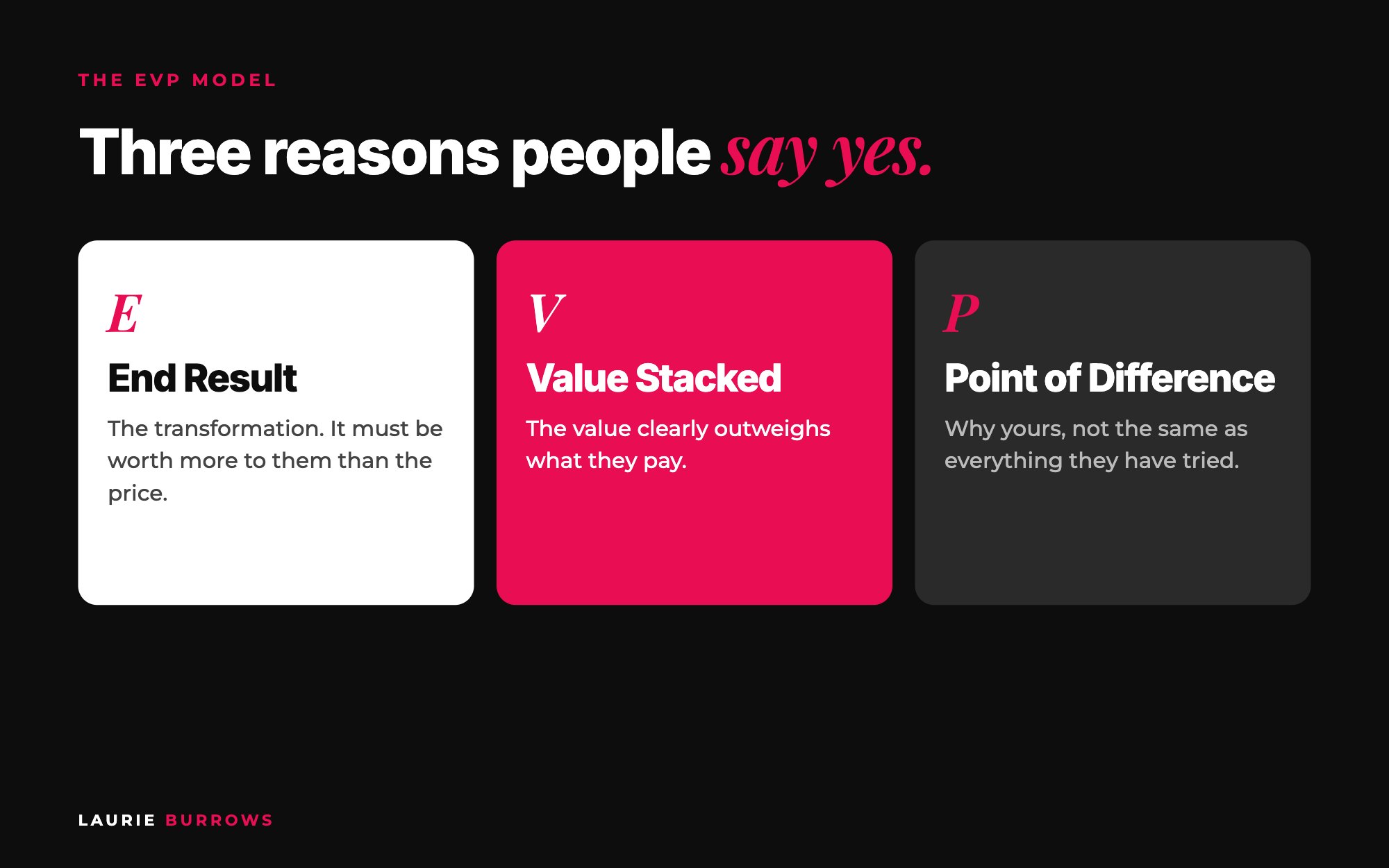
My EVP Model covers the three biggest reasons people part with their money: End Result, Value Stacked and Point of Difference. Everything in this guide hangs off those three letters. If you want the short version first, read the EVP Model explained and the 3 reasons people buy.
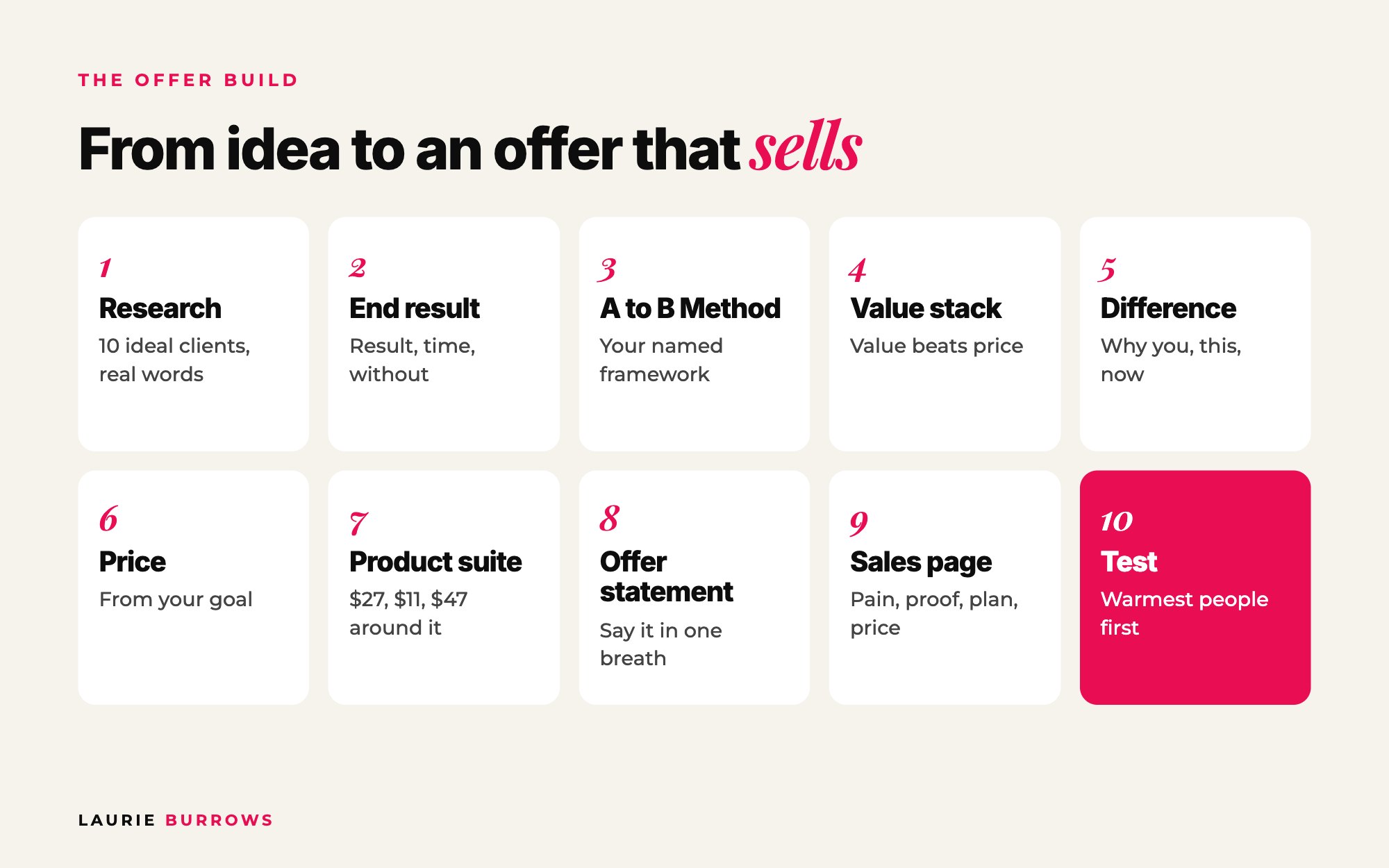
But the EVP Model sits inside a bigger build. Here's the order I take people through, and the order this guide follows:
- Research: find out what your ideal client actually wants and will pay for.
- End result: the transformation, in one sentence (the E).
- A to B Method: your named framework that closes the gap.
- Value stack: what's included and what it's worth (the V).
- Point of difference: why you, why this, why now (the P).
- Price: worked out from your revenue goal, not your gut.
- Product suite: the offers that lead into it and out of it.
- Offer statement: how you say it in one breath.
- Sales page: the page that does the selling for you.
- Test: sell it to your warmest people, learn, then scale.
Each phase below has numbered steps, a time estimate, what "done" looks like, a template and a worked example, following one made up business the whole way through.
Our worked example (illustrative, not a real client): a gut health coach who currently sells "an eight module video programme on gut health" for $497 and can't work out why it isn't selling.
Phase 1: Market research (before you build a single module)
Most offers get created in one of two ways. Option one: you create the offer you want to create, then go looking for people to buy it. Option two: you research your ideal client first, then build the offer around what they actually want and will pay for. Option two sells more reliably, because option one is built on assumptions. Stop playing a guessing game. Start finding out what your ideal clients actually want.
Step 1: Study your own buying decisions
This is the exercise I give everyone before I teach them a single framework. Write down the courses, programmes, mentors and services you've invested in. For each one, map the stepping stones you took before you bought and, at every step, ask yourself why. Why did you follow them? Why didn't you buy the first time? What made it a hell yes in the end?
Here's one of mine. In late 2020 my business was growing quickly and someone I trusted said, "You should get a mentor. I know the perfect person." I went over to that mentor's Instagram, loved the content, sent a message, jumped on a call and invested $20,000 into their mastermind. Three days earlier I had no idea who they were. When I broke it down, there were three reasons I said yes so fast:
- Trust by association. Someone I trusted recommended them.
- Evidence based content. They weren't just talking the talk, they were showing results.
- A personal conversation. They spoke to me themselves instead of sending me to a sales page.
I took that straight into my own business: a referral programme, far more evidence based content and the option to message me instead of just landing on a sales page. That led to my first six figure launch of my mastermind, before that mentor had taught me anything. Your own buying behaviour is the cheapest market research you will ever do. (The psychology behind this is in the psychology of why people buy, and the full research process has its own post: how to do market research before you build an offer.)
Time: 30 minutes. Done when: you've written the buying journey for at least three things you've bought, and listed what you'll copy into your own offer.
Step 2: Ask your current clients why they bought
If people are already buying, you're doing something right. Find out what it is so you can do more of it. Ask two things: why did you buy, and what led you to buying? When I asked my clients why they chose me, a lot of them said my story and the fact they could relate to it, so we knew we needed more of it in my messaging. When I asked about the stepping stones, on average our clients had watched three free offers before they bought, which told me our free resources were a key part of the strategy.
Copy and paste: client research message
Hey [name], I'm working on [my programme / a new offer] and your opinion would really help. Could you answer these quickly? Voice note is perfect.
1. What was going on for you right before you decided to work with me?
2. What made you choose me over the other options you looked at?
3. What did you see, watch or read of mine before you bought?
4. What nearly stopped you from buying?
5. What has changed for you since? Any numbers you can share?
Thank you so much. This genuinely shapes what I build next.
Step 3: Survey your audience
If you have an audience, simply ask them. You want to know three things: what they want right now, what they've already invested in and why, and what was missing from those things. The surveys that get the most replies are the ones where everyone who fills it in gets something useful. A prize that everyone gets (a training, a template, a recording) beats a prize draw every time.
Copy and paste: audience survey questions
1. Where are you in your business right now? (multiple choice ranges work well)
2. What is the one thing you most want to fix or achieve in the next 90 days?
3. What have you already tried to fix it?
4. What have you invested in before (courses, coaching, programmes, services)? Roughly how much?
5. What did you love about it, and what was missing?
6. If there was a [programme / service] that got you [result], what would it need to include for you to say yes straight away?
7. How do you prefer to learn and get support? (pre-recorded, live calls, community, done for you, AI support)
8. Would you like to be first to hear when this opens? (yes / no + email)
Thank you line: As a thank you, here is [free training / template] straight away: [link]
Step 4: Run market research calls
Tell your audience you're building something new and want to interview a handful of people to make sure it's exactly what they need. Offer something useful in return, like a short one to one session. These calls often turn into sales, because people who love the idea ask how they can join.
Copy and paste: market research call post
I'm building something new for [ideal client] who want [end result] and I want to make sure it's exactly what you need, not what I think you need.
I'm looking for 10 people to jump on a 20 minute call with me this week and tell me what you're struggling with and what you've already tried.
As a thank you, you'll get [a 30 minute strategy session / a free audit / early access] with me.
Comment RESEARCH or send me a message and I'll send you the link.
On the call, use the survey questions as your script, listen far more than you talk and write down their exact words. They become your sales page copy.
Step 5: Social listening and competitor research
No audience yet? You can still do proper research:
- Join Facebook groups where your ideal clients hang out and read the questions they ask and the struggles they post. Some groups will even let you post a survey or offer free audits.
- Google the key terms people would use to find an offer like yours (for example "gut health coach" or "bloating programme"). Do the same on Instagram and TikTok. See who comes up.
- Study the businesses further ahead than you: their website, content, funnels, what's included in their offers and their pricing. There's usually a reason they do what they do.
- Read their reviews on places like Trustpilot or Udemy. Note what people love and, more importantly, what they complain is missing. That gap is your opportunity.
Time for Phase 1: one week, alongside everything else. Done when: you've heard from at least 10 ideal clients (calls, surveys or replies) and filled in the research summary below.
Copy and paste: research summary sheet
The problem they describe most often, in their words: ...
What they have already tried: ...
What was missing from those solutions: ...
The result they want most right now: ...
What they have invested before, and roughly how much: ...
How they want to be supported: ...
Exact phrases to steal for my copy: "...", "...", "..."
Worked example: our gut health coach speaks to 12 people. Ten of them say some version of "I'm bloated by 3pm every day and I've tried cutting out everything". Eight have already bought a programme before. Most say the same thing was missing: "it was so restrictive I gave up after two weeks". That one sentence is going to change her whole offer.
Phase 2: Nail the end result (the E)
The end result is the number one reason anyone buys. It's your client's return on investment, and that return doesn't have to be money. It's the transformation they get from working with you, and it has to be worth more to them than the price you're charging. When it is, the offer becomes a hell yes.
Step 6: Run the priority check
Here's the part that catches out so many brilliant coaches: the problem has to be a priority for your ideal client right now. It must be:
- Painful enough that they take action now.
- Urgent enough that they're actively looking for help.
- Specific enough that they recognise themselves in your copy.
Ask yourself: what is my ideal client struggling with daily? What have they already tried that didn't work? What are they secretly googling at 2am?
Say you have a $997 confidence programme for mums working nine to five. If what that mum is actually lying awake about is making enough money to leave her job, confidence isn't her priority right now, and she won't buy, however good the programme is. Your offer isn't bad. It's mismatched. You then have two options: change the end result to one they want right now, or change the ideal client to someone for whom your result is already a priority. I break this down properly in ideal client and offer mismatch.
Step 7: Find the why behind the why
The more tangible the result, the more likely people are to invest. The things people spend most on tend to be health, wealth and love. Intangible results still sell, you just need to keep asking why. Why does your client want confidence? To speak on stage. Why? To build their reputation. Why? To get more clients and grow their business. Now "more confidence" has become "the confidence to speak on stages that bring you clients". That's something people will pay for.
Step 8: Write it with the end result formula
The strongest end results have three parts: the result, the timeframe, and the thing they don't want to have to do or sacrifice to get there.
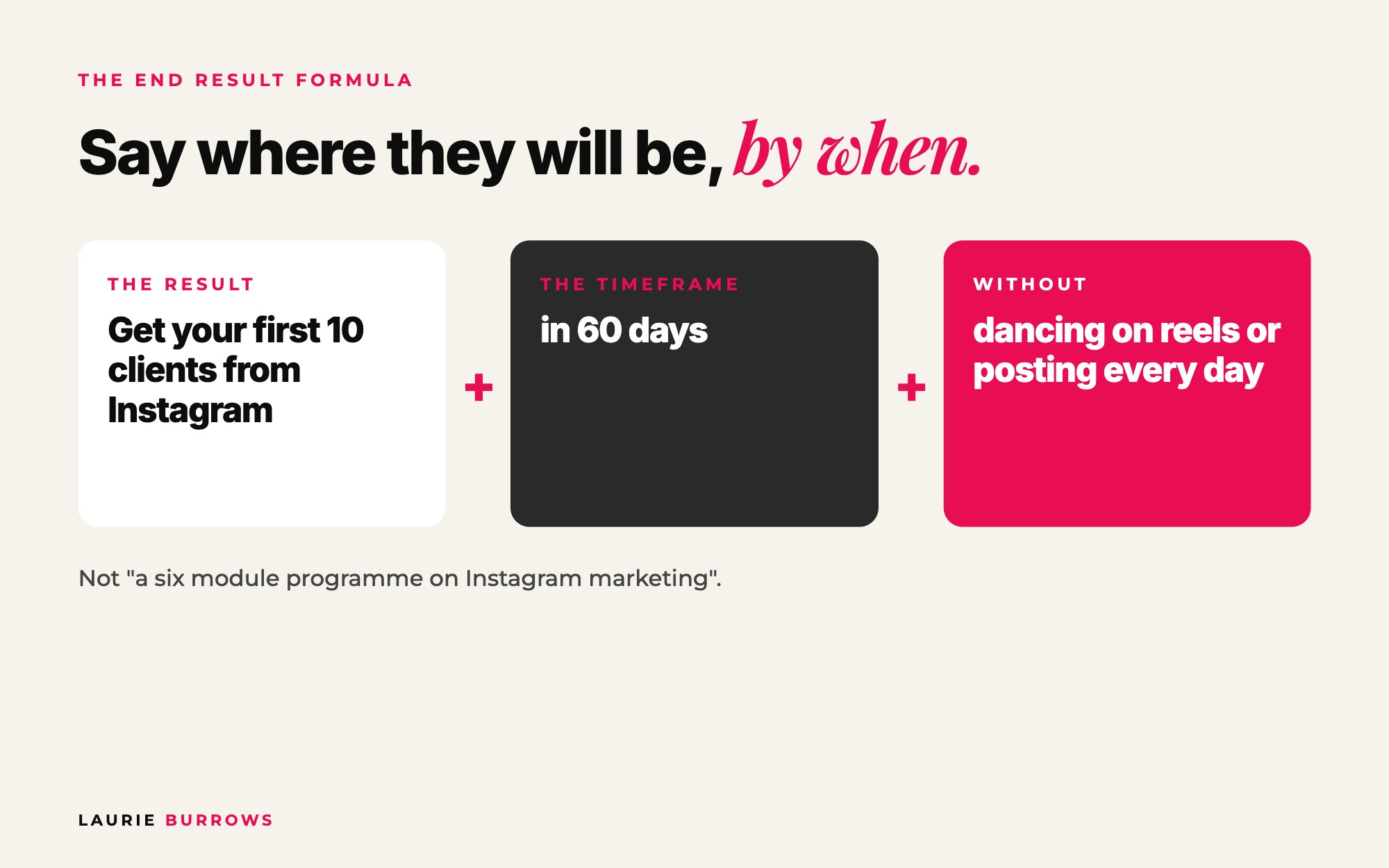
The timeframe shows them when they'll see their return. The "without" speaks straight to the objection that's already in their head.
Copy and paste: end result worksheet
Where my ideal client is now (point A): ...
Where they want to be (point B), in their words: ...
Why they want that (ask why three times): ...
How long it realistically takes with my help: ...
What they do NOT want to do or give up to get there: ...
My end result: [Result] in [timeframe] without [thing they want to avoid].
Worked example: "An eight module video programme on gut health" describes what she delivers. Using her research, it becomes: "Heal your gut and stop feeling bloated in 30 days, without restrictive dieting." Same expertise. Completely different offer. The "without restrictive dieting" came straight from what her research calls said was missing.
Time: 1 to 2 hours. Done when: you can say your end result in one sentence and three people from your audience say "yes, that's exactly what I want".
Phase 3: Build your A to B Method (your signature framework)
Your offer is the gap between where your ideal client is now (point A) and the end result they want (point B). Your signature framework is the set of stepping stones that closes that gap. Mine is the Freedom Funnel, which takes people from where they are now to generating daily sales. A named framework makes your offer look and feel different from yet another course, and it shows the buyer there's a clear path.
Step 9: Brain dump, order, group, name
- Brain dump. On a sheet of paper or a whiteboard, write point A on the left and point B on the right. In between, write everything you'd need to take someone through to get them there. Don't edit. (15 minutes)
- Order it. Put everything into the order you'd teach it. What has to happen first? (10 minutes)
- Group it. Some things will be similar. Put those together into one stepping stone or module. Aim for three to seven stepping stones. (10 minutes)
- Name it. Give the framework a name, and ideally give each step a name too. Some people match each module to a letter of the framework name. It's optional, but it makes it memorable. (20 minutes)
- Sense check it. Could someone follow this in order and get the end result? Is anything missing that past buyers said was missing elsewhere? (5 minutes)
Copy and paste: A to B Method builder
Point A (where they are now): ...
Point B (the end result): ...
Brain dump: ...
Stepping stone 1: [name] What they do / get: ...
Stepping stone 2: [name] What they do / get: ...
Stepping stone 3: [name] What they do / get: ...
Stepping stone 4: [name] What they do / get: ...
Stepping stone 5: [name] What they do / get: ...
Framework name: The [word] Method / The [word] Framework / The [acronym] System
Worked example: our gut health coach's brain dump has 23 things on it. Ordered and grouped, they become five stepping stones: calm the flare ups, find your triggers (without cutting everything out), rebuild with food you actually like, make it fit your week, and keep it for life. She names it The CALM Gut Method (Calm, Assess, Layer, Maintain), and her old eight modules slot straight into it. Nothing new to create, it's just finally packaged in a way people understand.
Full walkthrough, with more examples: how to create your signature framework.
Phase 4: Stack the value (the V)
Once a buyer has seen the end result, the next thing they look at is the value versus the price. When the value clearly outweighs the price, the offer becomes a no brainer. If someone can see they're getting $23,000 worth of value and you're only charging them $3,000, the decision gets a lot easier.
Step 10: Decide what goes in (the two question filter)
Before adding anything to your offer, ask two questions:
- Does it get my clients better or faster results?
- Can I deliver it without needing more of my time?
The best additions are a yes to both: templates, swipe files, a community, group workshops, an implementation session, a custom AI trained on your method so people get instant answers instead of waiting for the next call. The classic mistake is piling on one to one time. If every client gets one to one calls, there's only so many clients you can take, and you've capped your own revenue.
Step 11: Put a value next to everything
List every part of your offer and give each one a value, as if you sold it on its own. Base the value on what you'd genuinely charge for it separately, or what similar things sell for. Then add up the total. That's the number you show next to your price on your sales page and in your pitch.
Copy and paste: value stack table
Core: [Framework name] programme (all stepping stones) . . . value $[ ]
Implementation: [templates / worksheets / swipe files] . . . value $[ ]
Support: [weekly live Q&A / community / AI support] . . . value $[ ]
Speed: [3 day implementation / done with you session] . . . value $[ ]
Bonus 1 (fast action, joins by [date]): [ ] . . . value $[ ]
Bonus 2 (pay in full): [ ] . . . value $[ ]
Total value: $[ ]. Your investment today: $[ ] or [x] payments of $[ ].
Worked example: our gut health coach lays it out like this: the CALM Gut Method programme (value $997), a 30 day meal planner and shopping lists (value $197), a trigger tracker (value $97), weekly live Q and A for 12 weeks (value $1,200), private community (value $297), and a fast action bonus of a 30 minute personal plan review (value $250). Total value: $3,038. Her price: $697. Notice she added things that make results faster and didn't add weekly one to one calls for everyone.
Fast action and pay in full bonuses add value without adding hours. I show you how to present it all in how to build a value stack.
Time: 1 hour. Done when: your total value is clearly higher than your price, and nothing in the stack depends on you personally doing more hours as you grow.
Phase 5: Build a real point of difference (the P)
You are not the only person doing what you do. There are other people doing what I do too. So why should someone choose you and this offer over everyone else?
Step 12: Answer the four point of difference questions
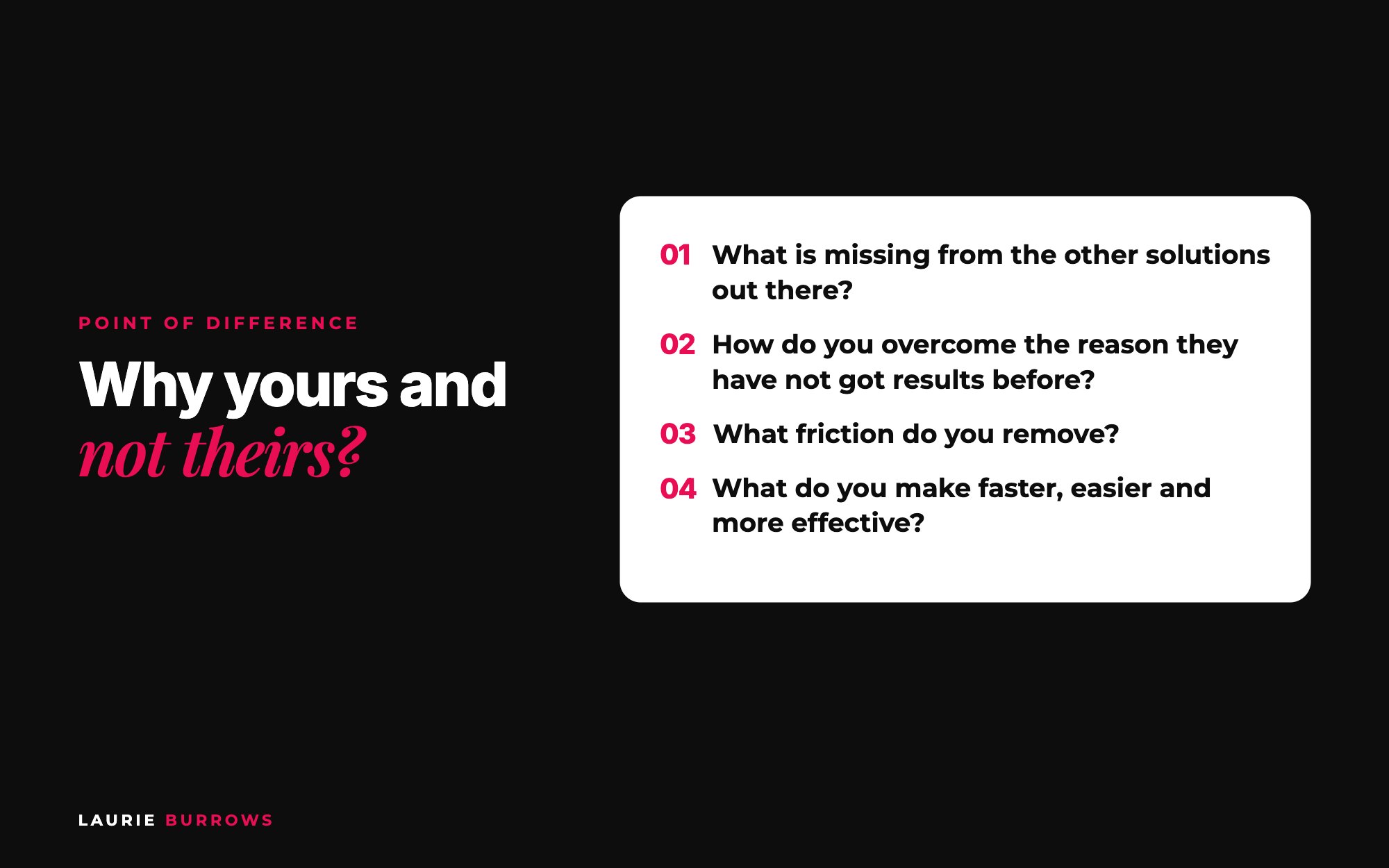
- What's missing from the other solutions out there? Your research from Phase 1 answers this.
- How do you overcome the reason people haven't got results before? Our research showed people joined courses and never implemented them, so we built a three day implementation into our academy so people leave with a sales system actually in place.
- What friction do you remove? My clients are business owners and they're time poor, so anything I create has to remove time as a barrier.
- What do you make faster, easier and more effective?
Step 13: Write your Different You Now answers
Then layer on Different You Now, the three questions every buyer is silently asking:
- Why you? Your experience, your story, your results. Nobody hands over four figures to someone who hasn't told them why they're the expert. Even a faceless business has a reason it exists.
- Why this? What makes this offer different from everything else they've tried.
- Why now? What does it cost them every month they wait? What do they lose by leaving it three, six or 12 months?
Copy and paste: point of difference worksheet
What other solutions are missing (from my research): ...
Why people haven't got results before, and how my offer fixes that: ...
The friction I remove: ...
What I make faster, easier or more effective: ...
Why me (experience, story, proof): ...
Why this offer (what's different about it): ...
Why now (the cost of waiting, per month): ...
Worked example: other programmes are restrictive and people give up (missing). Hers rebuilds with food you like, so people stick with it (overcomes the reason). She removes the friction of planning with done for you meal planners. Why her: she's a qualified practitioner who healed her own gut after years of bloating. Why now: every month they wait is another 30 days of planning their outfits around their stomach.
If you want the deeper version of these questions and how they show up in your messaging, read why is no one buying my offer.
Phase 6: Price it from your goal, not your gut
More people can afford less, and fewer people can afford more. Both can work, but they need completely different strategies. This is the maths I want you to do before you pick a number.
Step 14: Do the pricing maths
- Write your monthly revenue goal from this offer.
- Divide it by each price you're considering. That's how many you need to sell every month.
- Look at your audience size and ask honestly: can I sell that many?
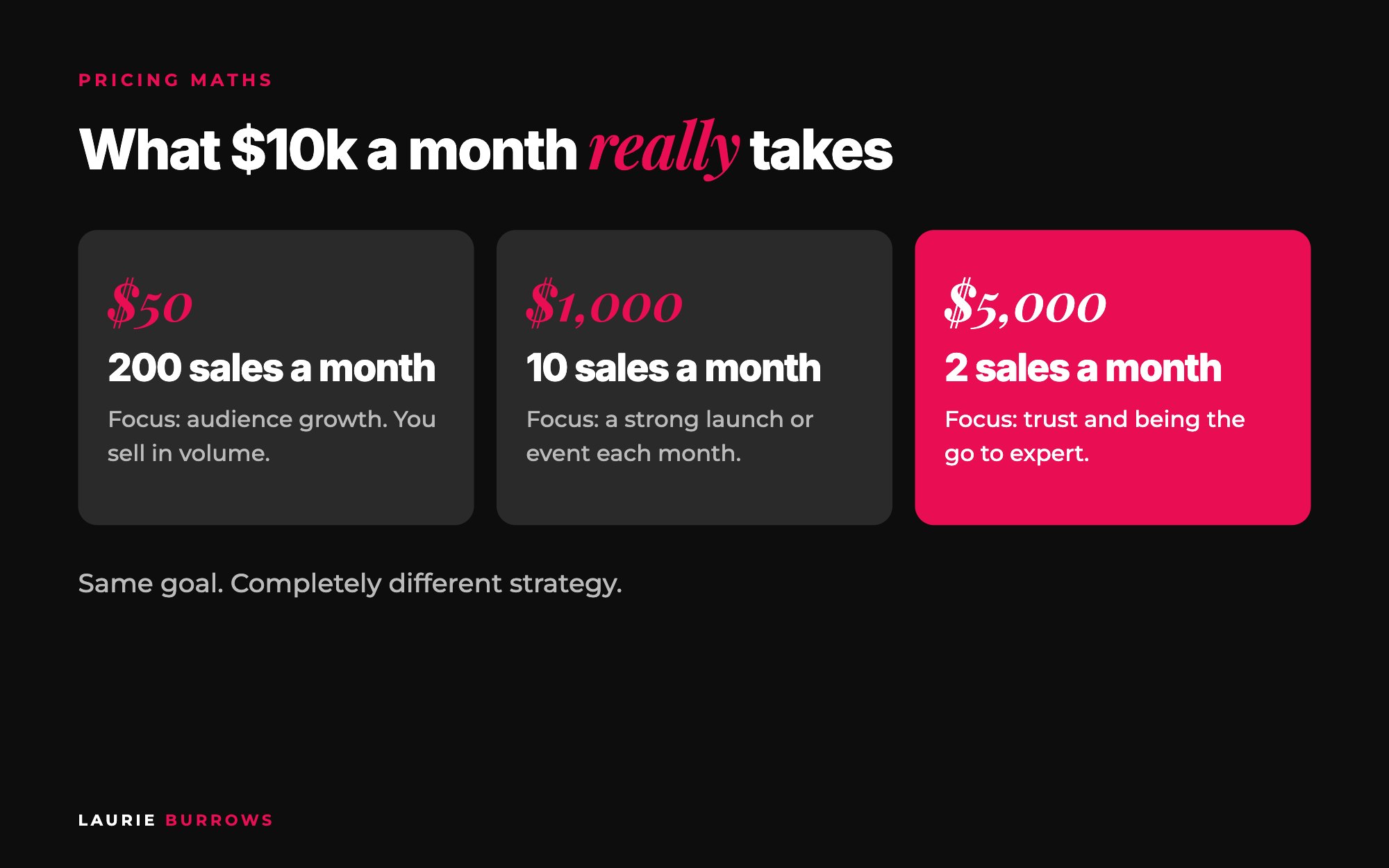
If your goal is $10,000 a month and your offer is $50, you need to sell 200 every single month. If your audience is only 200 people, you'd need to convert 100% of them, which I've never seen anyone do. At $5,000, you need two a month, which is 1% of that same 200 people. So:
- Low price: your main focus has to be audience growth, because you're selling in volume and you'll keep needing new people to sell to.
- High price: your main focus has to be trust and being seen as the go to expert, because nobody hands over $5,000 to someone they don't trust.
How someone buys a $50 offer is very different to how they buy a $5,000 one. A $27 offer is an impulse buy: they're buying the content, not you. A four figure offer needs far more trust, more questions answered, more objections handled and a longer customer journey.
Step 15: Sense check the price
- Ask your research people what they'd pay and what they've paid before. Your survey answers to question 4 are gold here.
- Benchmark against people where you want to be. There's usually a reason they charge what they charge.
- Check value versus price for your ideal client. Where they are matters. Many service based business owners scaling to their first $5,000 to $10,000 months aren't used to investing in themselves yet. The first time a coach told me her one to one was $1,500 a month, I thought she was mad. Today I'd tell her it's far too cheap. Know which version of your client you're selling to.
- Check the end result is worth more than the price. If it isn't, you either change the end result, change the ideal client or change the model.
- Offer payment plans and pay in full. Payment plans make the investment feel less risky and build recurring revenue. A pay in full bonus brings cash in now.
Worked example: our gut health coach wants $10,000 a month from this offer. At $697, that's about 15 sales a month. Her email list is 1,800 people and growing. At the 3% average conversion, a launch to 500 new opt-ins would give her around 15 sales, so the maths works if she runs one strong launch or event a month, or builds an evergreen funnel. At $297 she'd need 34 a month, which her audience can't support yet. She keeps $697, with three payments of $249.
For the full pricing method, read how to price a coaching programme.
Time: 45 minutes. Done when: you know your price, your payment plan, and exactly how many sales a month that means.
Phase 7: Build the product suite around it
Your product suite is the set of offers that takes your ideal client from first finding you to buying the next thing, and the next, which increases what each client is worth to you. I break down every level in how to build a product suite.
- Free offers: your content, free trainings, challenges, masterclasses, podcasts. They attract people and build trust.
- Entry level (low priced) offers: convert people for the first time. They test the waters with you, have a brilliant experience and come back for more.
- Your core offer: usually mid priced, ideally $1,000 plus once you've built some trust. The main thing you sell into.
- High ticket: the most access to you. Brilliant for recurring revenue.
Step 16: Pull your low priced offers out of your core offer
You don't need to create anything new. Your core offer is very likely to already contain pieces you can sell on their own. I usually pull out three: one at $27 (the thank you page offer after someone opts in for a free resource), one at around $11 to $14 (the order bump) and one at around $47 (the upsell). We've tested those price points across lots of different industries and they work almost no matter what the end result is. It's the core offer price that changes from business to business.
The benchmarks I work to: the thank you page offer converts 8 to 10% of opt-ins, and 70 to 80% of buyers add the order bump. So $27 plus an $11 bump becomes $38 per buyer.
Worked example: from her programme our gut health coach pulls her trigger tracker as the $27 offer, her 30 day shopping lists as the $11 bump and a recorded "eating out without bloating" workshop as the $47 upsell. Every buyer is now someone who has paid her once, and those are the people most likely to buy the $697 programme next. If you want the whole system for turning content and these small offers into daily sales, that's exactly what I teach in Content To Clients®.
Step 17: Perfect one offer before you add the next
Here's what I actually did. When I started in January 2020, nobody knew who I was. I grew a free Facebook group and documented it, and the first thing I ever sold was a $47 masterclass on how I'd grown it. Then a one month one to one intensive at $555, which led to $10,000 in sales within a couple of months. One to one wasn't sustainable with a baby on the way, so I built a signature programme, launched it at $997 (it later went up to around $1,500) and sold just that one offer for the rest of 2020, with a five day challenge every quarter and the odd paid masterclass in between. Only then did I launch a 12 month mastermind, and I sold it to the people already in my signature programme first. Ten people paying $1,000 a month meant $10,000 coming in every month before I launched anything else. The full story is in how I went from a $47 masterclass to a $1,500 signature programme, and the reasoning is in perfect one offer before you launch the next.
It's better to give 100% to one thing than 10% to 10 different things. If you're part time, a parent or running everything on your own, start with one core offer and one way to convert people for the first time. Add the next offer once you've perfected selling the first.
Phase 8: Write your offer statement
Now you can say it. Your offer statement is the one or two sentences you use in your bio, at the end of a masterclass, in DMs and at the top of your sales page. If you can't say it in one breath, it's not clear enough yet. (If yours keeps coming out fuzzy, read why your offer sounds too vague to buy.)
Step 18: Fill in the formula
Copy and paste: offer statement formula
Short version: I help [ideal client] [end result] in [timeframe], without [thing they want to avoid].
Long version: [Offer name] is a [format and length] for [ideal client] who [painful, urgent problem]. Using my [framework name], you'll [end result] in [timeframe], without [thing they want to avoid]. Unlike [what they have tried before], you get [point of difference], so you [faster / easier / more effective outcome].
Pitch line: It's worth $[total value]. Your investment is $[price], or [x] payments of $[ ].
Worked example:
- Short: "I help busy professionals stop feeling bloated in 30 days, without restrictive dieting."
- Long: "CALM Gut is a 12 week programme for busy professionals who are bloated by 3pm every day and sick of cutting out food. Using my CALM Gut Method, you'll heal your gut and stop feeling bloated in 30 days, without restrictive dieting. Unlike plans that make you give up everything you enjoy, you rebuild with food you actually like, with weekly live support, so it sticks."
Read it out loud to someone who fits your ideal client. "How?" means curiosity. "What do you mean?" means it's still too vague.
Phase 9: Outline your sales page
Your sales page doesn't need to be clever. It needs to take the reader from where they are, to where they want to be, to why you and this offer are the answer, with a button to the price in every section so nobody has to scroll to find it. Most people landing on it are already warm (from your content, a free resource, a low priced offer or your emails), so it's reminding them as much as introducing you. This is the structure we use:
Copy and paste: sales page outline
1. Headline: the end result. Subheadline: who it is for and the timeframe. Button: "Join now" (jumps to pricing).
2. Proof straight away: two or three testimonials or results.
3. "Are you fed up of...?" Their current pains, in the words from your research.
4. The relatable bit: I see you, I have been there, here is how I got through it.
5. What they want: paint point B.
6. More proof that you can get them there.
7. Why me: your experience, story and results. Button.
8. Introducing [offer name]: the solution, with a short behind the scenes video of what it is like inside.
9. Everything included, with visuals. What they will learn, stepping stone by stepping stone.
10. Bonuses with values (fast action and pay in full). Total value vs price.
11. Objections handled: "I don't have time", "I've bought courses before", "money". Then: still got questions? Message me or book a call.
12. Pricing options (pay in full, payment plan, and a VIP upgrade if you have one).
13. FAQ.
14. Final call to action: "Got a question? Message me [link]".
A much shorter page worked just as well for us with an audience who'd already watched a masterclass. Start with the full structure, then adapt.
If writing and building the page is the bit you've been putting off, this is where you can hand it over. The Copywriter inside Ascendia OS writes sales pages that sound like you, and the Funnel Builder builds the page and checkout inside your account, with order bumps, upsells and payment plans, ready to go live. You bring the research phrases and the offer; it does the build.
Time: half a day for the copy. Done when: every section is drafted using your research phrases, and there's a button to pricing in at least four places.
Phase 10: Test it before you scale it
Step 19: Sell it to your warmest people first
- Go back to your research people. Everyone who filled in your survey or jumped on a call has already told you they have this problem. Tell them it's ready, first.
- Offer an introductory price. I launched my signature programme at $997 and my mastermind at $6,000, then raised both as results and proof came in. Be honest that it's a first round and that the price will go up.
- Run one conversion event. A free five day challenge, a short free training with a pitch, or a pop up paid masterclass. Pitch on the day you've planned, not "when it feels right". The Launch Manager in Ascendia OS can plan the whole event for you, from first email to cart close, and set it up to run again on repeat once you know it works.
- Open your DMs. Give people a way to ask questions, like "message me OFFER". Personal conversations close sales that pages don't.
Copy and paste: first round launch message
You told me [the problem in their words] was the thing you most wanted to fix. So I built it.
[Offer name] helps you [end result] in [timeframe], without [thing they want to avoid].
Because you helped shape it, you get first access at the founding price of $[price] (it goes up to $[future price] after this round). Doors close [day and date].
Want the details? Reply YES and I'll send them over.
Step 20: Read the numbers and fix the right thing
- Conversion benchmark: an average live launch converts around 3% of leads. Mine sit at 10 to 12%, but plan with 3% for wiggle room. That means around 333 leads for every 10 sales.
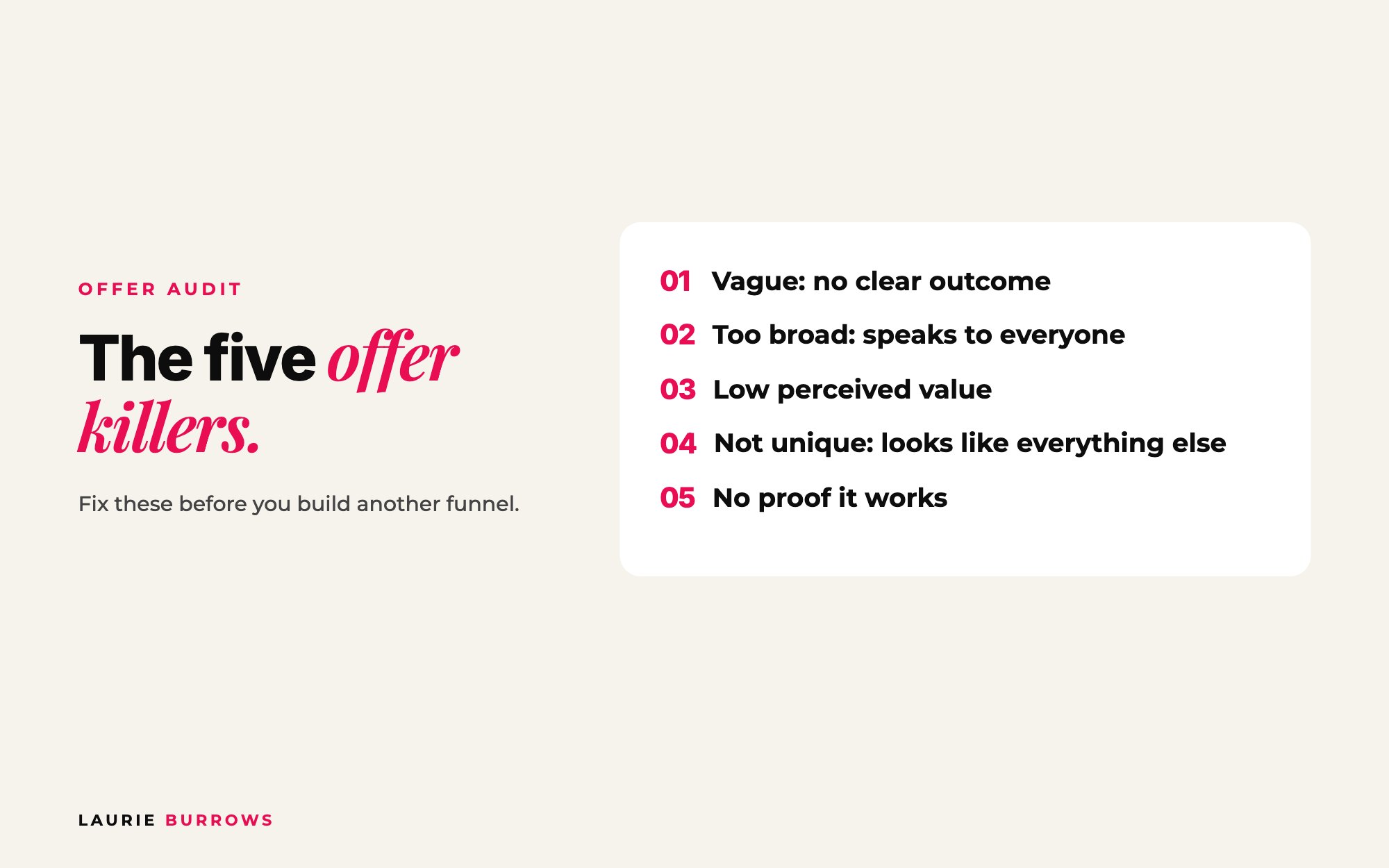
- If lots of the right people see it and fewer than 5 in 100 buy, work on the offer, the messaging and your sales skills.
- If very few people see it, it's a visibility and leads problem, not an offer problem. Don't rebuild a good offer because 40 people saw it.
- Write down every objection you hear. Each one is either something to handle on the sales page or something missing from the offer.
- Keep 80% of what works, test 20%. Change one thing at a time so you know what made the difference.
My very first launch sold one spot. I didn't throw the offer away. I looked at what went well, what didn't and what I could improve, and ran it again. Then it sold 15, then 25, then 50, then 75. Rinse and repeat.
Common mistakes (and the fix)
- Building first, researching later. Fix: 10 conversations before you build a single module.
- Targeting a problem that isn't a priority. Fix: change the end result or change the ideal client.
- Stuffing the value stack with one to one time. Fix: add things that speed up results without needing more of your hours.
- Picking a price from your gut. Fix: divide your goal by the price and check your audience can support that number.
- Launching five offers at once. Fix: perfect one core offer and one first time conversion offer first.
Troubleshooting: if your offer isn't selling, check this
- If people say "sounds great, not right now", check the priority. Your end result may not be what they want most at this moment, or your why now is missing.
- If people say "it's too expensive", check the value stack and the proof. The price feels high when the value isn't stacked or they can't see it working for someone like them.
- If people say "I've tried something like this before", check your point of difference. It looks like everything else they've already bought.
- If nobody asks any questions at all, check the offer statement. Too vague or too broad, and they can't picture what changes.
- If lots of people buy the $27 offer but nobody upgrades, check the next step. Is the core offer the logical next stepping stone from the low priced offer, and are you actually inviting them to it?
- If it sold well before and has stopped, check what has changed for the buyer. People are bored of information and want implementation and faster results. Re-stack around speed and support. More on this in why traditional courses and programmes stopped selling.
That last one happened to me in 2025. I went back to Phase 1, listened to the objections (no time, too much information, bought courses before and didn't finish them) and asked what offer would answer all of them. The answer was a passive AI product trained on my frameworks. We launched it at four figures and had over 100 sign-ups. Same process, new answer.
Your 30 day offer plan
| Week | What to do | Done when |
|---|---|---|
| Week 1: Research | Study your own buying decisions. Message 10 past clients. Send your survey. Book 5 to 10 market research calls. Start social listening and competitor research. | At least 10 ideal clients heard from and the research summary sheet filled in. |
| Week 2: Build the EVP | Run the priority check. Write your end result with the formula. Build and name your A to B Method. Create your value stack table. Answer the point of difference and Different You Now questions. | End result, framework, value stack and point of difference all written down. |
| Week 3: Price and package | Do the pricing maths. Decide payment plans. Pull out your $27, $11 to $14 and $47 offers. Write your offer statement. Draft your sales page using the outline. | Price set, offer statement tested out loud, sales page drafted. |
| Week 4: Test | Send the first round launch message to your research people. Run one conversion event. Open your DMs. Log every objection and every sale. | First buyers in, or a clear list of what to fix next. |
Your action plan
Today
- Write down three things you've bought and why you said yes to each.
- Draft your end result: result, timeframe, without.
- Send the client research message to three past clients.
This week
- Publish your survey or market research call post.
- Hold at least five research conversations and save their exact words.
- Brain dump your A to B Method and give it a name.
- Build your value stack with a value next to every line.
Next 30 days
- Price it from your goal and check your audience can support the number.
- Create your $27 offer from part of your core offer.
- Write your offer statement and sales page.
- Sell it to your warmest people first, then review: what went well, what didn't, what can be improved.
Do this now: write your end result in one sentence using the formula (result, timeframe, without), then read it to one person who fits your ideal client. If they say "I need that", you're ready for the value stack. If they say "what do you mean?", go back to your research.
Want help building and selling your offer?
The 90 Day Revenue Growth Accelerator is where I help you build an offer your ideal clients say hell yes to, price it from your goal and put the plan in place to sell it, with me in your corner for 90 days.
Rather have it done for you?
Let Ascendia OS build and launch your offer
The Strategist maps how many sales your price needs, the Copywriter writes your sales page and launch emails, the Funnel Builder builds your pages and checkout with order bumps and upsells, and the Launch Manager runs your first round from first email to cart close. 14 days free, no tech skills needed.
Frequently asked questions
What makes an offer irresistible?
A clear end result that's worth more to the client than the price, a value stack that clearly outweighs what they pay, and a point of difference that makes it stand out from everything they've tried before. On top of that, it has to solve a problem that's a priority for them right now.
How do I know if my offer is the problem or my marketing?
Check how many of the right people are seeing it. If plenty of your ideal clients see it and fewer than 5 in 100 buy, look at the offer and messaging first. If very few people see it, it's a visibility and leads problem, not an offer problem.
How do I do market research if I don't have an audience?
Use social listening in Facebook groups where your ideal clients ask questions, search the key terms they'd use on Google and social media, and read the reviews of similar offers to see what people love and what's missing. Some groups will also let you post a survey or offer free audits.
How should I price my first offer?
Start from your monthly goal and divide it by possible prices to see how many sales each needs. Then check what your research people have paid before and what people where you want to be charge. Launch at an introductory price, and raise it as results and proof come in.
How long does it take to create an offer that sells?
About 30 days if you follow the plan above: a week each for research, building the EVP, pricing and packaging, and testing.
Should I lower my price if my offer isn't selling?
Usually not as a first step. Check the end result is a priority for your ideal client, that the value is stacked, that your point of difference is obvious and that enough people are seeing it. Dropping the price rarely fixes a vague offer.
Laurie Burrows is a revenue growth strategist for coaches, consultants and online service providers, with 15 years of experience in marketing and sales and a business that's generated multi-seven figures in sales. She's the founder of Ascendia OS.
Do you want to scale your business to 10K months in the next 90 days? I am looking for 10 people for my new case study program. DM me the word CASE STUDY on Instagram (@_laurieburrows) to learn more.