The Ultimate Guide to a 6 Figure Course Launch
Short answer: a 6 figure course launch comes from three things working together: enough leads, a free conversion event that builds trust fast, and a proper sales process after you pitch. Set two goals (sales and leads), map exactly where every lead will come from, run a short free experience such as a 5 day challenge, pitch on day three with a fast action bonus, follow up personally while cart is open, then down sell to everyone who didn't buy. Do it once, analyse the numbers, and rinse and repeat.
If you've ever put your heart and soul into a launch, shown up every day, done all the things, and then watched it flop, you are not on your own. My very first launch was a flop. It did not go to plan at all.
But I didn't give up. I looked at what worked, what didn't, and improved it. The next launch sold 15 spots. Then 25. Then 50. Then 75. These days my launch strategies make six figures per launch, and my launches convert at 10 to 12% when the industry average sits at 1 to 3%. None of that came from luck. It came from a repeatable process, and this guide is that process, written out so you can follow it step by step.
Who this guide is for (and what you'll have by the end)
This is for coaches, consultants and online service providers who have a course, programme or membership in the low to mid four figures and want to sell it in bulk, without guessing. It works whether you've never launched, you've launched and been disappointed, or you've had good launches and want them to be bigger and calmer. If you haven't made your first 6 figures yet and want the bigger picture first, read my guide to your first 6 figures alongside this one.
By the end you will have:
- Your launch numbers: your sales target and your leads target, worked out on one page.
- A Lead Map: every source your leads will come from, with a number next to each.
- Your 5 Day Experience planned: the promise, the theme of each day, what to teach, what to say and the action step.
- Your pitch: a day three pitch script you can adapt.
- Your cart open plan: the emails, content and follow up messages for every day the doors are open.
- Your post-launch plan: an encore or down sell, and a simple way to analyse the numbers.
- A week-by-week launch calendar you can copy into your diary today.
What is a course launch, really?
A launch is simply a period of time where you open the doors to your offer and actively sell it. Most coaches, consultants and online service providers use a conversion event to do it.
A conversion event is an experience designed to build trust fast, overcome objections, create desire for your offer and move people to buy right now. It could be a 3 to 5 day challenge, a masterclass or webinar, a one day virtual event, a workshop, a live training series or even a private podcast series. It can be live or pre-recorded.
Lots of people in this industry teach one way of launching and tell you it's the only way. I've tested many different conversion events, in my own business and with clients in different industries. They all work. What decides your sales is how you plan and structure the event, not which format you pick.
Every launch follows Attract Nurture Convert. You attract leads into the free event, you nurture them during it, and you convert them into your paid offer. If one of those three is weak, the whole launch suffers.
Why do most launches fail?
When people come to me after a launch that didn't go to plan, I look at their data first. The same five problems come up again and again, and every step in this guide is there to fix one of them.
- Not enough leads. If the average challenge converts at 1 to 3%, then 100 sign-ups gets you one to three sales. Most people never work out how many leads they actually need.
- Not enough trust. We're in a trust economy. People think harder about where they spend their money and who they invest in. If your event doesn't show them why you're the expert, they won't buy.
- A low show up rate. People sign up, then only 10 to 15% turn up. If they're not showing up, you can't build trust with them.
- No follow up. It used to be enough to go live, announce your offer and send people to a sales page. It isn't anymore. People want conversations, reminders and answers before they buy.
- A weak pitch. You get to the pitch, panic, and mention your offer in two sentences on the way out. That isn't a pitch. That's an apology.
I go deeper into how the old way of launching stopped working in why my old launch strategy stopped working.
The 3 phases of a 6 figure launch
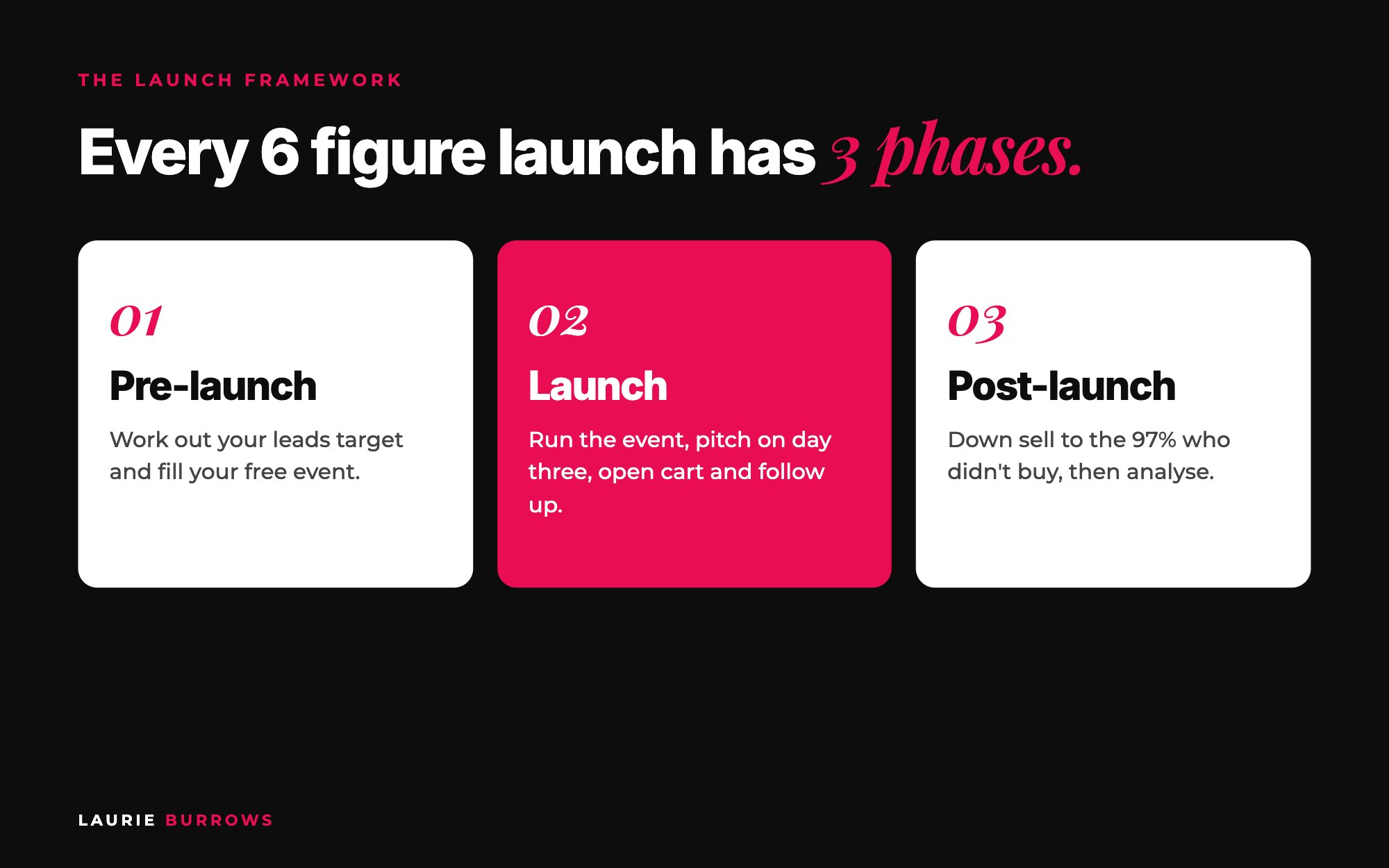
Every launch I run, whatever the format, has three phases. Most people pour everything into phase two, do half of phase one and forget phase three exists. That's how you leave money on the table.
| Phase | Your job | Steps in this guide |
|---|---|---|
| 1. Pre-launch | Work out your numbers, plan the event and fill it with the right number of leads. | Steps 1 to 6 |
| 2. Launch | Run the event, pitch on day three, keep cart open and follow up personally. | Steps 7 to 10 |
| 3. Post-launch | Encore or down sell to everyone who didn't buy, then analyse every number. | Steps 11 and 12 |
Free 5 day event · 12th to 16th October
The 6 Figure Game Plan
Want to see your launch mapped out before you build a thing? Join my free 5 day event (12th to 16th October). You'll map your strategy to 6 figures and get the plan, content and pages created for you.
Phase one: pre-launch
Pre-launch is about two things: knowing your numbers and filling your event. Your launch is mostly won or lost here, before you've said a single word on day one.
Step 1: Set your two goals (sales and leads)
When you launch, you need two goals, not one. Goal one is your sales goal. Goal two is your leads goal. Almost everyone forgets the second, and it's the one that decides whether the first happens.
- Revenue goal: how much you want to make from this launch.
- Price: what your offer costs.
- Sales target: revenue goal divided by price.
- Conversion rate: what percentage of sign-ups bought last time. Never launched? Use 3%.
- Leads target: sales target divided by conversion rate.
Here's what that looks like with real numbers:
| Revenue goal | Price | Sales needed | Conversion | Leads needed |
|---|---|---|---|---|
| $10,000 | $500 | 20 | 3% | 667 |
| $15,000 | $1,500 | 10 | 3% | 333 |
| $15,000 | $1,500 | 10 | 1% | 1,000 |
| $100,000 | $1,200 | 83 | 5% | 1,667 |
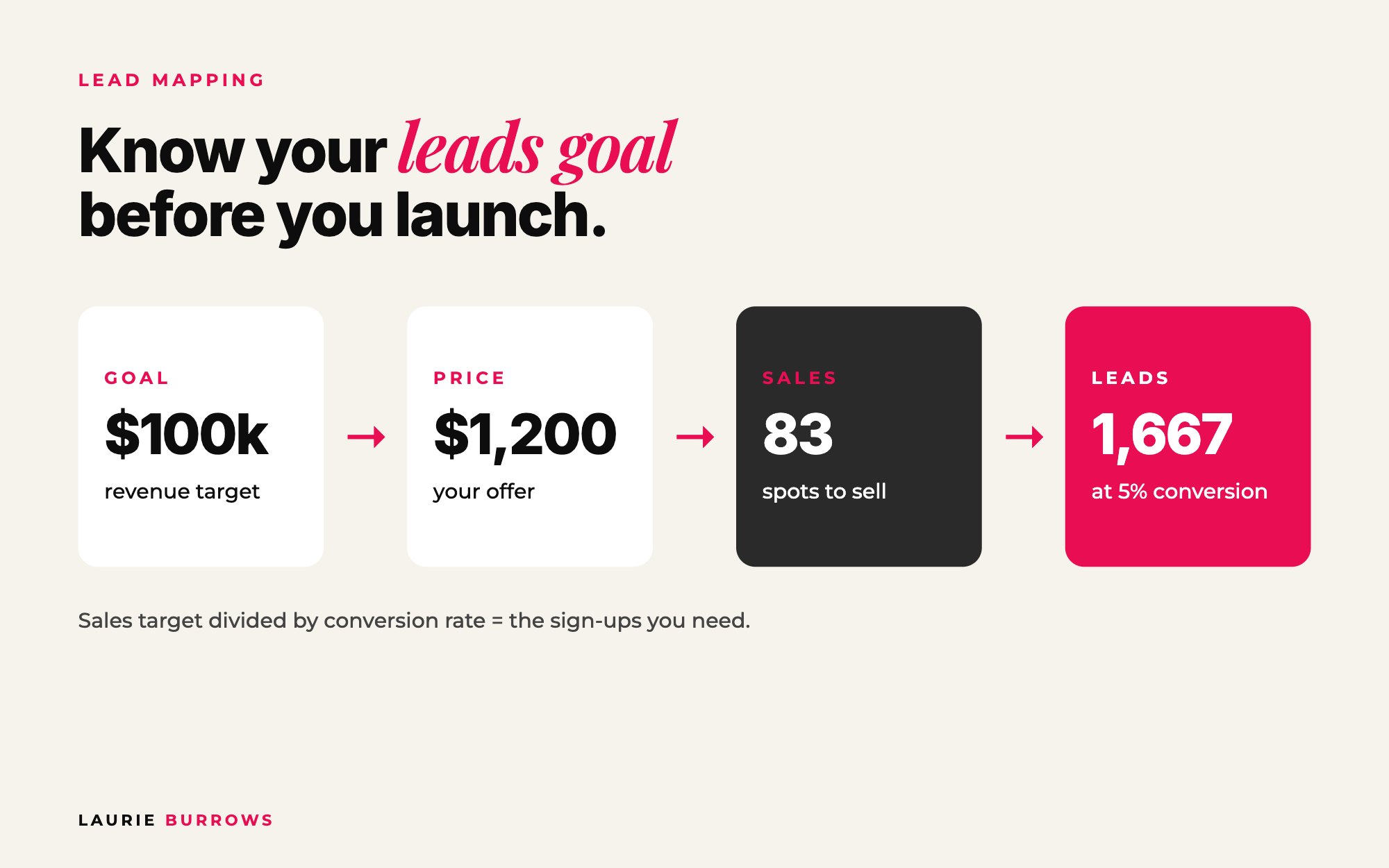
I always put a slightly lower conversion rate into my calculator than I expect, even though mine averages 10 to 12%. I like the wiggle room. If you want the numbers broken down further, read how to have a 6 figure launch.
Copy and paste: launch numbers sheet
Launch name: [name of your free event]
Offer and price: [offer] at $[price]
Revenue goal: $[goal]
Sales target: [goal divided by price] sales
Conversion rate I'm planning with: [last launch, or 3%]
Leads target: [sales target divided by conversion rate] sign-ups
Leads target must be hit by: [the day before day one]
Time: 20 minutes. Done when: you have one sales number and one leads number written somewhere you'll see every day of the launch.
Step 2: Build your Lead Map
Knowing your number is step one. Lead Mapping is step two: you list every place your leads will come from and put a realistic number next to each one.
This is where most launches fall apart. People only use their email list and their social media. Say that's 300 from email and 200 from social. That's 500. If you need 1,667, you're 1,167 short before you've even started, and no amount of posting harder in launch week will fix that.
So you fill the gap with other routes. Here's a worked example.
Example: a $100,000 launch needing 1,667 leads.
| Lead source | How it works | Realistic sign-ups |
|---|---|---|
| Email list | Promo emails across the promotion window | 300 |
| Social media | Daily posts, stories and lives with the event as the call to action | 200 |
| Guest speaking (2 spots) | Teach in someone's membership or programme, promote your event at the end | 100 |
| Collaborations | Joint lives, interviews or summit spots | 50 |
| Launch partners | 50 partners each bringing in 10 people | 500 |
| Ads | Paid traffic to the opt-in page, covered by a VIP upgrade | 520 |
| Total | 1,670 |
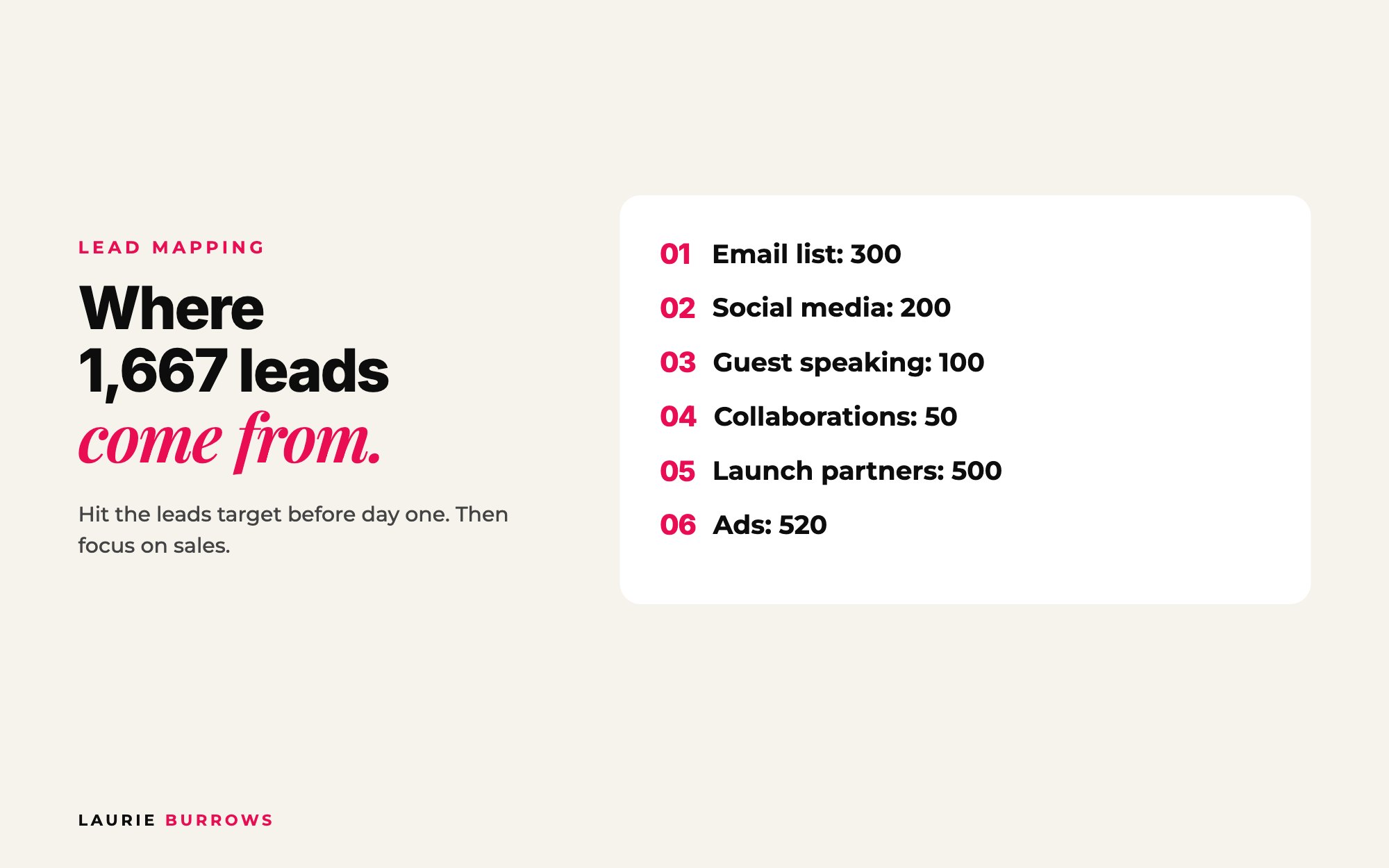
The goal is that before launch week begins, you've hit your leads target. Then during the launch you focus on hitting your sales target. Two separate jobs.
Copy and paste: guest speaking request
Hey [name], I love what you're building inside [their programme or membership]. I'm running a free [event name] on [dates] that helps [ideal client] get [end result], and I'd love to give your members a 20 to 30 minute training on [specific topic] as a thank you for having me.
No pitch for a paid offer. At the end I'd simply let them know about the free event. Would that be useful for your members? Happy to send over a couple of topic options.
Copy and paste: launch partner invite
Hey [name], I'm opening the doors to [event name] on [date], a free [5 day] experience for [ideal client] who want [end result].
I'm looking for a small group of launch partners to share it with their audience. I'll give you the graphics, the copy and a tracking link, and [your thank you, for example a commission on any sales or a free seat in the programme].
If you'd like to be part of it, just reply with the word PARTNER and I'll send the details.
Time: One to two hours, plus outreach time. Done when: every source has a number next to it and the total is equal to or above your leads target.
Do this now: write down your revenue goal, your price and your conversion rate (use 3% if you've never launched). Work out your leads target, then list every source those leads will come from with a number next to each. If the total doesn't reach your target, you know exactly what to fix before you launch.
Step 3: Choose your conversion event
The right event depends on how warm your audience is. I split audiences into Cold Warm Hot:
- Hot: they've been in your world a while, love what you do and are close to buying.
- Warm: they follow your content but they're not at a "hell yes, I'm in" yet.
- Cold: they're completely new to you.
The colder the audience, the more time they need with you. Google's research found people need around seven hours of content and 11 touch points across four platforms before they buy. A 90 minute masterclass is a long way from seven hours. Price matters too. How you buy something at $25 is very different to how you buy something at $25,000. The higher the price, the more nurture people need.
| Your situation | Best event | Pitch |
|---|---|---|
| Warm or hot audience, they already know you | 60 to 90 minute masterclass | Mention working with you halfway, full pitch at the end |
| Selling in bulk (50 to 100 plus spots) or reaching a new, cold audience | 3 to 5 day challenge (The 5 Day Experience) | Day three of five, or day two of three |
| Multi-day events don't suit you or your audience | One day experience | In the middle, around lunch |
| High ticket offer | Masterclass to your warm audience | End of the masterclass, then conversations |
A 3 to 5 day event is often perfect for an offer in the low four figures, so the rest of this guide uses The 5 Day Experience as the example. The same steps work for the other formats; you just condense the days.
Time: 15 minutes. Done when: you've picked one format and written down your pitch day.
Step 4: Plan The 5 Day Experience, day by day
Your free event is your try before you buy. Think of a gym's free three day pass, or a software free trial. It's a snippet of your paid offer, and it should feel like working with you, so that by pitch day buying is the easiest yes ever.
Set the promise (talk to Buyer A and Buyer B)
You have two types of buyer. Both know the end result they want, say consistent $10k months. Buyer A knows what their problem is. Buyer B has no idea what's stopping them. If you name your event after the problem, Buyer B scrolls past because they don't know it's their problem. Name it after the end result and you attract both, then use the event to teach them what the real problem is. People join outcomes, not topics.
Your event has one promise, and it matches your paid offer's end result. If your programme helps people add $10k a month through Instagram, so does your free event, just with a smaller scope and smaller milestones.
Copy and paste: event name formula
The [number] Day [End Result] [Challenge / Experience / Sprint]
Example: The 5 Day First 10 Clients Experience
Promise line: In 5 days and 20 minutes a day, you'll [small version of the end result] so you can [bigger end result], even if [the objection they'd have].
Keep each day to around 20 minutes
The traditional advice is 45 to 90 minutes a day. These days I recommend around 20 minutes. Your audience is tight for time. When each day is an hour or two you get a huge drop off, and by pitch day hardly anyone is watching. A high value 20 minute session is easy to commit to, so more people are still there when you pitch. Do not panic if you go over or under. It's a guide.
Each day gets one aha moment and one action step. The aha moment shows them the missing gap. The action step gets them a small result. A small result builds trust, and trust creates the sale.
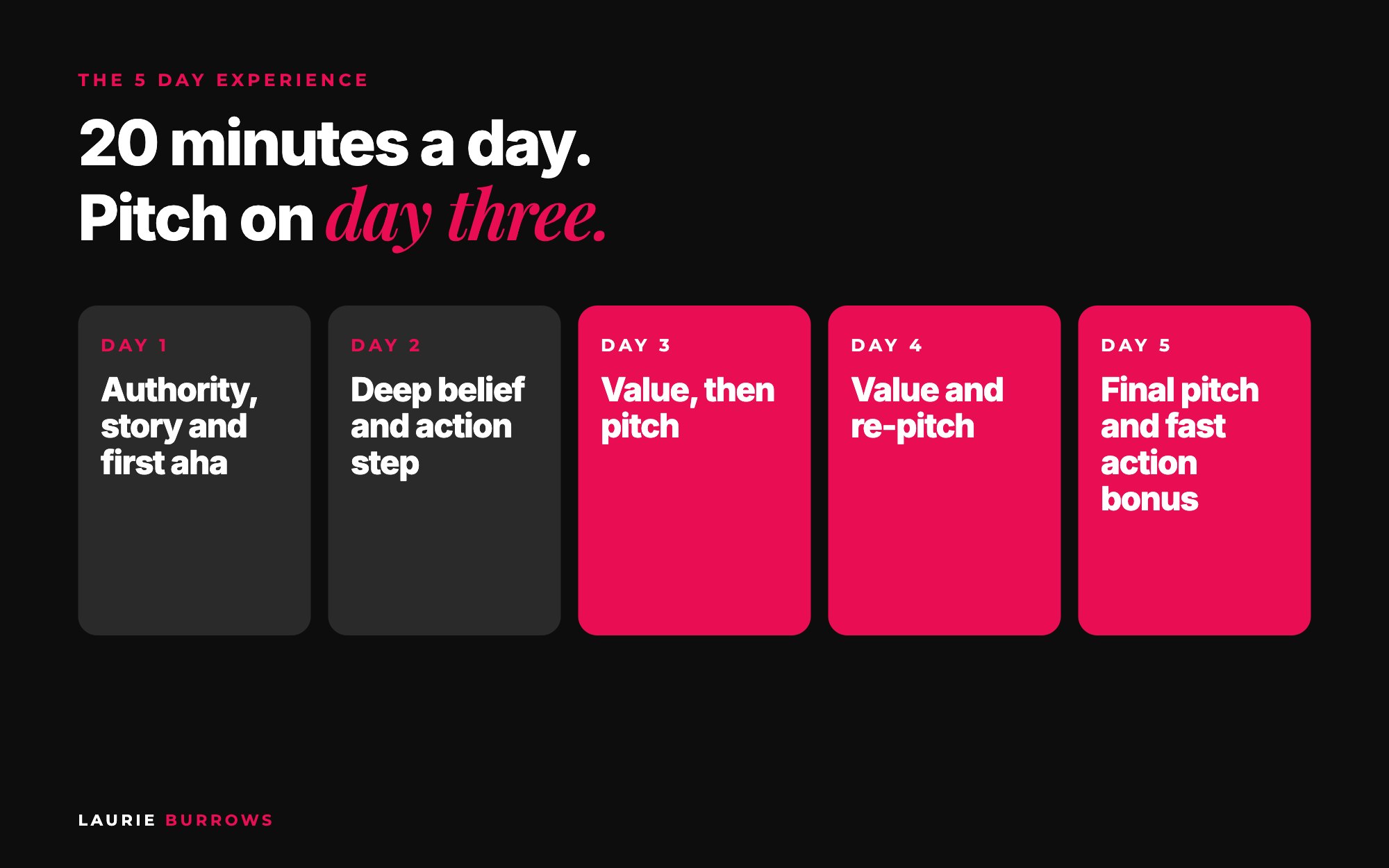
What to teach and say each day
Here's the structure I use, with an illustrative example for a business coach selling a $1,200 programme on getting clients.
| Day | Job of the day | What to teach (example) | Action step (example) |
|---|---|---|---|
| 1. Authority and foundations | Why you, your story, results, first aha | Why most people don't have a client problem, they have a visibility problem | Work out how many people saw your content last week |
| 2. Deep belief | Go deeper into your method, shift a belief | The 3 stages of your method and where they're stuck | Score yourself on each stage |
| 3. Value, then pitch | More value, then the full pitch while attention is highest | The missing piece: turning attention into conversations | Start three conversations today |
| 4. Value and re-pitch | More value, answer objections, pitch again with your face and voice | How to handle "not right now" in a conversation | Follow up with yesterday's three |
| 5. Bring it together | Recap the journey, final pitch, fast action bonus ends | Your 30 day plan if you keep going | Choose: do it alone or join |
Build authority from day one. People joining may be new to you, so tell them why they should listen: your story, your results, and if you have them, client stories. No client results yet? Use your own story and document your journey so you become your own evidence. I break the daily content down further in what to teach on each day of a challenge.
Copy and paste: day one opening
Welcome to day one of [event name]. By the end of these five days you're going to [promise], and today we're starting with the piece most people skip.
Before we start, here's why you should listen to me: [one or two lines of your story and your best result].
Today's session is about 20 minutes. Stay to the end, because your action step is where the result comes from. And post your win in the group once you've done it, because there's a prize for the most committed person this week.
If planning five days, the emails around them and the cart close schedule sounds like a lot, it is. That's the job of the Launch Manager inside Ascendia OS: it plans your challenge, webinar or launch from first email to cart close, then sets it up to run again on repeat, so your second launch takes a fraction of the effort of the first.
Time: Two to three hours to plan, plus recording time if pre-recorded. Done when: you have a name, a one line promise, and for each day a title, one aha moment, one action step and a proof point.
Step 5: Build your pages, community and prizes
You need four simple things in place before you promote anything.
- Opt-in page: a headline about the end result, the dates, what they'll get each day, a bit about you and a sign-up form. Everyone opts in, so you grow your email list and know who your leads are.
- Thank you page with three steps: step one is the action you most want them to take. For me it's join the community. Step two is add the dates to your calendar (make the link open in a new tab so they don't lose the page). Step three is a VIP upgrade.
- A community: a Facebook group works well during a launch. People introduce themselves, share wins and post about how much they're loving it, and those posts re-engage the people who signed up and forgot. I honestly don't think my sales would be anywhere near what they are without it.
- Prizes: for the most engaged or most committed person, or milestone prizes for watching each day. A bit of gamification gets people engaging, which also helps the group's posts reach more members.
The VIP upgrade deserves a moment. It gets people spending money now, gives them extra value (which builds more trust and often leads into your core offer), and if you're running ads, it can cover your ad spend.
Copy and paste: thank you page copy
You're in! Your first session lands on [day one date] at [time]. Here are your next three steps.
Step 1: Join the private community. This is where the daily sessions, the prizes and the support happen. [Join the community button]
Step 2: Add the dates to your calendar so you don't miss day three. [Add to calendar button]
Step 3: Want to get ahead? Upgrade to VIP for [what VIP includes, for example the replays for life, a bonus workbook and a live Q&A] for just $[price]. [Upgrade to VIP button]
Not techy, or just short on time? The Funnel Builder in Ascendia OS builds your opt-in page, thank you page and VIP upgrade checkout inside your account, ready to go live on your own domain, and the community and calendars sit in the same login.
Time: One to two days of build time. Done when: you can opt in yourself, land on the thank you page, join the community and see your welcome email arrive.
Step 6: Promote for 7 to 14 days (and get people to show up)
Usually one to two weeks. I wouldn't go to three. If someone signs up 21 days before day one, they'll forget about you by the time it starts. How long you need depends on how many leads you need and how big your audience is. I have a large audience, a community who promote for me and an ad budget, so I often promote for around seven to nine days. If I needed 500 leads, five to seven days would be plenty. If I needed 5,000, I'd give myself a good couple of weeks.
Every piece of content and every visibility activity in this window has the same call to action: sign up for the event.
| Day of promotion | Content | Personal outreach | |
|---|---|---|---|
| Day 1 | Announcement post and story: what it is, who it's for, the dates | Announcement email | Message 10 warm contacts |
| Days 2 to 4 | One teaching post a day that ends with the event, a story share of sign-ups | Value email with a link | Reply to every comment with a DM |
| Days 5 to 7 | Your story post, a "what you'll get each day" post, a live | Story email | Guest spot or collaboration |
| Final 3 days | Countdown content, sign-up screenshots, "doors close on sign-ups" reminder | Daily reminder email | Launch partner nudge |
Copy and paste: promo email
Subject: [end result] in 5 days (free)
Hi [name],
If you've been [pain they recognise] and still not [end result], I want to show you what's actually missing.
On [date] I'm running [event name], a free 5 day experience. Around 20 minutes a day, one action step each day, and by day five you'll have [specific outcome].
Here's what we'll cover: Day 1 [title]. Day 2 [title]. Day 3 [title]. Day 4 [title]. Day 5 [title].
[Save my free seat]
See you on day one,
[Your name]
Show up rate is part of promotion. Expect a drop off each day (something like 25% on day one, 20% on day two, 15% on day three is common). So plan your reminders now: a welcome email, a calendar link, a reminder the day before, a reminder an hour before each session, and if you can, a WhatsApp message too. I'm more likely to open a WhatsApp than an email, and so are most of your leads. A kickoff party the night before day one helps too; I cover that in kickoff parties and community.
Time: 7 to 14 days. Done when: your sign-ups have hit your leads target before day one.
Phase two: the launch
Now the event runs, you pitch, the cart opens and your job becomes conversations. Here's each step.
Step 7: Run the event (and be present)
Live lets you interact more. Pre-recorded means you build it once and rinse and repeat. When I asked my own community what they preferred, around 80% said pre-recorded. My most recent challenge launch was fully pre-recorded, released at 9am EST each day so people had the whole day to watch and take action.
One warning from my own data. I ran that same launch three times. The third time I was away for my birthday, less present in the community and posting less. The conversion rate dropped. Still good, but nowhere near the first two rounds. The only thing that changed was me. Pre-recorded doesn't mean absent.
During the event, every day:
- Post the day's session in the community, plus a question that gets people commenting.
- Celebrate wins publicly and tag people who completed their action step.
- Announce the prize leaderboard.
- Reply to every post and comment, with a voice note where you can.
- Remind sign-ups by email and WhatsApp that today's session is live.
Time: About an hour a day in the community, five days. Done when: every day has a session, a community post, a reminder and a celebration of wins.
Step 8: Pitch on day three
Not at the end. Pitch while people are most engaged. In a 5 day event that's day three. In a 3 day event it's day two. In a one day event it's the middle, around lunch. In a 90 minute masterclass, mention halfway through that there's a way to work with you, then give the full pitch at the end.
Then add a fast action bonus for 24 to 48 hours. You want people buying while they're in the experience, excited and getting results, not ten days later when they've forgotten about you. If you pitch on Wednesday, a 48 hour bonus ends on Friday.
And make it a real pitch. Here's the order I use.
- Bridge from the value: remind them what they've learned and done this week.
- Name the solution: what your offer is and the end result it gets.
- Proof: your results, and client stories if you have them.
- What's included and why it matters: every part tied back to the outcome, not a list of features.
- Stack the value: recap everything with a value next to each part.
- Bonuses: real ones only, with a deadline.
- Price with confidence: pay in full and the payment plan, said without apology.
- Belief close: a question that shows the result is worth more than the price.
- How to join and how to ask questions: the link, plus where to message you.
Copy and paste: day three pitch script
Over the last three days you've [what they've done: for example worked out your numbers, fixed your offer and started conversations]. Some of you have already posted wins in the group, and that's after 20 minutes a day.
So here's the question: what would happen if you had the full system, and support while you put it in place? That's exactly what [offer name] is. It's how you [end result] without [what they don't want to do].
Inside you get [part one], so you can [outcome]. You get [part two], because [why it matters]. And you get [part three], which means [outcome].
Added up, that's over $[total value] of value. You're not paying that today. Your investment is $[price], or [number] payments of $[amount].
And because I want you buying while you're in the energy of this week, if you join in the next 48 hours you also get [fast action bonus], which helps you [outcome].
Here's my question for you: do you believe that with this system and my support you could [modest result that more than covers the price] in the next 90 days? If the answer is yes, this is a no brainer.
The link is below this video. Got a question first? Message me on [WhatsApp / Instagram] and I'll voice note you back.
Want the full pitch structure, the slides and the objection handling? The 5-Figure Webinar Formula ($27) gives you the 10-step framework, a slide deck template, the pitch script and objection handling slides, and the same pitch works on day three of a challenge. If pitching makes you squirm, read how to pitch without feeling icky.
Time: Two hours to write, 15 to 25 minutes to deliver. Done when: your pitch has every one of the nine parts and you've said it out loud once before day three.
Step 9: Run cart open like a campaign
Cart open is usually five to ten days. Don't let it drag on long after the event, because your sales come from the energy of the event itself. If your event runs Monday to Friday, open cart on the Wednesday for around seven days.
A small but useful tweak: I now close cart on a Monday instead of a Sunday. On Sundays most people are resting or out with family, not checking emails. On Monday they're back at their desks.
During cart open you want content every day (multiple pieces), at least one email a day (ideally one to three), and a proper follow up process. Here's a seven day plan.
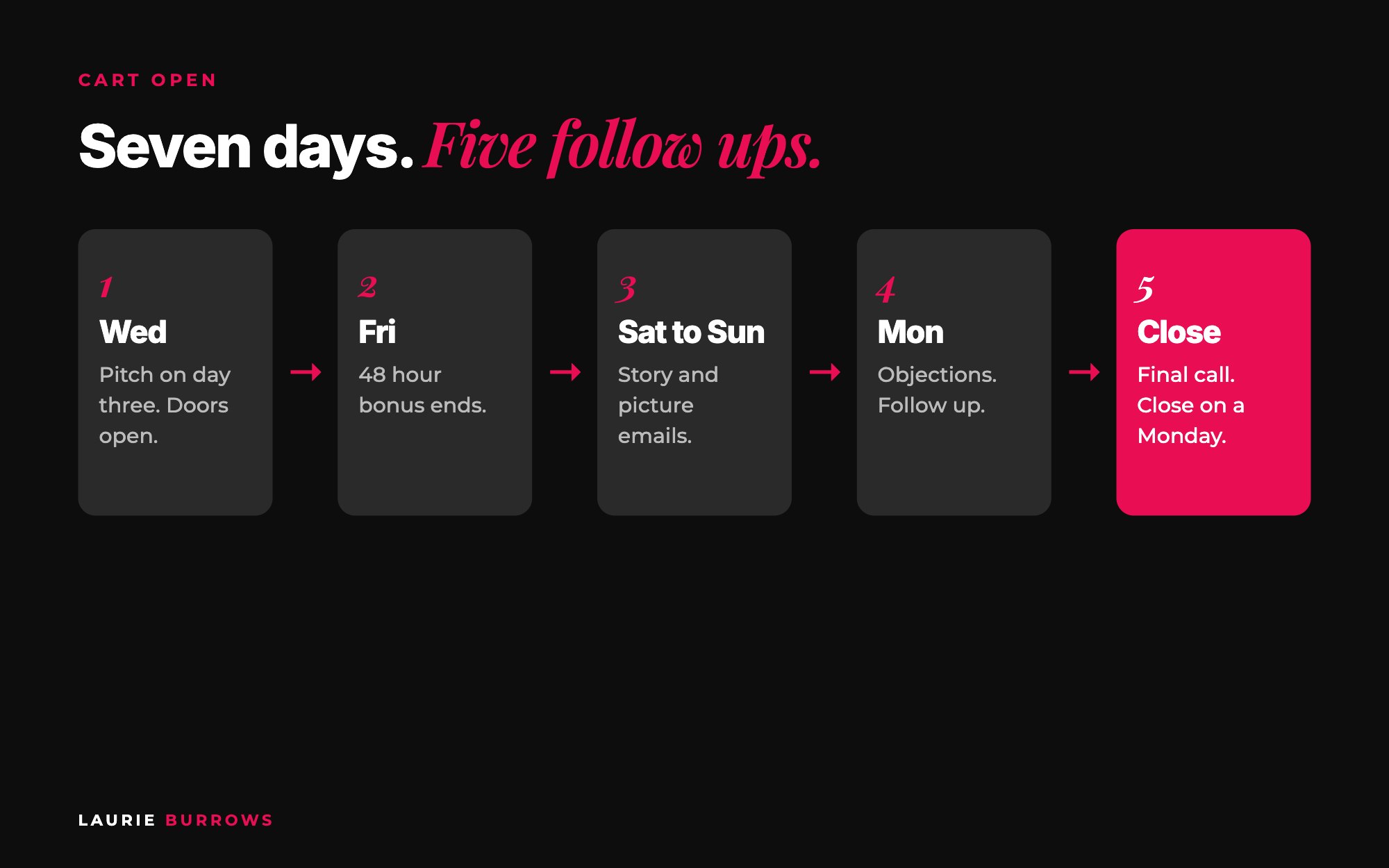
| Cart day | Email(s) | Content | Follow up |
|---|---|---|---|
| Day 1 (Wed, pitch day) | Doors are open: what it is, what's included, the bonus | Pitch replay clip, "doors open" post | DM everyone who watched live |
| Day 2 (Thu) | Answers to the top 3 questions | Day four session, an objection post | Voice notes to people who clicked |
| Day 3 (Fri) | Bonus ends tonight (AM), Last few hours (PM) | Day five session, countdown stories | Message everyone who asked a question |
| Day 4 (Sat) | Your story: why you built this | Behind the scenes, a win from the week | Light touch |
| Day 5 (Sun) | Paint the picture: imagine 90 days from now | One reflective post | Rest |
| Day 6 (Mon) | Objection email: time or money | FAQ live or post | Second follow up to everyone engaged |
| Day 7 (close) | Doors close today (AM), Final call (PM), Closing in 1 hour | Final call stories | Last personal message |
Copy and paste: cart open email 1
Subject: Doors are open (and your bonus)
Hi [name],
Today on day three I opened the doors to [offer name], the full version of what we've been doing this week.
It's for you if you want to [end result] without [what they don't want]. Inside: [part one], [part two], [part three].
Join in the next 48 hours and you also get [fast action bonus].
[Join here]
Questions? Hit reply. I read every one.
Copy and paste: objection email
Subject: "I don't have time right now"
Hi [name],
This is the message I get most. And I get it. But not having the time is exactly why [offer name] is built the way it is: [how it saves time, for example 20 minute sessions and templates you can use straight away].
Here's the real question: if nothing changes, where will you be in 12 months? The same place, with the same amount of time and the same results.
Doors close on [day]. [Join here]
Time: Emails written before the launch, 30 to 60 minutes a day during cart open. Done when: every cart day has its emails scheduled and a follow up list.
Step 10: Follow up personally (the fortune is in the follow up)
Around 80% of conversions happen on the fifth follow up. How much money are you leaving on the table by not following up?
That means personal follow up, not just automation. DMs, voice notes, WhatsApp messages and conversations with the people who engaged. Here's why it matters: on one masterclass launch, 500 people signed up and 50 showed up live, around 10%. The overall conversion was around 2.5% of sign-ups. But of the people who showed up live, around 25% bought. That's ten times more. So the work isn't only the pitch. It's getting people to show up and following up with everyone who didn't buy yet. More on that in why live attendees buy 10 times more.
Make a simple list of everyone who engaged: watched live, commented, posted, clicked the sales page, replied to an email. Work through it every day of cart open.
Copy and paste: follow up DMs
To someone who was active all week: Hey [name]! Loved seeing your posts this week, especially [specific win]. How are you feeling about the next step? Happy to answer anything about [offer name] before the bonus ends on [day].
To someone who signed up but went quiet: Hey [name], I know life gets in the way. Did you get a chance to catch day three? It's the one that ties it all together. Want me to send you the link?
To someone who clicked but didn't buy: Hey [name], I noticed you had a look at [offer name]. Is there anything I can answer for you? No pressure at all, I just don't want you to miss the bonus if it's a yes.
Fifth touch, before close: Hey [name], last message from me on this one. Doors close tonight at [time]. If now isn't the time, no problem, and I'd love to know what would make it a yes in the future.
For a full follow up system after an event, read how to follow up after a masterclass. And if urgency feels uncomfortable, ethical urgency and scarcity shows you how to do it honestly.
Time: 30 to 60 minutes a day during cart open (or a sales assistant). Done when: every engaged lead has had at least five touch points before cart closes.
Phase three: post-launch
If your launch converts at 3%, then 97% of people didn't buy. So many people close cart and forget about them completely. They're still leads. People don't buy for all sorts of reasons: affordability, not enough trust yet, life got in the way.
Step 11: Run an encore or a down sell
After cart closes I do one of two things:
- An encore. "Life got in the way, I know. So I'm running it again." This can be a rinse and repeat of the event or a condensed 90 minute masterclass, and it gives you another chance to sell.
- A down sell. A low priced offer, usually around $27 to $97, often a live three day mini programme around $47. I find live low priced offers convert higher than pre-recorded ones. They buy, they spend more time with you, trust builds, and then you sell into your core offer again.
Copy and paste: down sell email
Subject: Not the right time? Start here instead
Hi [name],
[Offer name] has now closed, and I know it wasn't the right time for everyone.
So next week I'm running [down sell name], a live [3 day] workshop where we'll [specific quick win]. It's $[27 to 97] and you'll leave with [tangible outcome].
[Grab your seat]
Time: One week to promote, a few days to deliver. Done when: everyone who didn't buy has been offered a next step.
Step 12: Analyse the numbers
Look at the numbers at every stage: how many leads, how many showed up each day, how many bought, and where they came from. What went well, what didn't, and what can you improve next time? This is how my launches went from a flop to 15, 25, 50 and 75 spots. Change one or two things at a time, so you know what made the difference.
| Number | Where to find it | What it tells you |
|---|---|---|
| Sign-ups vs leads target | Opt-in page or email list | Whether pre-launch did its job |
| Show up rate each day | Session views or live attendees | Whether the event kept people |
| Sign-ups by source | Tracking links and pages | Which lead sources to double down on |
| VIP upgrade rate | Checkout | Whether your thank you page is working |
| Sales and conversion rate | Sales divided by sign-ups | Your number for the next calculator |
| Sales by day | Checkout | Whether the bonus and follow up drove sales |
Time: One to two hours. Done when: you have a short "keep, change, test" list for the next launch.
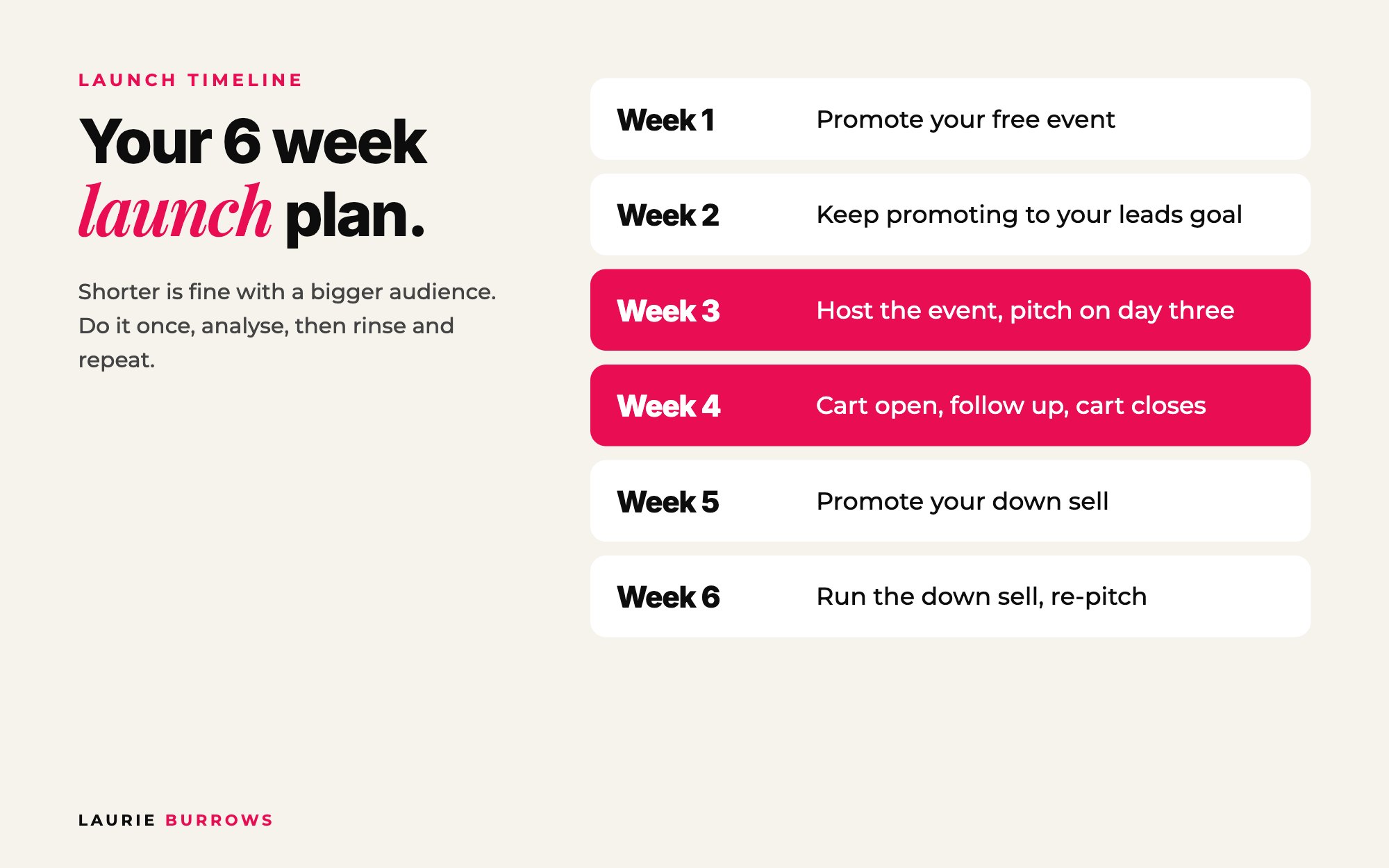
Your week-by-week launch calendar
Put it all together and a typical launch looks like this. It can be shorter. With a big audience you might only promote for one week and run the whole thing in four. Mine currently runs as a three week cycle. Do it once, analyse it, then adapt it to your audience size and your offer.
| Week | Focus | Key tasks |
|---|---|---|
| Before week 1 | Plan and build | Numbers sheet, Lead Map, event plan, pages, community, emails written, guest spots and partners booked |
| Week 1 | Promote | Announce, daily content, promo emails, guest spots, partners live, ads on |
| Week 2 | Promote to target | Countdown content, reminders, kickoff party, hit the leads target |
| Week 3 | Host and pitch | Days 1 to 5, pitch day three, fast action bonus ends day five, daily follow up |
| Week 4 | Cart open and close | Objection emails, story emails, personal follow up, close on Monday |
| Week 5 | Down sell | Promote the encore or low priced offer to everyone who didn't buy |
| Week 6 | Down sell and re-pitch | Run it live, pitch the core offer again, analyse every number |
Benchmarks to aim for
| Number | Benchmark |
|---|---|
| Average challenge conversion (sign-up to sale) | 1 to 3% (most launches sit between 2 and 5%) |
| Conversion to plan with if you've never launched | 3% |
| A strong, well run launch | My launches convert at 10 to 12% |
| Live attendees vs overall | Around 25% of live attendees vs around 2.5% of all sign-ups on one masterclass launch |
| Show up rate if you do nothing | 10 to 15% of sign-ups |
| Session length | Around 20 minutes a day |
| Promotion window | 7 to 14 days (not three weeks) |
| Fast action bonus | 24 to 48 hours |
| Cart open | 5 to 10 days, close on a Monday |
| Follow up | Around 80% of conversions happen on the fifth follow up |
| Down sell price | Around $27 to $97 |
Common launch mistakes (and the fix)
- Only setting a sales goal. Fix: set a leads goal and build a Lead Map before you promote.
- Naming the event after the problem. Fix: name it after the end result so Buyer B signs up too.
- Hour long sessions. Fix: around 20 minutes, one aha, one action step.
- Pitching on the last day. Fix: pitch on day three while attention is highest.
- Mentioning the offer instead of pitching it. Fix: use the nine part pitch above.
- Scheduling it all and disappearing. Fix: be in the community every day, even if it's pre-recorded.
- Relying on emails and a sales page. Fix: personal follow up by DM, voice note and WhatsApp.
- Forgetting the 97%. Fix: encore or down sell, every time.
Troubleshooting: if your launch isn't working
| If this is happening | Check this first |
|---|---|
| Not enough sign-ups | Your Lead Map. Did you rely on email and social only? Add guest spots, partners or ads, and give yourself the full two weeks. |
| Plenty of sign-ups, nobody shows up | Your reminders (email, WhatsApp, calendar), your thank you page step one, and whether there's a community and prizes. |
| People show up, then drop off each day | Session length. Cut to around 20 minutes and give one clear action step a day. |
| Good engagement, few sales on pitch day | Your pitch. Did you name the offer, explain why each part matters, stack the value and state the price with confidence? |
| Lots of sales page visits, no purchases | Follow up. Message every visitor, answer objections by email and DM, and check the bonus deadline is clear. |
| Sales only from your existing audience | Your event promise. It may be speaking to people who already know you rather than the end result a new audience wants. |
| Conversion dropped on a repeat launch | Your presence. Were you in the community and creating excitement like the first time? |
Your action plan
Today
- Fill in the launch numbers sheet: goal, price, sales target, conversion rate, leads target.
- Draft your Lead Map with a number next to every source.
- Choose your conversion event and your pitch day.
This week
- Name your event after the end result and write the one line promise.
- Plan each of the five days: title, aha moment, action step, proof.
- Send five guest speaking requests and your launch partner invite.
- Book your launch dates in your diary using the calendar above.
Next 30 days
- Build your opt-in page, thank you page, community and VIP upgrade.
- Write your promo emails, your day three pitch and your cart open emails.
- Promote for 7 to 14 days until you hit your leads target.
- Run the event, pitch on day three and follow up personally every day.
- Down sell to everyone who didn't buy, then analyse every number and plan the next round.
Can you launch without launching? Yes. Some people take a launch that worked and turn it into a pre-recorded experience they rinse and repeat, and others use an evergreen funnel like my Freedom Funnel that sells every day. Evergreen vs live launch helps you decide. Either way, the pieces are the same: enough leads, a trust-building experience, a real pitch and follow up. Guessing and hoping isn't a strategy.
Want the pitch done with you?
The 5-Figure Webinar Formula is my 10-step framework for the event that sells, with a slide deck template, the pitch script and objection handling slides. It's $27 and it works for a masterclass or day three of your challenge.
Rather have it done for you?
Let Ascendia OS plan, build and run your launch with you
The Strategist works out your sales and leads targets, the Launch Manager plans the 5 Day Experience and cart open, the Funnel Builder builds your pages and checkout, and the Email Marketer writes the promo, pitch and follow up emails. You approve the work and show up for your people. 14 days free, no tech skills needed.
Frequently asked questions
How many people do I need on my email list to have a 6 figure launch?
It's less about your list size and more about how many leads opt into your free event. Divide your revenue goal by your price, then divide by your conversion rate. For $100,000 at $1,200 with a 5% conversion rate, you need around 1,667 sign-ups, which can come from email, social, guest speaking, collaborations, launch partners and ads.
What is a good conversion rate for a course launch?
The average challenge launch converts at around 1 to 3% of sign-ups, and most launches sit somewhere between 2 and 5%. My own launches convert at 10 to 12%. Lower priced offers usually convert higher and higher priced offers lower.
Should I do a challenge or a masterclass for my launch?
Use a masterclass for a warm or hot audience who already know you. Use a 3 to 5 day challenge when you want to sell in bulk or bring in a new, cold audience, because they need more time with you before they buy.
What day should I pitch in a 5 day challenge?
Day three. You've built authority on day one and belief on day two, attention is at its highest, and you still have two days to re-pitch and answer objections before the fast action bonus ends.
How long should I promote my free event for?
Usually one to two weeks. Use the shorter end if you have a big audience, partners and ads, and the full two weeks if you need a lot of leads or have a smaller audience. Longer than that and people forget they signed up.
How long should cart be open?
Five to ten days, starting on pitch day. Your sales come from the energy of the event, so don't let it drag on, and close on a Monday rather than a Sunday.
What should I do with people who didn't buy during the launch?
Don't ignore them. Run an encore or offer a low priced down sell (around $27 to $97), ideally live. It builds trust with people who weren't ready and gives you another chance to sell your core offer.
Can a pre-recorded launch make six figures?
Yes. A pre-recorded event can be rinsed and repeated, which makes launching far easier. You still need to be present in the community during the launch, because engagement and excitement have a direct effect on your conversion rate.
Laurie Burrows is a revenue growth strategist for coaches, consultants and online service providers, with 15 years of experience in marketing and sales and a business that's generated multi-seven figures in sales. She's the founder of Ascendia OS.
Do you want to scale your business to 10K months in the next 90 days? I am looking for 10 people for my new case study program. DM me the word CASE STUDY on Instagram (@_laurieburrows) to learn more.