The Ultimate Guide to a 6 Figure Year
Short answer: a 6 figure year is $100,000 in revenue, which works out at roughly $8,333 a month or $1,923 a week. To get there, set a revenue goal (not just what you want to take home), decide exactly what you'll sell, at what price and how many spots, then work out how many leads you need and map where every one of them will come from. Build recurring revenue so you're not starting every month from zero, plan 90 days at a time (month, week and day), promote something every single week, track your numbers weekly and review every quarter.
Who this guide is for: coaches, consultants and online service providers who want their first (or first consistent) $100,000 year, and who are tired of going into every month guessing and hoping.
What you'll have by the end: your real revenue goal, your offer mix with the number of spots for each, a leads goal and a lead map, a recurring revenue tracker, a 12 month launch map, a 90 day plan broken into weeks and days, a weekly rhythm you can actually stick to and a simple tracker to tell you if you're on track.
When I started my business in January 2020, I found out I was pregnant the same month. Then COVID hit. I didn't have a team, I didn't have a big audience and I definitely didn't have time to waste. So I picked one core offer, one core platform and one core strategy, and I made nearly $200,000 in sales in my first year as a new mum. (The full story is in how I made $200k in my first year as a new mum.)
That didn't happen because I was lucky. It happened because I had a plan. I've since built a business that's generated multi-seven figures in sales, and the planning process I use now is the same one I'm about to walk you through, with the templates and the maths. Because guessing and hoping isn't a strategy.
What does a 6 figure year actually mean?
A 6 figure year means $100,000 or more in sales across 12 months. Broken down, that's $8,333 a month, around $1,923 a week and around $25,000 a quarter. Seeing it like that makes it feel a lot less scary, doesn't it?
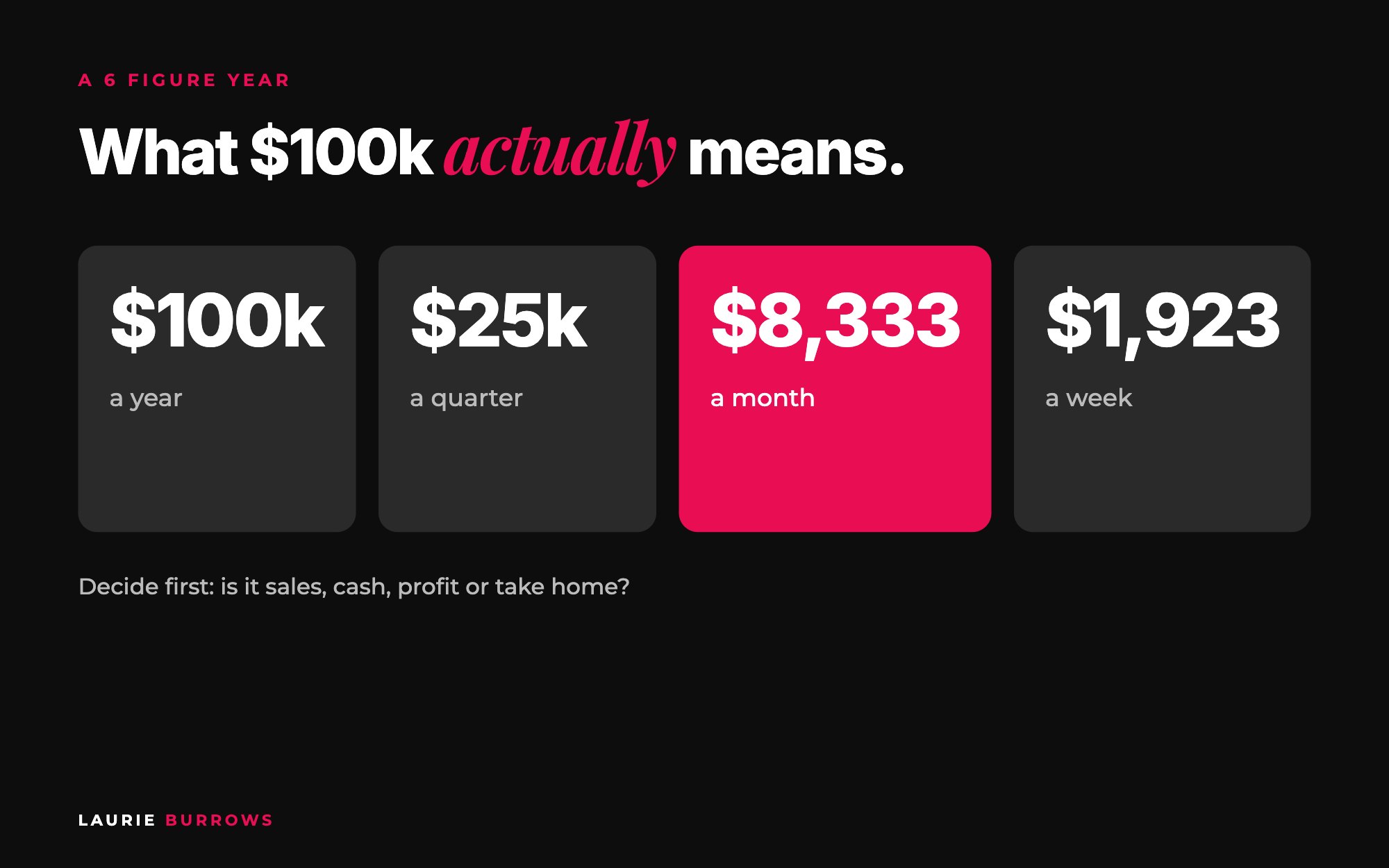
But before you write $100k at the top of your planner, you need to know what kind of number it is:
- Sales: the total value of everything you sell, whether people pay in full or go on a payment plan.
- Cash: the money that physically hits your bank account this month.
- Profit: the cash coming in minus all your expenses.
- Take home: what you actually pay yourself after expenses, tax and the money you keep in the business.
If 100 people buy your $1,000 offer, that's $100,000 in sales. But if 50 pay in full and 50 go on a payment plan, it isn't $100,000 in cash this month. This is where so many founders get caught out. They hit their sales goal and still feel skint, because they never decided which number they were aiming for. You might have a goal for each one.
Free 5 day event · 12th to 16th October
The 6 Figure Game Plan
Want to build this plan with help? In my free 5 day event you'll map your strategy to 6 figures and get the plan, content and pages created for you.
The framework: the 6 figure year plan
Every plan I build, for my business or a client's, follows the same flow: goal, offer, spots, leads, strategy, weekly plan. Then you track it and review it.
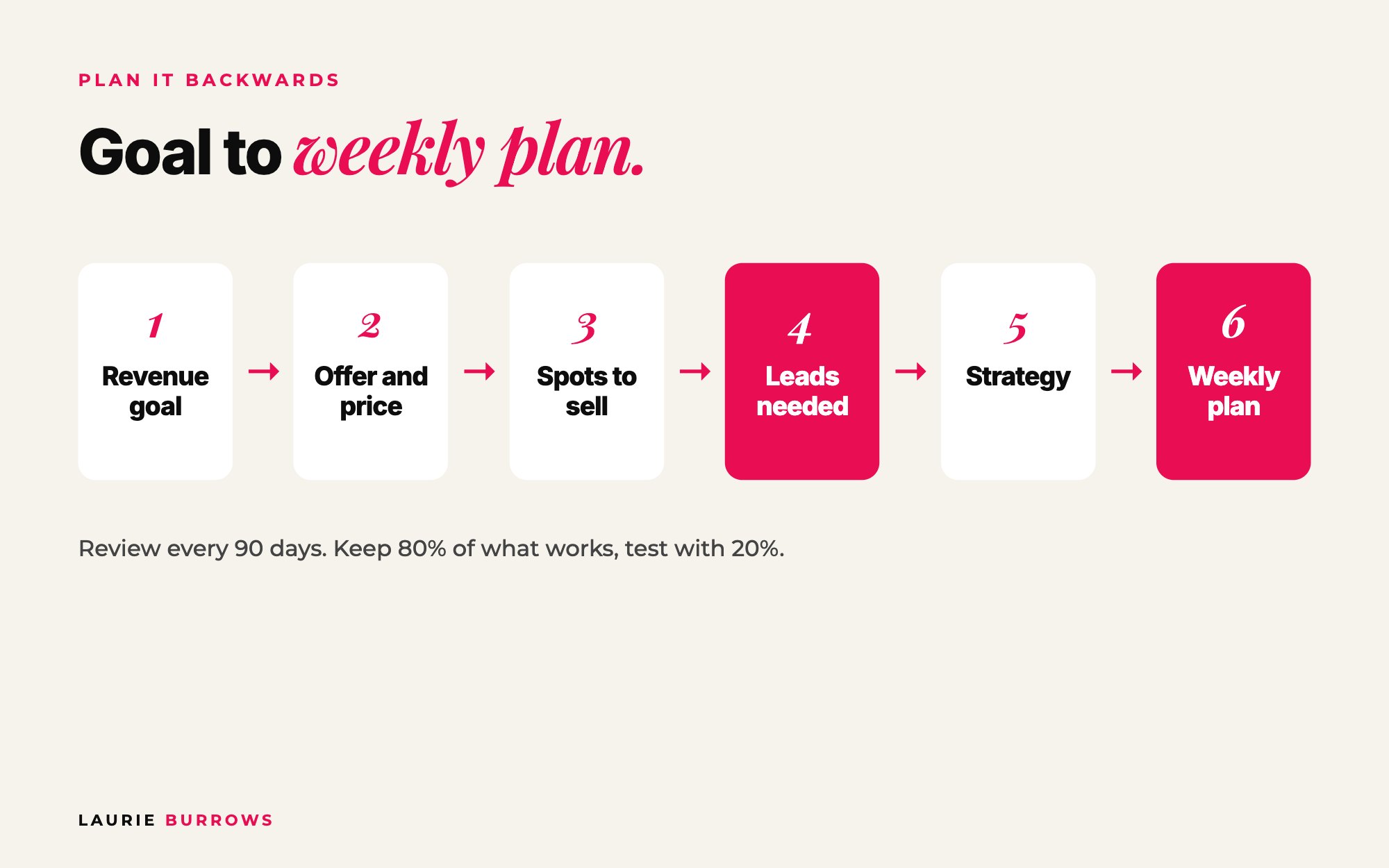
This guide works through it in eight phases. Each one has steps, a template and benchmarks. I'll follow one made up business the whole way through so you can see the maths in action.
Our worked example (illustrative, not a real client): a business coach with a $1,000 group programme and a small audience of 1,500 email subscribers, who has had a few good months but never a consistent year.
Phase 1: Start with future you
Step 1: Journal on the year as if it's already happened
Before I touch a spreadsheet, I start with future me. I imagine it's 12 months from now and everything has gone as well as it possibly could. Then I journal on these questions as if I'm looking back on the year:
Copy and paste: future you journal prompts
It is [date, 12 months from now] and this year went better than I could have imagined.
1. What business goals have I achieved?
2. What personal goals have I achieved?
3. What obstacles did I have to face?
4. How did I handle them?
5. What skills did I need to learn?
6. What resources or tools were most valuable?
7. Who did I need to connect with or hire?
8. What mindset shifts had to happen?
Daily check in: Am I on track? If not, what can I do about it today?
This isn't fluffy. The obstacle questions let you prepare for problems before you're in the middle of them. The skills, tools and people questions show you the gaps you need to fill (and often the future expenses you need to budget for). And the mindset question matters more than most strategy people will admit. You can have the best strategy in the world, but if you don't believe in your offer and your prices, you'll self sabotage without even meaning to.
Time: 45 minutes. Done when: you've written your answers and put a daily reminder in your phone to ask "am I on track?"
Phase 2: Set a revenue goal (not an income goal)
Step 2: Work out your real number
This is one of the biggest mistakes I see when founders plan their year. They write down $100k, but what they really mean is they want to pay themselves $100k. Then they aim for $100k in the business, and by the time expenses and tax have come out, they're nowhere near it. To work out your real number, add up:
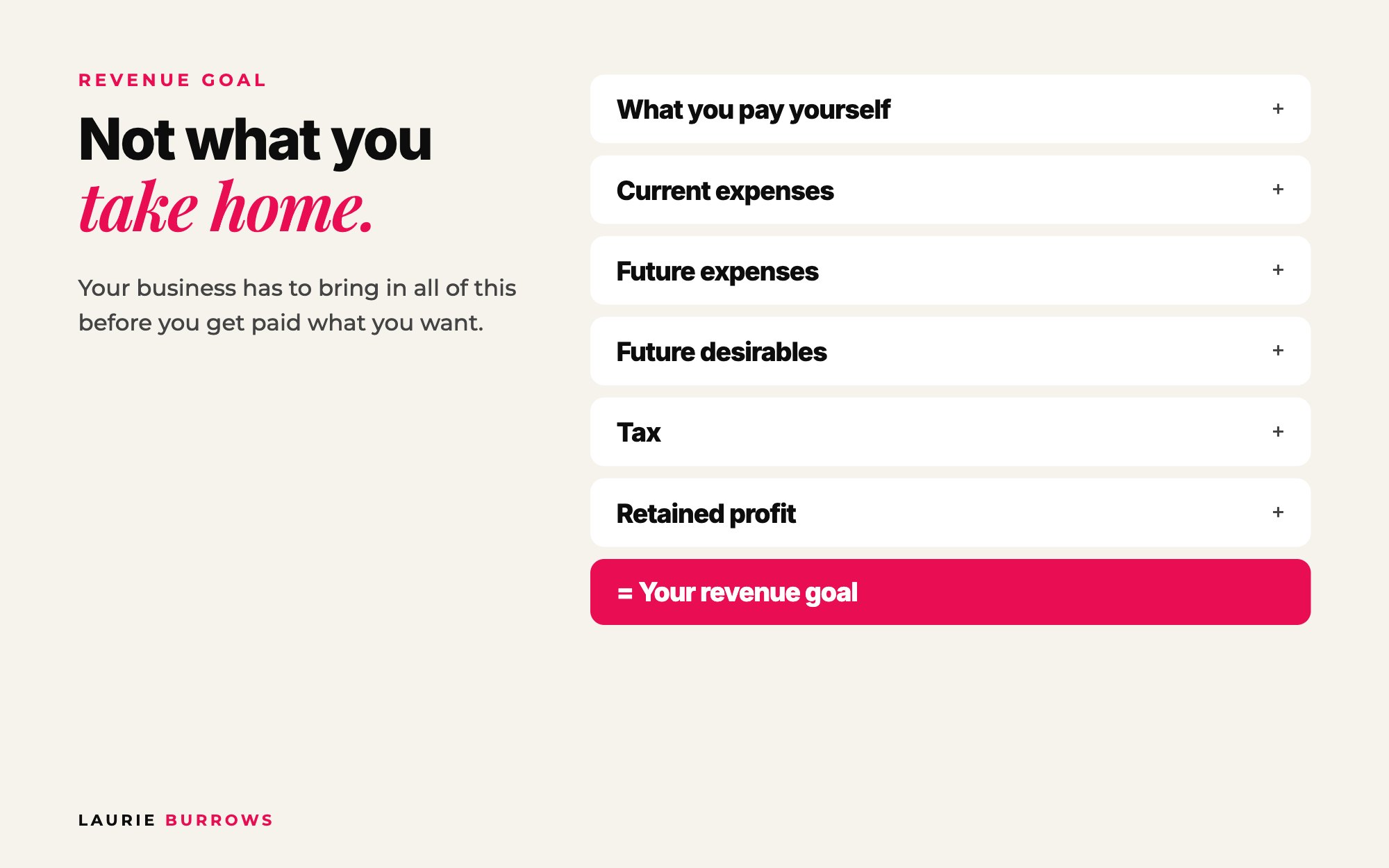
Copy and paste: revenue goal calculator
What I want to pay myself this year: $[ ]
+ Current expenses (software, team, Zoom, everything) x 12: $[ ]
+ Future expenses (the hires, systems or tools I will need to hit the goal): $[ ]
+ Future desirables (a house deposit, a car, anything big I am saving for): $[ ]
+ Retained profit (money kept in the business for a rainy day or investment): $[ ]
+ Tax (ask your accountant what to allow for your country and set up): $[ ]
= My revenue goal for the year: $[ ]
Monthly: divide by 12. Weekly: divide by 52.
Worked example: our business coach wants to pay herself $45,000. Her expenses are $2,000 a month ($24,000 a year). She knows she'll need a VA from month six ($6,000). She wants $5,000 kept in the business, and her accountant tells her to allow around $20,000 for tax. Her real goal: $100,000. Notice that's a 6 figure business paying her $45,000, not $100,000. If she'd wanted to take home $100,000, the plan would look completely different.
I'm not an accountant and this isn't financial advice, so get a good accountant to sanity check your numbers. I go through the full calculation in how to set a revenue goal (not an income goal).
Time: 30 minutes. Done when: you have one annual number, one monthly number and one weekly number, and you know whether each is sales or cash.
Phase 3: Choose your offers, prices and spots
Step 3: Decide what you're selling and how many you need
Once you know your goal, the next question is simple: what are you selling, at what price, and how many spots do you need to sell? This is the part most people skip, and it's why they go into every month throwing spaghetti at the wall. Here's what $100k looks like with different offers:
| Offer | Price | Spots for $100k |
|---|---|---|
| Signature programme | $1,000 | 100 |
| 12 month mastermind | $1,000 a month ($12,000) | 9 |
| All in package (everything you launch for a year) | $6,000 | 17 |
| Low priced product | $50 | 2,000 (about 167 a month) |
Step 4: Pick the model that fits your life
Before you ask me, they all work. Low ticket works. High ticket works. One core mid priced offer works. A mix works. What matters is choosing the model that fits your time, your team, your audience and your energy, and then understanding what it asks of you.
- Low ticket: more people can afford less. Decisions are quick, but you need to sell a lot more. For $10k a month from a $50 product, that's 200 sales every month. Your focus has to be audience growth, because once everyone who's going to buy has bought, your audience goes stale.
- High ticket: fewer people can afford more. At $5,000 you only need two sales a month for $10k. Your focus shifts to trust, relationships and being seen as the go to expert.
- A mix of low, mid and high: whoever someone is and wherever they are in the customer journey with you, you have something to sell them into next.
In my first year I had one core offer, a signature programme at around $1,000, and I sold it in different ways: a challenge every quarter, the odd masterclass and low priced offers to convert people for the first time. That one offer got me to multiple six figures. Then I added a mastermind for recurring revenue, and for a good couple of years I focused on just one mid ticket and one high ticket offer. Now I have multiple programmes, but I also have a team and co-coaches. If you're doing most of the work yourself, running too many offers at once is the quickest route to burnout. Watching someone further ahead run ten things doesn't mean you should.
Step 5: Split your goal across your offers
Copy and paste: offer mix planner
Offer 1: [name] at $[price]. Spots this year: [ ]. Revenue: $[ ] ([ ]% of goal)
Offer 2: [name] at $[price]. Spots this year: [ ]. Revenue: $[ ] ([ ]% of goal)
Offer 3: [name] at $[price]. Buyers this year: [ ]. Revenue: $[ ] ([ ]% of goal)
Total: $[ ] (must equal or beat my revenue goal)
Gut check: can I deliver this many spots with the time and team I have?
Worked example: our business coach plans 60 spots on her $1,000 programme ($60,000), five spots on a new 12 month mastermind at $500 a month ($30,000 in sales) and around 260 buyers of a $27 offer with an $11 order bump, so $38 each ($9,880). Total: just under $100,000 in sales. Ninety percent comes from two offers, which keeps her focused.
Phase 4: Work out your leads and map where they come from
Every revenue goal needs a second goal sitting next to it: a leads goal. A lead is anyone who shows interest in something you have to offer, like opting in to your free training or signing up to your challenge.
Step 6: Do the leads maths
- Revenue goal divided by price = sales needed.
- Sales needed divided by conversion rate = leads needed.
- Leads needed divided by 52 (or by 13 for a quarter) = your weekly leads target.
Benchmarks to plan with:
- The average live launch or live virtual event converts around 3% of leads. That's 333 leads for every 10 sales. Mine sit at 10 to 12%, but I always plan with a lower number for wiggle room.
- Aim to convert at least 5 in every 100 leads. If you're converting fewer, that tells me it's time to work on your sales skills, not just your lead generation.
- The average live show up rate is around 10% of people who sign up, and every day of a multi day event loses some (100 on day one can become 80 on day two and 60 on day three).
- A $27 thank you page offer converts 8 to 10% of opt-ins, and 70 to 80% of buyers add the order bump.
- Warm, qualified leads for a high ticket offer convert far higher than cold leads, because they already trust you.
Here's a real example from one of my quarterly plans. Around 101 sales at $997, at a 5% conversion rate, meant about 2,000 leads for the quarter. That's roughly 674 a month, or 156 a week. Suddenly you know exactly what your visibility has to deliver every single week. More on this in how many leads do I actually need?
Step 7: Build your Lead Map
The biggest mistake I see with any launch is setting the financial goal, never working out the leads, and never working out where those leads are coming from. That's what Lead Mapping fixes.
On one of my launches I needed 1,500 people to opt in. We mapped it: 500 from our email list, 300 from social media posts and another 300 from comment below posts and reels. That's 1,100. So I still needed 400, and before launch week started I knew I had to find them through guest speaking (100), collaborations (100) and affiliates promoting it to their audiences (200). Without the map, I'd have just posted a bit more and hoped for the best.
Copy and paste: Lead Map
Offer: [ ]. Sales needed: [ ]. Conversion rate I am planning with: [ ]%. Leads needed: [ ]
Email list: [ ] leads
Social media posts: [ ] leads
Comment to get posts and reels: [ ] leads
Guest speaking (other people's audiences): [ ] leads
Collaborations and swaps: [ ] leads
Affiliates: [ ] leads
Ads: [ ] leads
Total mapped: [ ]. Gap: [ ]. How I will close the gap: [ ]
My top tip: always be growing your email list. When you have free resources being promoted every day, every live event you run gets more sign ups straight from your list.
Worked example: our business coach sells her programme through a five day challenge every quarter. She needs 15 sales per challenge, so at 3% that's 500 leads per challenge. Her map: 250 from her email list, 100 from posts, 75 from comment to get reels, 50 from two guest spots and 25 from a collaboration. That's exactly 500. For her mastermind, she plans to sell to her warmest people (programme graduates and $27 buyers), so she needs around 50 warm conversations across the year, not thousands of cold leads.
Do this now: write your revenue goal for the year, divide it by the price of your main offer, then divide that by 3% (or your real conversion rate). That's your leads goal. Divide it by 52 and you have the number of new leads you need every week.
Phase 5: Build recurring revenue (and watch where it drops off)
Step 8: Add recurring revenue to your mix
This is the bit that changes everything. Recurring revenue comes from payment plans, masterminds and memberships. If you have 10 people paying $1,000 a month in a 12 month mastermind, you have $10,000 coming in every month for the year, even if you don't launch anything.
The more recurring revenue you build, the less you have to sell each month. If you want $20k months and you already have $10k recurring, you only need $10k in new sales that month. You're not starting every month from scratch.
Recurring revenue is also where a lot of founders quietly lose money. I explain the most common slip in the recurring revenue mistake.
Step 9: Track when it drops off
Recurring revenue has a catch. It ends. I keep a simple spreadsheet showing exactly how much recurring revenue is coming in each month and when it drops off. I learned that the hard way, after a month where 10 people finished a programme at the same time and we lost about $20k in recurring revenue overnight. Now, if I can see a drop coming in July, I promote the mastermind again in May or June.
| Client or offer | Monthly amount | Start month | Last payment | Renewal or upsell date |
|---|---|---|---|---|
| Mastermind member 1 | $500 | February | January | Invite to renew in November |
| Mastermind member 2 | $500 | April | March | Invite to renew in January |
| Programme payment plan (3 people) | $1,050 | March | May | Offer mastermind in April |
| Total recurring this month | $2,050 |
Payment plans or pay in full?
I offer both on everything. Payment plans build recurring revenue and make the investment feel less risky, so you get more sales. Pay in full brings cash in now. If you need cash, add a pay in full bonus (a one to one, a VIP day or access to another course). Just remember that if nine people join a $12,000 mastermind on a $1,000 a month plan, it's a six figure launch in sales but only $9,000 in cash this month.
Worked example: by month six, our business coach has four mastermind members at $500 a month and three people paying off the programme at $350 a month. That's around $3,000 already coming in before she sells anything, which means her $8,333 month only needs about $5,300 of new sales.
Phase 6: Map your year and choose a strategy for each offer
Step 10: Spread your goal across the year
There are three ways I've split an annual goal, and all of them work:
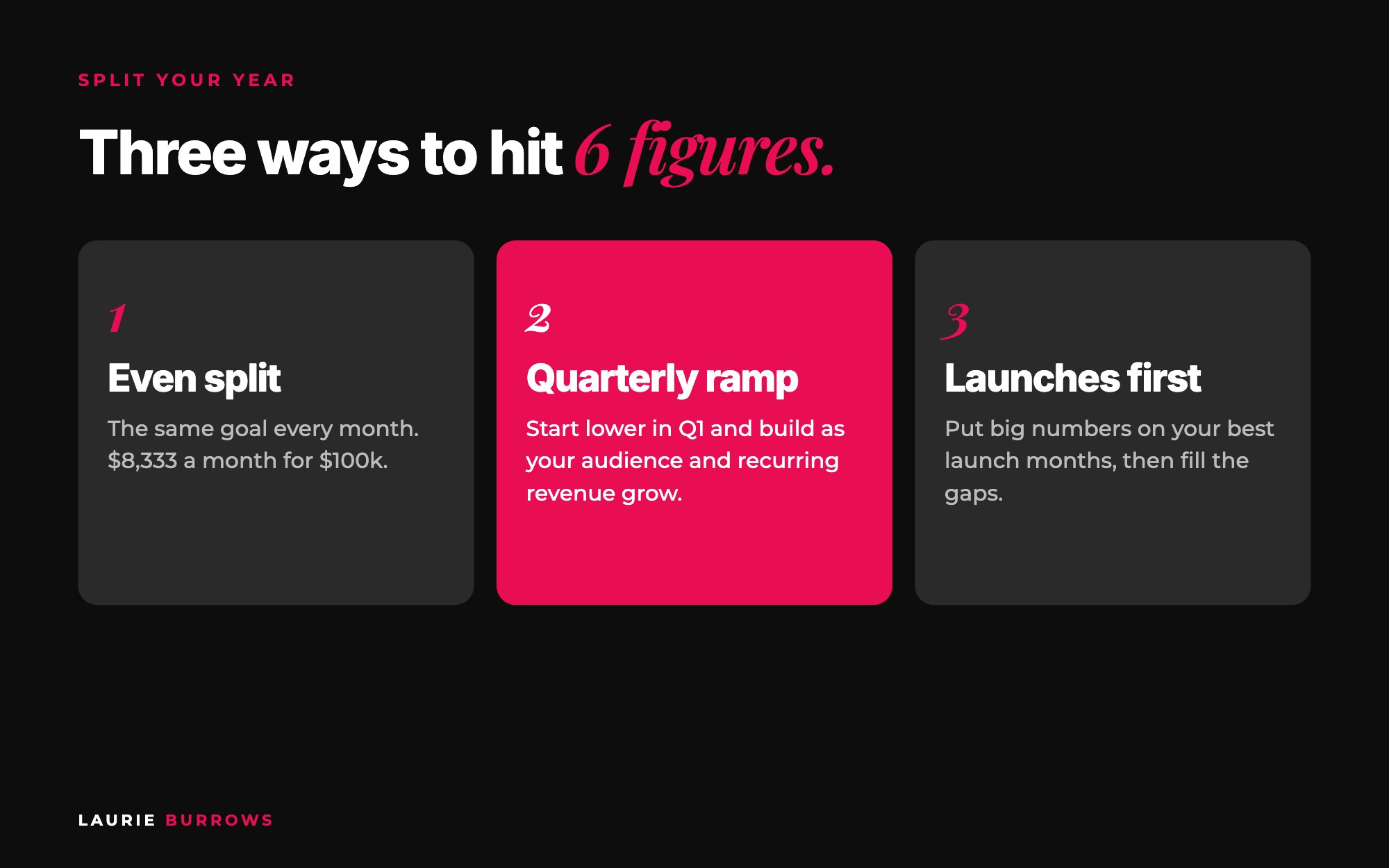
- The even split. Same goal every month. $100k becomes $8,333 a month. Simple and easy to track.
- The quarterly ramp. Start lower in quarter one and build each quarter. At the start of the year you have your smallest audience, reputation and team, so selling should get easier as you grow.
- Launches first. Map your big launches into the months they work best, give those months their bigger numbers, then fill the months in between. This is how I plan now.
Use your own data if you have it. Which months were your best sales months last year, what were you selling and what did you do to bring people in? In my business our biggest launches usually land around January, March, July and November. For our mastermind, January, April, September and November into December work best. April works because people have just finished their first quarter and they're reflecting. September is the entrepreneur's January. November and December are when people start thinking about next year. The months before a big launch need a heavy focus on audience growth, so mark those too. No data yet? Start keeping it now so next year's plan is easier.
Step 11: Match each offer to the right selling strategy
Every strategy follows Attract Nurture Convert: you get visible to attract people, your content nurtures them, and an event, offer or conversation converts them. This is what works best in my business:
| Strategy | Best for | How often | Why |
|---|---|---|---|
| 3 to 5 day challenge | Offers around $1,000 to $2,000, selling in bulk | Around once a quarter | Long enough to take someone from cold to ready to buy |
| One day strategy day | Mid priced offers, better show up | Occasionally | Everything in one day solves the daily drop off |
| Masterclass (60 to 90 minutes) | Warm audience, mid or high ticket | In between big launches | Quick to run, higher conversion with people who already know you |
| Paid low priced event | Warm leads, high ticket upsell | Monthly or as needed | Paying people show up and are warmer |
| Content and DMs | High ticket to a warm audience | Every week | I once sold 10 mastermind spots in about a week from content |
| Automated funnel (the Freedom Funnel) | Everything, every day | Always on | Free resource, $27 offer, bump, upsell, emails, DMs |
| Offer to current clients | All in package or next level | When clients finish | They already know what it's like to work with you |
If you want the step by step for the big launches, read the ultimate guide to a 6 figure course launch.
Worked example: our business coach maps a five day challenge into January, April, July and October for her programme (15 spots each). She opens her mastermind to programme graduates in March, June, September and December. Her $27 offer runs every day through a simple funnel, with a few dollars a day of ads behind her free resource.
Phase 7: Build your 90 day plan (month, week, day)
I plan at least three months ahead. A year is too far to hold in your head, and a month at a time leaves you scrambling. Ninety days is the sweet spot.
Step 12: Write the plan in a Google Doc
- Write out the three months.
- Under each month, write the goal, what you're selling, the price and how many spots you need.
- Split each month into weeks. I write them as "WC" (week commencing) with the Monday's date.
- Give every week a job. For example: promote the challenge, promote the challenge, run the challenge and open cart, close cart, then promote a low priced offer.
- Under each week, list the daily activities that make that job happen.
Then I move it onto a project board so the team can see every date and task. You don't need fancy tools, a document works fine.
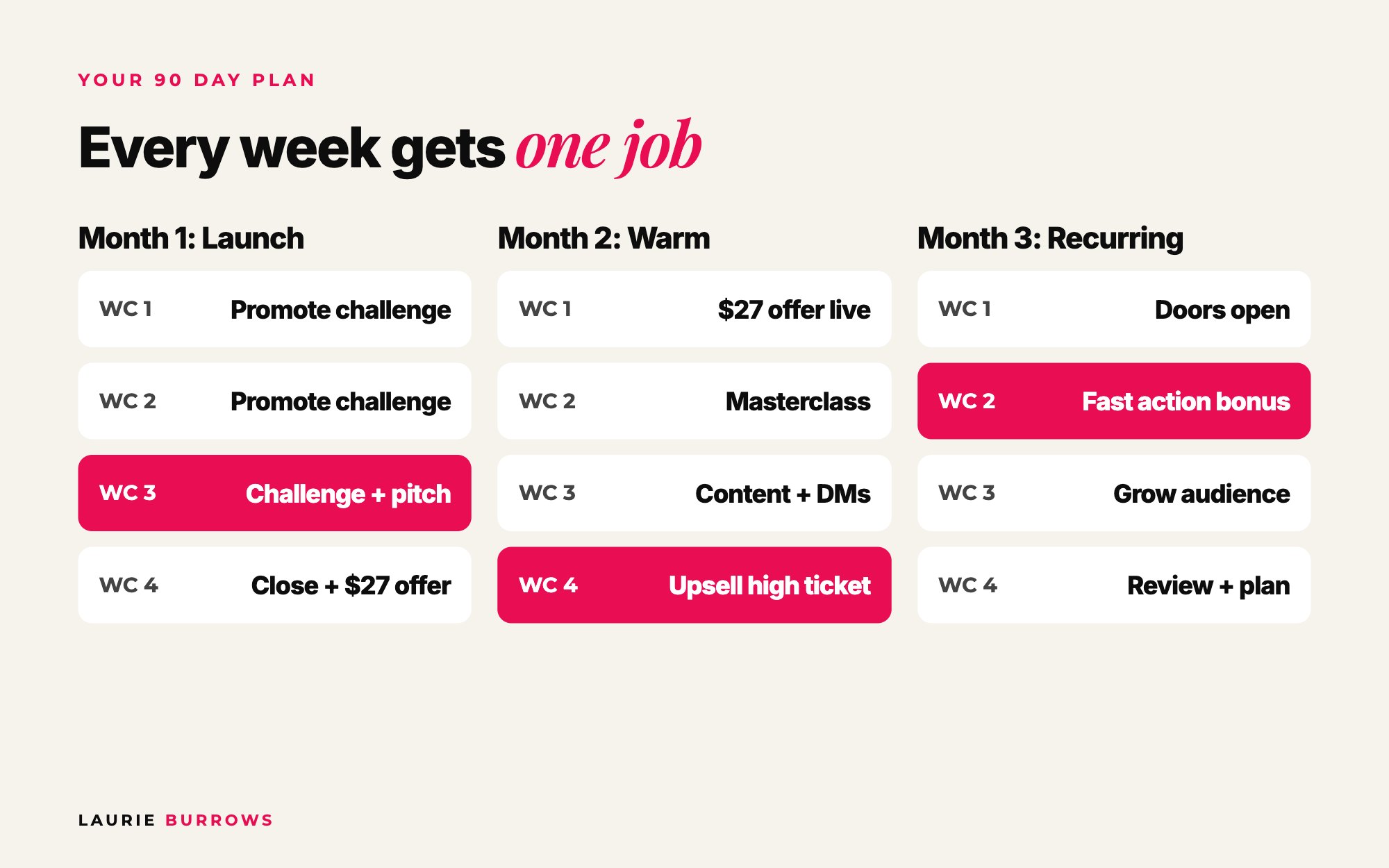
Copy and paste: 90 day plan template
MONTH 1: [month]. Goal: $[ ]. Selling: [offer] at $[ ]. Spots needed: [ ]. Recurring already in: $[ ]. Strategy: [ ]
WC [date]: Job: [ ]. Daily: [ ]
WC [date]: Job: [ ]. Daily: [ ]
WC [date]: Job: [ ]. Daily: [ ]
WC [date]: Job: [ ]. Daily: [ ]
MONTH 2: [month]. Goal: $[ ]. Selling: [ ]. Spots: [ ]. Strategy: [ ]
(repeat the weeks)
MONTH 3: [month]. Goal: $[ ]. Selling: [ ]. Spots: [ ]. Strategy: [ ]
(repeat the weeks)
Recurring revenue drops to watch this quarter: [ ]
Leads needed this quarter: [ ]. Per week: [ ]
Worked example (January): goal $15,000 (a launch month). Selling the $1,000 programme, 15 spots, via a five day challenge.
- WC 5th January: promote the challenge. Daily: one challenge post, one comment to get reel, one email every other day, two guest spot or collaboration pitches.
- WC 12th January: promote the challenge. Daily: same, plus personal invites to past $27 buyers.
- WC 19th January: run the challenge, pitch on day three, cart open. Daily: show up live, follow up in DMs, daily sales email.
- WC 26th January: cart closes, then promote the $27 offer to everyone who didn't buy. Daily: closing emails, DMs, downsell.
February then becomes a quieter month: $27 offer promotion, a free masterclass, content and DMs to sell two mastermind spots to warm people. March opens the mastermind properly with a fast action bonus. I walk through the planning in more depth in how to plan your next 90 days.
Planned and unplanned sales activities
Your 90 day plan is your planned sales activity. On top of that, I do unplanned sales activities every day by asking myself two questions:
- What is one thing I can do today to generate leads and grow my audience?
- What is one thing I can do today to generate more sales?
That might be an exclusive offer, reaching out to old clients or following up with old leads. It's often where the "extra" money in a month comes from.
A shortcut: plan it with AI
I record a voice note brain dump about my business, goal, offers, prices and past conversion rates, get it transcribed, and give it to an AI tool to turn into a draft plan. Then I tweak what I don't like and ask for a week by week calendar. The more detail you give it, the better the plan.
Copy and paste: AI planning prompt
Act as a world class marketing and sales strategist for coaches. Here is my business: [what I do, who for]. My revenue goal for the next 90 days is $[ ] in [sales / cash]. My offers and prices: [ ]. My recurring revenue already coming in: $[ ] a month. My audience: [email list size, followers]. My past conversion rates: [ ] (if unknown, use 3%).
Strategies I am happy to use: [challenge / masterclass / low priced offer / content and DMs / funnel].
Please: 1) tell me how many spots of each offer I need, 2) how many leads I need per month and per week, 3) which strategy to use for each offer, 4) a week by week calendar with one clear job per week, 5) the daily actions for each week.
Or skip the prompting altogether. The Strategist inside Ascendia OS learns your business, sets the goal and maps what to sell, when, and how many sales you need, then the Launch Manager plans each launch from first email to cart close.
Phase 8: Your weekly rhythm
A plan only works if your week is built around it. This is the rhythm I recommend.
Step 13: Promote something every single week
In my business we promote something every single week, whether it's free, low, mid or high priced. That's how we keep attracting, nurturing and converting consistently. Some weeks it's a challenge, some weeks a $27 offer, some weeks doors open on the mastermind with nothing but content and DMs. But there is never a week where nobody is being invited to anything.
Step 14: Pick your three visibility habits
If nobody knows who you are, nobody can buy from you. And your content isn't your visibility strategy, it's your nurture. Visibility in front of a new audience comes from guest speaking, summits, collaborations, ads and genuinely engaging with your ideal clients on their social media. If you tend to try everything at once, pick just three things: one you'll do every day, one every week and one every month. Then stick to them for the whole quarter.
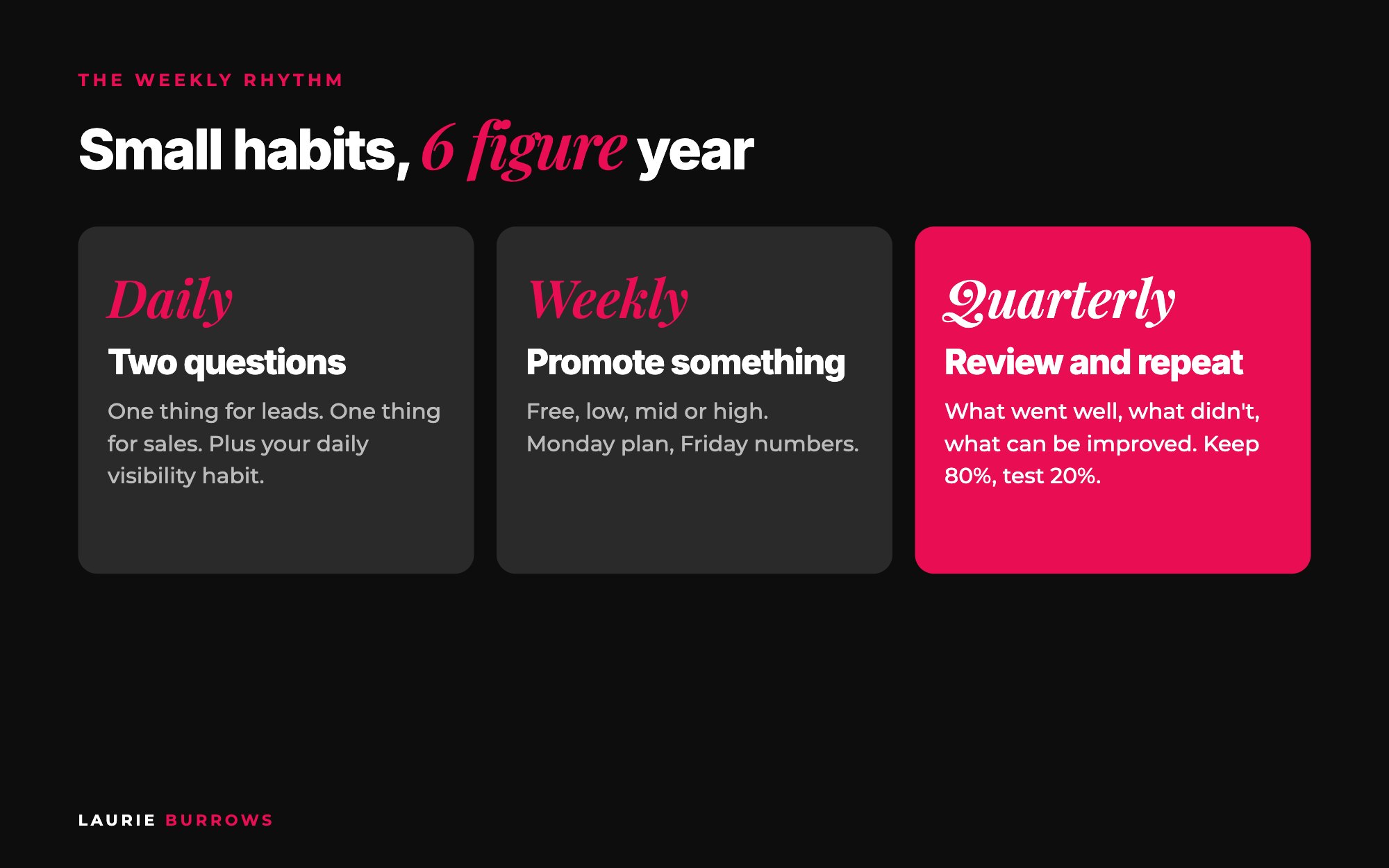
| When | What | Time |
|---|---|---|
| Every day | Ask the two questions (one lead action, one sales action). Do your daily visibility habit. Reply to DMs and comments. | 20 to 60 minutes |
| Monday | Check this week's job in the 90 day plan. Write the week's content and emails around it. | 1 to 2 hours |
| Midweek | Your weekly visibility habit (a guest spot, a collaboration pitch, a live). | 1 hour |
| Friday | Fill in the weekly tracker. What went well, what didn't, what can be improved? | 20 minutes |
| Once a month | Your monthly visibility habit (a summit, a masterclass, a podcast). | Half a day |
Phase 9: Track it and review it
Step 15: Track your numbers every week
You can't tell if you're on track by how busy you feel. Track the numbers. This takes 20 minutes on a Friday.
| Number | Target this week | Actual | On track? |
|---|---|---|---|
| New leads (opt-ins) | Weekly leads target | ||
| Email list size | |||
| Live show up rate | Around 10% or better | ||
| $27 offer buyers (% of opt-ins) | 8 to 10% | ||
| Order bump take rate | 70 to 80% | ||
| Sales of core offer | Spots needed / weeks selling | ||
| Conversion rate | At least 5 in 100 | ||
| Sales this month vs goal | |||
| Cash collected this month | |||
| Recurring revenue next month |
Step 16: Review every quarter (and stop jumping ship)
Before I plan any new quarter, I review the last one with three questions: what has gone well? What has not gone so well? What can be improved? The answers aren't always about strategy. Sometimes what didn't go well is me, trying to do everything at once. That's useful to know too.
Then I follow one rule: keep 80% of what's working and test with 20%. Not the other way round. So many founders find something that works, then a shiny new idea or a new mentor's strategy comes along and they abandon it completely.
My very first launch was a flop. I sold one spot, on a payment plan, and made $200. Most people would have blamed the strategy and moved on. I looked at what went well, what didn't and what I could improve, and ran it again. The next one sold 15 spots. Then 25, then 50, then 75. If you jump from strategy to strategy, you never get the data to know what's actually working. Rinse and repeat.
Common mistakes (and the fix)
- Setting an income goal and calling it a revenue goal. Fix: use the revenue goal calculator.
- A financial goal with no leads goal. Fix: do the leads maths and build a Lead Map for every launch.
- Forgetting recurring revenue ends. Fix: track every drop off date and sell before it hits.
- Too many offers for one person. Fix: one core offer and one way to convert people for the first time until you have support.
- Planning a month at a time. Fix: plan 90 days, with a job for every week.
- Weeks with nothing to buy. Fix: promote something every week, free or paid.
- Abandoning a strategy after one launch. Fix: review, keep 80%, test 20%, run it again.
Troubleshooting: if you're behind, check this
- If you're short on sales but hitting your leads target, check your conversion rate. Below 5 in 100 means work on the offer, the pitch and your follow up (DMs, emails, calls).
- If you're short on leads, check your Lead Map. Which source under delivered? Add guest speaking, collaborations or ads before launch week, not during it.
- If people sign up but don't show up, check your reminders and consider live only access with a paid replay upgrade, or a one day format.
- If sales are fine but cash is tight, check your payment plan mix. Add a pay in full bonus.
- If one month is great and the next is empty, check your recurring revenue and whether you promoted something every week.
- If sales have slowed after a good run, check your audience growth. Your audience may have gone stale: everyone who was going to buy has bought.
- If you keep going off plan, check your weekly rhythm. Is the 90 day plan open on Monday and the tracker filled in on Friday?
Your first 90 days, week by week
| Weeks | Focus | Done when |
|---|---|---|
| Week 1 | Future you journal, revenue goal calculator, offer mix planner, leads maths. | Annual, monthly and weekly goals and leads targets written down. |
| Week 2 | Recurring revenue tracker, 12 month launch map, strategy for each offer, 90 day plan with a job for every week. | You know what you're selling every week for 13 weeks. |
| Weeks 3 to 4 | First promotion window. Lead Map for your first launch. Daily two questions. Weekly tracker every Friday. | Leads coming in on target, or the gap identified and a plan to close it. |
| Weeks 5 to 6 | Run your first launch or event. Pitch, follow up, close cart, then downsell to a low priced offer. | Sales logged, conversion rate calculated. |
| Weeks 7 to 9 | Warm audience month: low priced offer, masterclass, content and DMs for your higher ticket offer. | Recurring revenue growing. |
| Weeks 10 to 12 | Second launch or open doors with a fast action bonus. Promote audience growth ahead of next quarter. | Quarter goal hit or the gap known. |
| Week 13 | Quarterly review: what went well, what didn't, what can be improved. Keep 80%, test 20%. Plan the next 90 days. | Next quarter's plan written. |
Your action plan
Today
- Write your future you journal answers.
- Calculate your real revenue goal and divide it into monthly and weekly numbers.
- Decide your main offer, its price and how many spots you need.
This week
- Work out your leads goal and build a Lead Map for your next launch.
- Set up a recurring revenue tracker with every drop off date.
- Map your best launch months for the year.
- Write your 90 day plan with a job for every week.
Next 30 days
- Promote something every single week.
- Ask the two daily questions every morning.
- Stick to your three visibility habits.
- Fill in the weekly tracker every Friday and adjust before the month ends, not after.
Do you need a team to have a 6 figure year?
No. I made nearly $200,000 in my first year without a team. But you do need to be honest about your capacity. If you're doing everything yourself, keep your model simple: one core offer, one core platform and one core strategy, sold in a few different ways. Add more offers when you have the support to deliver them.
If the thing holding you back is all the marketing a team would normally do, that's what the AI marketing team in Ascendia OS is for: the Content Creator writes and schedules your posts in your voice, the Email Marketer writes your sequences and broadcasts, and the Funnel Builder builds your pages and checkouts. You approve the work and get back to doing what you love.
Want your 6 figure plan built with you?
The 90 Day Revenue Growth Accelerator is where we map your goal, offers, leads and weekly plan together, then I help you make it happen over the next 90 days.
Rather have it done for you?
Let Ascendia OS run your 6 figure plan with you
The Strategist sets your goal and works out the spots and leads you need, the Launch Manager plans every launch on your 12 month map, and the Content Creator and Email Marketer keep something promoted every single week. 14 days free, no tech skills needed.
Frequently asked questions
How much do I need to make a month for a 6 figure year?
$100,000 a year is about $8,333 a month or $1,923 a week. If $100,000 is what you want to take home, your revenue goal needs to be higher to cover expenses, tax and retained profit.
How many clients do I need for a 6 figure year?
Divide $100,000 by your price. That's 100 clients at $1,000, 20 at $5,000 or 9 on a $12,000 mastermind. Then divide the number of clients by your conversion rate (around 3% if you're not sure) to find how many leads you need.
How many leads do I need for a 6 figure year?
At $1,000 and a 3% conversion rate, around 3,333 leads across the year, which is about 64 a week. At a 5% conversion rate it drops to 2,000. Higher prices and warmer audiences need far fewer leads.
Is it better to sell low ticket or high ticket?
Both work. Low ticket needs a lot more sales, so audience growth has to be your focus. High ticket needs fewer sales but much more trust, so relationship building and credibility come first. A mix gives every buyer a next step.
How far ahead should I plan my business?
At least 90 days. Plan your big launches for the year if you have the data, then map each quarter into months, weeks and daily activities so you always know what you're selling and how.
What's the difference between sales, cash and profit?
Sales is the total value of what you sell, including payment plans. Cash is the money that actually lands in your bank account. Profit is that cash minus your expenses. Decide which one your goal is before you plan.
What should I track each week?
New leads, show up rate, low priced offer buyers, core offer sales, your conversion rate, cash collected and next month's recurring revenue. Twenty minutes every Friday is enough to know whether you're on track.
Laurie Burrows is a revenue growth strategist for coaches, consultants and online service providers, with 15 years of experience in marketing and sales and a business that's generated multi-seven figures in sales. She's the founder of Ascendia OS.
Do you want to scale your business to 10K months in the next 90 days? I am looking for 10 people for my new case study program. DM me the word CASE STUDY on Instagram (@_laurieburrows) to learn more.