The Ultimate Guide to Getting Coaching Clients From Zero
Short answer: to get coaching clients from zero, get visible first, then turn that visibility into conversations, and turn conversations into sales. Use Build Borrow Buy to get known (communities, other people's audiences, small ads), then use direct client getting methods every single day: DM conversations from engagement, lead generation stories, comment below posts, free audits, case study spots, your existing network, guest spots with a call to action, a free live training, a $27 first offer, Facebook groups, a waitlist and $5 a day ads. Track every lead, follow up at least five times, and run the 30 day first clients plan at the end of this guide.
"What would you do if you were starting your business from zero?" is the question I get asked more than any other. Some people asking are brand new. Some had great years before and noticed that what used to work isn't working the same way anymore. Some are making sales, just not consistently.
Whichever one you are, this guide is my answer. It's what I did when I came into the online space in January 2020, when nobody had any idea who Laurie Burrows was. It's what took me to nearly $200,000 in sales in my first year as a new mum and my first six figure month 18 months in. And it's what I'm doing right now, because I recently launched a brand new software business, Ascendia OS, from zero.
Most advice about starting from zero stops at "get visible". Visibility matters (it's step one), but visibility on its own doesn't pay you. Followers don't pay you. Likes don't pay you. Clients pay you. So this guide doesn't stop at visibility. It walks you through the exact ways I would turn that visibility into paying clients, with the words to use, the numbers to aim for and a day by day plan.
Who is this guide for, and what will you have by the end?
This is for coaches, consultants and online service providers who have no clients, very few clients, or clients that only come in by luck. You might have a tiny audience, no email list and no testimonials. That's fine. Everything here works from a standing start.
By the end of this guide you will have:
- A one sentence offer people can say yes to.
- A visibility plan for building, borrowing and buying an audience.
- 12 client getting methods, each with steps, a script and a target number.
- A DM sales conversation you can use with every single lead.
- A worked example with the maths behind your first clients.
- A 30 day first clients plan with daily actions and targets.
- A troubleshooting list for when something isn't working.
Bookmark it. This is a playbook, not a one time read.
How does getting clients from zero actually work?
There is so much conflicting advice out there. One mentor says do this, another says do that, another says absolutely don't do either. And the truth? It all works. What matters is that whatever you choose covers three stages: Attract Nurture Convert.
- Attract: people become aware of you. This is your visibility.
- Nurture: they build trust with you. This is your content, your emails and your conversations.
- Convert: they buy. This is your sales process.
And inside that, there's one simple chain I want you to tattoo on your brain: visibility leads to leads, leads lead to conversations, conversations lead to sales. If you have no clients right now, one link in that chain is missing. Usually it's more than one. Most people starting out are posting content (a bit of visibility), generating almost no leads, and having zero real conversations. Then they wonder why no one buys.
Every single day, I still ask myself two questions: what can I do today to generate a lead? And what can I do today to bring in a sale? If you only take one thing from this guide, take those two questions and answer them every morning.
The guide is split into four phases:
- Phase 1: Get ready (one offer, one tracker, one profile). About two hours.
- Phase 2: Get visible with Build Borrow Buy. Ongoing, about 30 minutes a day.
- Phase 3: Turn visibility into clients with 12 methods. This is where the money is.
- Phase 4: Have the conversation and close, then follow up until you get an answer.
Free 5 day event · 12th to 16th October
The 6 Figure Game Plan
Starting from zero and want the whole plan mapped out? Join my free 5 day event and map your strategy to 6 figures, then get the plan, content and pages created for you.
Phase 1: Get ready (do this in one afternoon)
Step 1: Choose one offer and write it in one sentence
You don't need a full product suite on day one. You need one offer people actually want, with a clear end result that's worth more to them than the price. When you're starting from zero, a case study programme is a brilliant first offer: you work closely with a small group at a lower price, you get them results, and those results become the evidence that sells your next round.
People need to know three things before they buy: what's different about this, why it's for them, and why now. So your offer sentence needs a who, a result, a timeframe and a "how" that sounds different to everything else they've tried.
Copy and paste: offer statement
I help [who] get [specific result] in [timeframe] without [the thing they hate or have already tried], using my [named method].
Example: I help new online coaches land their first five paying clients in 60 days without posting every day and hoping, using my Conversation First method.
Time: 30 minutes. Done when: you can say it out loud in one breath and a stranger understands exactly who it's for and what they'll get.
If you're not sure your offer is landing, read the ultimate guide to creating an offer that sells before you go any further. A great sales process can't fix an offer nobody wants.
Step 2: Set up a lead tracker
If you are not tracking leads, you are leaving so much money on the table. The fortune really is in the follow up, and you can't follow up with people you've forgotten about. A lead is anyone who shows interest in something you have to offer: they comment, vote on a poll, DM you, opt in, ask a question, join your event.
Your tracker can be a spreadsheet, a board or a CRM. It needs these columns: Name, Where they came from, Date, What they're interested in, Where they are vs where they want to be, Struggle, Stage (new, talking, pitched, yes but, client, not now), Last contact, Next follow up date. I walk through mine in how to track your leads.
Time: 20 minutes. Done when: you have a tracker open and every person who has ever shown interest in your work is on it. If you want it all in one place, Ascendia OS has a CRM and pipeline built in, so every lead, conversation and follow up date sits right next to your pages and emails.
Step 3: Make your profile do some of the selling
When someone discovers you, they click on your profile. In a few seconds your profile decides whether they stay or forget about you. Fix three things today:
- Bio: your offer sentence, shortened. Who you help and what result.
- Link: one link to one free resource or "DM me the word START".
- Top three posts (pinned): your story, a piece of teaching that shows how you think, and a post that tells people exactly how to work with you.
Time: 45 minutes. Done when: a stranger landing on your profile can tell in five seconds who you help, how, and what to do next.
Phase 2: Get visible with Build Borrow Buy
If nobody knows who you are, you have nobody to sell to. It's not about being the best anymore. It's about being the best known. There are people out there with a quarter of your experience making ten times what you make, because they've mastered being known. Annoying? Very. But it means the gap between where you are and where you want to be might not be more expertise. It might be visibility.
When I ask people what they're doing to get visible, the answer is almost always "posting content". Content is key, but on its own you're relying on an algorithm you have zero control over. So think outside the box with Build Borrow Buy.
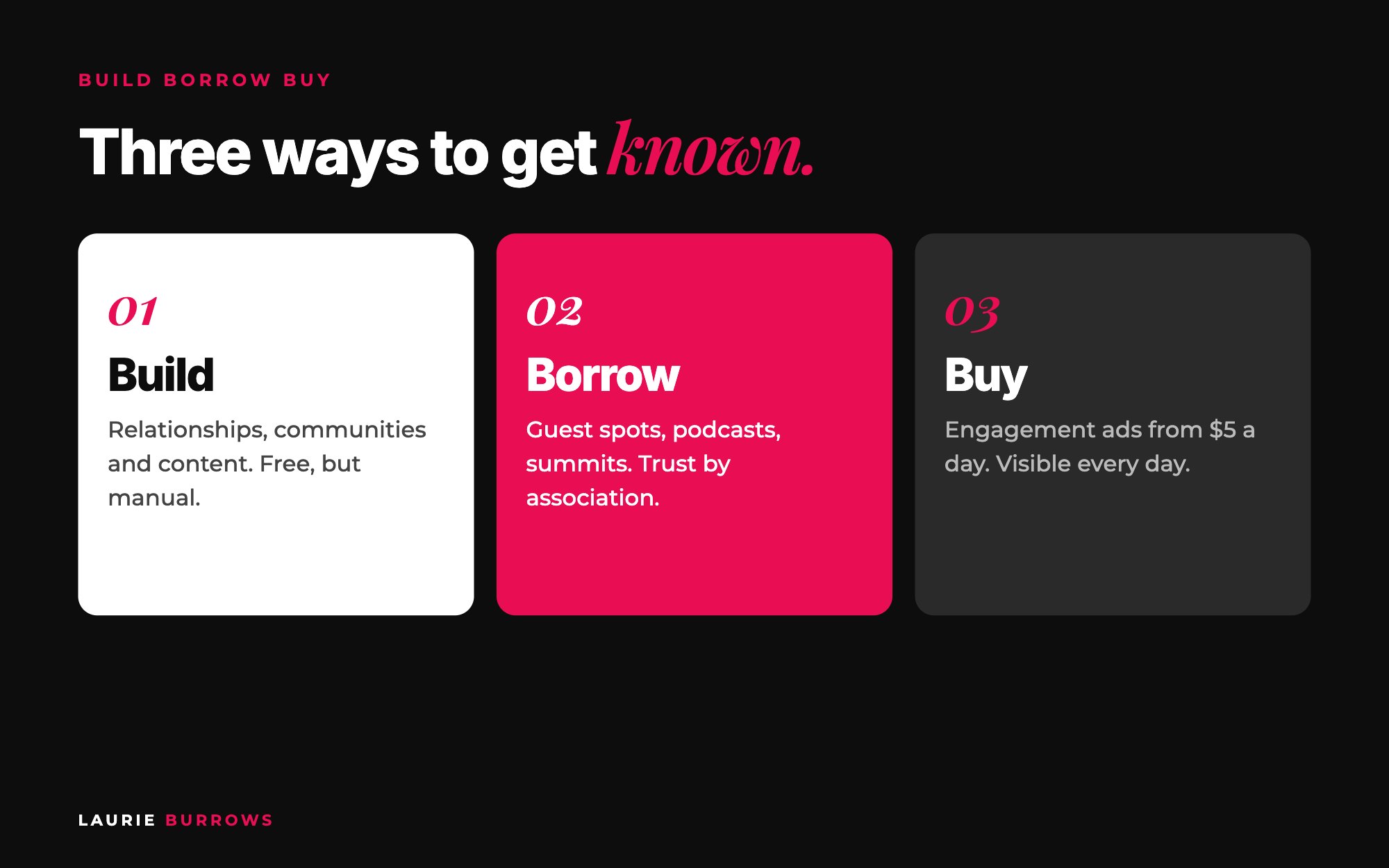
Build: grow your own audience (about 20 minutes a day)
Relationships. Your network really is your net worth. In my first year, I joined a mastermind that cost around $20,000 at the time. In all honesty, I didn't learn much I didn't already know. But I stayed for a second year, because the relationships I built in that room turned into clients and referrals that brought in more than the investment every year. You don't need an expensive mastermind. You do need to be an active member of the communities you're already in.
Communities. When I started, I spent time in an online community for a software platform where people were always asking questions about funnels, sales and marketing. I'd answer them properly. People clicked through to my profile, saw my content and came into my world. Find where your ideal clients hang out and be the most helpful person in the room.
- List every programme, membership, mastermind and community you're in, paid or free. If you're in none, ask AI for a list of communities your ideal clients are likely to be in, then join three.
- Every day: answer three questions properly, post once, and engage with 10 to 20 ideal clients.
- Every week: attend at least one call or event in those communities and introduce yourself.
Social media. Platforms behave differently. Facebook tends to show your posts to people who already know you. If I was starting from zero today, I'd lean into the places that reach new people, like TikTok and Instagram trial reels (reels that go out to non-followers first). Get on video. In a world where AI can churn out 100 posts an hour, people want to connect with a real person.
Borrow: get in front of other people's audiences (one spot a week)
This is my favourite, because of something I call trust by association. When someone invites you to speak to their audience, that audience already trusts them, and they know the host wouldn't bring just anyone in front of them. So they start trusting you quickly. Guest speaking is one of the reasons I was able to grow my business so quickly.
- Guest speaking in other people's programmes, memberships, masterminds and events.
- Podcasts. There are groups and websites full of hosts looking for guests. Your story often gets you booked, not the size of your audience.
- Summits and virtual events, as a speaker or the host.
- Affiliates and launch partners who promote your free event to their audience.
How do you find these opportunities? Ask. If you don't ask, you don't get. More on how in guest speaking: how to use other people's audiences.
Copy and paste: guest spot pitch
Hi [name], I love what you're doing with [their community or podcast]. I help [who] with [result], and I think your audience would get a lot from a short session on [specific topic, e.g. "how to get your first 5 clients without a big following"].
It would be completely free, I'd keep it really practical with one action step they can do the same day, and I'd share a free [guide or training] with them afterwards. Would that be helpful for your members? Happy to fit around you.
Buy: small, smart ads (only once money is coming in)
Buying an audience simply means paid ads. If I was starting from zero with no budget, I'd focus on build and borrow first. I didn't run a single ad until my second year. As soon as money is coming in, add the $5 a Day Ads Strategy (method 12 below), because ads get you visible every single day without the manual work.
Phase 3: The 12 ways to turn visibility into paying clients
This is the part most guides skip. Visibility gets people to notice you. These methods turn the people who notice you into leads, conversations and clients. You don't need all 12. Pick three to start (I'd choose 1, 2 and 4 if you have under 1,000 followers), then add more as you grow.
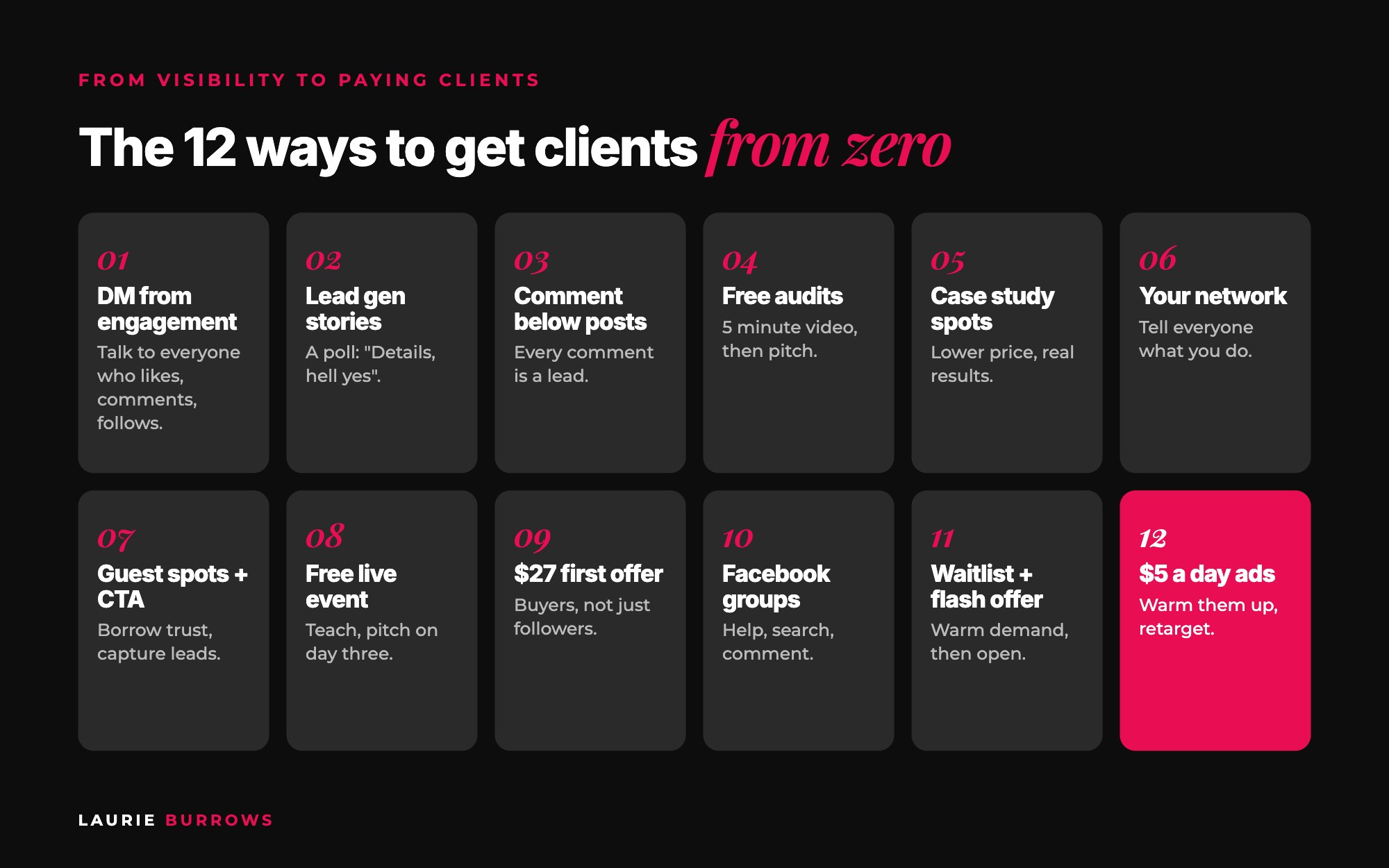
1. DM conversations from engagement
Every like, comment, new follower, story reply and poll vote is someone raising their hand a little bit. Most people ignore them. Don't. When I was growing my business as a new mum, I didn't have time for lots of sales calls, so I opened up my DMs instead: if you have a question, come and message me. My conversion rate went up when I offered conversations in the DMs rather than just sending people to a sales page.
- Every day, open your notifications and list everyone who engaged in the last 24 hours who looks like an ideal client.
- Send a short, genuine message about the thing they engaged with. No pitch.
- Ask one question about where they are now.
- Add them to your tracker.
Copy and paste: engagement DM
Hey [name], thank you so much for [commenting on / sharing / following] my post about [topic]. Really appreciate it.
Out of curiosity, is [topic] something you're working on in your business at the moment?
Target: 5 new conversations a day. Time: 15 minutes.
2. Lead generation stories
A lot of people watch your content and are interested in working with you, but you don't know they're there because they never engage. Lead generation stories pull these warm, quiet people out. You upload an image or a short video, put a line of text over it, and add a poll. Anyone who votes is a potential lead.
The poll options are always a positive and a positive. Never give people the option to say no. If they're not interested, they'll just scroll on by. You can be direct ("who wants to work with me for a year for $997?") or talk to the end result ("I'm looking for three people who want to get to $10k months in the next 90 days. Is that you?"). Test different wording and keep what works. I break this down in how to make money this week.
Copy and paste: lead generation story
Story text: I'm opening 5 case study spots for [who] who want [result] in the next [timeframe]. Is that you?
Poll options: "Details please!" / "Hell yes, send them to me"
Follow up DM: Hi [name], you voted on my poll about [result]! Tell me a little bit more about where you're at in your business at the moment compared to where you want to be?
Target: one lead generation story every two to three days. Time: 5 minutes to post, 20 minutes to DM every voter.
3. Comment below (ladder) posts
This is the feed version of the story. You write a short post offering something (a free guide, a free training, a case study spot, early bird access) and ask people to comment a word. It's called a ladder post because the comments stack up, and the more people comment, the more the post reaches other people. Every person who comments is a lead you can now talk to.
Copy and paste: comment below post
I'm looking for 5 people who want to [result] in the next 90 days for my case study programme.
You'll get [what they get] at a much lower rate than it will ever be again, and in return I'd love your feedback and a testimonial if you get results.
Want the details? Comment "ME" below and I'll message you.
A free version works just as well: "I've created a free guide that walks you through [result]. Comment GUIDE below if you want it." Then DM everyone the link plus your "where are you now" question.
Target: one comment below post a week. Done when: every commenter has a DM and is in your tracker.
4. Free audits
An audit is when you look at someone's marketing (or whatever your expertise is) and give them feedback on how to improve it. Content audits, social media audits, funnel audits, website audits, ad audits, money audits, pretty much anything can be audited. The key: only audit the thing your paid offer fixes. If you build websites, don't offer social media audits.
- Promote it: "I'm offering 10 free [type] audits this week. Comment AUDIT or DM me the word AUDIT." Get people commenting, voting or DMing so you can see who they are.
- Qualify in the DMs: "Tell me a bit more about where you are compared to where you want to be, so I can make sure this audit is right for you." If they're not a fit, send them a free training instead.
- Send a short form asking where they're at, where they want to be and what they're struggling with. This doubles as brilliant market research.
- Record a five minute video audit (screen share, your face on). Give a few tips and one action step. If they implement and see it work, instant trust.
- Pitch at the end, tailored to what they wrote in the form, with a bonus if they sign up within 24 hours.
- Follow up.
I prefer live calls or video over written audits. Written is quicker, but you can't show your personality or your excitement, and it's much harder to pitch. A group version also works brilliantly: get everyone on one Zoom, audit a few live, teach the lessons, then pitch to the whole room. Talk about time saved and return on investment, because that's why people hire you instead of doing it themselves. The full process is in the free audit strategy.
Copy and paste: audit pitch (end of video)
So [name], those are the three things I'd fix first. If you do just the first one this week, you should notice [quick win].
You told me you want [their goal] and you're struggling with [their struggle]. That's exactly what my [offer] does. Over [timeframe] we'll [outcome 1], [outcome 2] and fix [their struggle], so you're not doing it all on your own.
If you join in the next 24 hours I'll also give you [bonus]. Want me to send you the details?
Target: 5 to 10 audits a week. Time: about 10 minutes each.
5. Case study spots
When I first started, I didn't have screenshots of clients celebrating big months. So I became my own evidence, and I would do everything I could to get evidence fast. Taking on case study clients at a lower rate (or even free to begin with) gets you paying clients now and testimonials for later.
- Decide how many spots (3 to 5) and the lower price.
- Be clear on the deal: a lower rate in return for showing up, implementing and giving feedback plus a testimonial if they get results.
- Promote with methods 2 and 3 above.
- Get every case study client a result, and document it (with permission) as evidence based content.
The mistake to avoid: treating case study clients as second class. Over deliver. Their results are going to sell every round after this one.
6. Your existing network and referrals
The fastest first clients usually come from people who already know, like and trust you. Old colleagues, past customers from a previous business, people from courses you've done, your community connections. Most people never tell their network what they now do.
- Write a list of 50 people you know. Not to sell to them, but to tell them what you do.
- Message 10 a day for five days.
- Ask two things: is this something you need, and do you know anyone who does?
Copy and paste: network message
Hey [name], hope you're well! Quick one: I've started helping [who] get [result], and I'm taking on a few clients at a lower rate while I build my case studies.
Is that something you'd ever want help with? And if not, is there anyone you know who'd love this? No pressure at all, I'd just really appreciate it.
And once you have clients, look after them. It is easier to sell to current clients than to attract new ones. Clients who get an incredible experience stay, buy again and refer.
7. Guest spots with a call to action
A guest spot without a next step is a nice chat. A guest spot with a next step is a client getting machine. When I speak on stages, I don't just speak. I have a plan for how that audience becomes clients. A 20 to 40 minute talk isn't always enough to take a cold audience to buying a four figure offer, so I invite them into something that gives them more time with me (a free resource, a free live training, a taster day).
- Teach one thing really well, with one quick win.
- Tell your story, briefly.
- End with one clear call to action: "DM me the word [WORD]" or "grab the free [resource] at [link]".
- DM every person who responds with your "where are you now" question.
Copy and paste: guest spot call to action
If this was helpful and you want the next step, I've put together a free [resource or training] that shows you exactly how to [result]. Just DM me the word [WORD] on Instagram and I'll send it straight over.
8. A free live training or 5 day experience
This is where I make most of my sales, and it works from zero too. A free live training (a masterclass, a challenge, a workshop, I call them virtual events because they have 100 different names) gives people enough time with you to trust you, and anyone who signs up is a lead. People who show up live buy far more: I've seen 25% of live attendees buy compared with 2.5% overall. And I pitch on day three of a multi day event, not at the very end.
- Pick a topic that leads naturally to your paid offer.
- Use Lead Mapping to work out how many sign ups you need, then map exactly where they'll come from (stories, comment below posts, communities, guest spots, your network).
- Before the event, DM everyone who signs up a reminder, not a pitch.
- Teach, give them an aha moment, then pitch.
- Offer a "stay until the end" gift they get by DMing you a word. Now they're in your DMs after hearing your pitch.
- Ask: "Will you be joining us inside [offer]?"
Copy and paste: event reminder DM
Hi [name], so excited to see you've joined [event name]! Just a quick reminder, day one is at [time]. Will you be joining us live?
Copy and paste: after the event DM
Hi [name], here's your gift! So glad you stayed until the end. Will you be joining us inside [offer]?
You can go deeper with how to run a 5 day challenge that sells. And if the setup is what's stopping you, the Launch Manager inside Ascendia OS plans the event from first email to cart close, and the Funnel Builder builds your sign-up page and thank you page for you.
9. A $27 first offer
Someone who buys from you once is far more likely to buy again. A low priced offer (around $27) turns followers into buyers fast. I call it a first time conversion offer. Put it on your free resource thank you page, promote it with ladder posts ("You and me working together for 21 days for just $21" is the kind of thing that works), and add an $11 order bump so the average order becomes $38. Then use what they bought to sell into your core offer.
- It must solve one small, specific problem quickly.
- It must lead naturally to your bigger offer.
- Aim for 8 to 10% of opt ins to buy it from the thank you page, and 70 to 80% of buyers to take the bump.
More in free resource or $27 offer.
10. Facebook groups and communities
Two ways to use groups. The first is method one of Build: be the most helpful person there. The second is a quick, daily search. In busy groups, people post asking for help ("looking for a copywriter", "anyone recommend a launch expert?"). Search the group for your keywords, sort by most recent, and reply.
It's competitive, so your comment must stand out: why should they hire you, and what results can you help them get? Lead with a result, explain the service in a sentence, invite a DM. The bonus is that other people read those comments too, and some of them will reach out even though they never posted. This isn't my favourite method for consistency, but it's ten minutes a day that can land you a client this week. More in how to get a client from a Facebook group.
Copy and paste: group reply
Hey [name]! This is exactly what I do. I help [who] [result], most recently [a specific, true outcome of your own work]. Happy to share a couple of ideas for your situation. I'll drop you a message!
11. A waitlist and a flash offer
If you're not ready to open your offer, open a waitlist. Post about what's coming, ask people to comment or DM "WAITLIST", and talk to everyone who does. When you open, waitlist people get first access or a bonus. Then, as your email list grows, a flash offer becomes one of your quickest cash injections: a short, time limited deal to your list and socials (a bundle, 50% off, or credit you can spend with your business at a discount). Every time we send a flash offer to our email list, we make a minimum of four figures. Don't run them too often, or people wait for the deal.
Copy and paste: waitlist post
Something new is coming. In [month], I'm opening [offer] for [who] who want [result].
Waitlist gets first access and [bonus]. Comment WAITLIST and I'll add you and send you the details first.
12. $5 a day ads to warm people up, then retarget
Once you have a little budget, this is the one that keeps you visible every day without the manual work. Record a handful of valuable talking head videos (90 seconds to a few minutes) with strong hooks, each giving an aha moment or an action step. Run them as engagement ads to a cold audience from around $5 a day. Every week, turn off what isn't working, keep what is and test new hooks. Then, when you have a free resource or event to promote, target the people who watched at least 25% of your videos instead of sending cold traffic straight to an opt in page. The full breakdown is in the $5 a day ads strategy.
Do this now: pick three of the 12 methods above and put them in your diary for this week. If you have under 1,000 followers, start with DM conversations from engagement, lead generation stories and free audits.
Phase 4: Have the conversation, pitch and follow up
Every method above ends in the same place: a conversation. These conversations don't have to be sales calls. They can happen in the DMs, which is how I sold most of my offers when I had a toddler and no time for calls. Here's the structure I use every time.
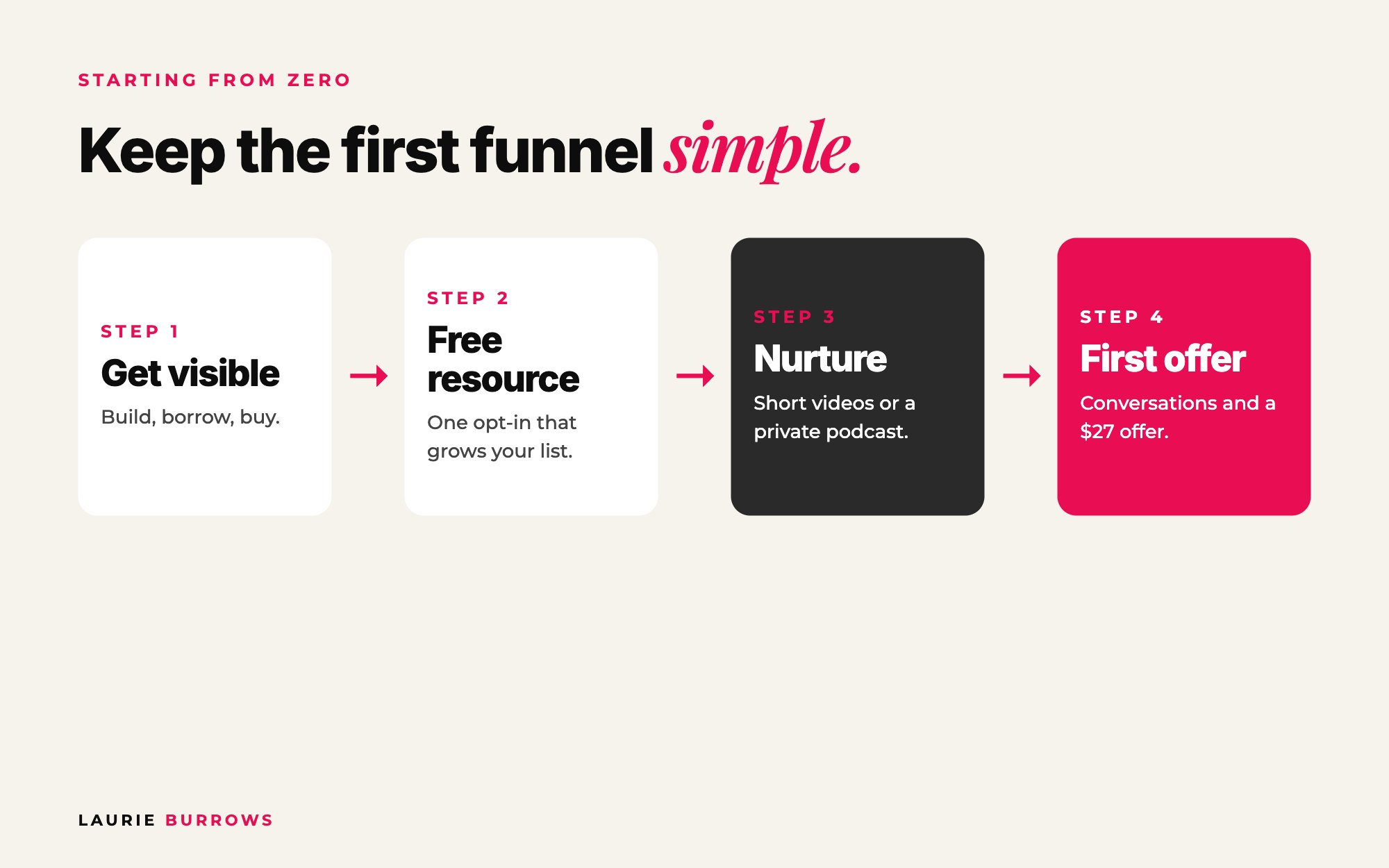
Step 1: Open with what they did
"Hi [name], you voted on my poll about [topic]" or "you commented on my post about my free audit". It reminds them why you're there and it isn't cold.
Step 2: Ask where they are compared with where they want to be
I love this question because it qualifies them and they almost always tell you their struggles too. If they don't, ask a follow up: "What do you feel is getting in the way right now?"
Step 3: Tailor the pitch to their words
Use the result they want and the struggles they told you. "My programme is perfect for you, [name], because it's going to help you [their result], and we're also going to cover [their struggle], which you said is the thing holding you back."
Step 4: Ask if they're ready, and handle the answer
They'll say yes (brilliant, send the link), yes, but (now they've told you their objection, so help with it), or no. Even when it's a no, always ask why. It's great feedback, and sometimes it turns into a yes. See how to handle the 5 most common sales objections.
Copy and paste: full DM conversation
You: Hi [name], you voted on my poll about getting your first clients! Tell me a bit more about where you're at in your business at the moment compared to where you want to be?
Them: [tells you]
You: Thank you for sharing that. And what do you feel is the biggest thing getting in the way right now?
Them: [struggle]
You: That makes total sense, and it's so common. Honestly, my [offer] would be perfect for you, because it's designed to help you [their result], and we specifically work on [their struggle]. It's [format and length], and [one line on what makes it different]. Would you like me to send you the details?
If no: Totally fine! Can I ask why? It's really helpful feedback for me.
Step 5: Follow up until you get an answer
People need reminding. You will make a majority of your sales by following up, and something like 80% of conversions happen on the fifth follow up. Most people stop after one. Put a follow up date in your tracker for every lead.
Copy and paste: follow up sequence
Day 2: Hey [name], just floating this back up in case it got buried! Did you get a chance to look at the details?
Day 4: Hi [name], I was thinking about what you said about [struggle]. Here's a quick tip that might help: [one tip]. Any questions about [offer]?
Day 7: Hey [name], a quick heads up that [bonus or price] ends on [date]. Want me to save you a spot?
Day 10: Hi [name], no pressure at all. Is now just not the right time, or is there something I can answer for you?
Day 30: Hey [name], how are things going with [their goal]? I'm opening [next offer or spots] soon and thought of you.
And go back to old leads. Look at what people were previously interested in and message them with an exclusive offer. It's one of the quickest wins there is.
Worked example: a business coach selling a $997 programme
Example (illustrative numbers): a new business coach with 400 Instagram followers, no email list, no testimonials. Offer: a 60 day case study programme at $997 for new coaches who want their first clients. Goal: 4 clients in 30 days, so about $4,000.
The maths. Use Lead Mapping: start with the goal and work backwards. On average about 3% of leads buy, which is why I say you need 333 leads for 10 sales. For a free live training, 4 sales at 3% means roughly 133 sign ups. That's a lot from 400 followers, so this coach leans on DM conversations, which convert much higher than cold opt ins because they're personal. Track your own numbers; these are just starting assumptions.
| Activity (30 days) | Daily or weekly target | Leads or conversations |
|---|---|---|
| DM conversations from engagement | 5 a day, 25 days | 125 conversations |
| Lead generation stories | 10 stories, about 6 voters each | 60 leads |
| Comment below posts | 4 posts, about 8 comments each | 32 leads |
| Free audits | 5 a week for 3 weeks | 15 audits, each with a pitch |
| Network messages | 50 people over 5 days | 50 conversations |
| Guest spot | 1 community training | 20 to 30 leads |
| Free live training (week 3) | Fed by everything above | 60 to 100 sign ups |
From roughly 300 conversations and leads, if one in ten becomes a proper sales conversation and one in four of those says yes after follow up, that's 7 to 8 clients. Even at half that, our coach hits the goal. The point isn't the exact numbers. The point is that when you know the numbers, you stop guessing and hoping. Guessing and hoping isn't a strategy.
The actual story she posts on day 3: a selfie video saying "I'm opening 4 case study spots for new coaches who want their first 5 clients in 60 days. Is that you?" with the poll "Details please!" / "Hell yes". Eight people vote. She DMs all eight that afternoon with the "where are you now" question. Five reply. Two are a fit. She sends the details to both. One says yes on day five. One says "yes, but I'm worried about time", so she shows her how the programme fits into 20 minute days, and she joins on day nine after the third follow up.
That's how clients from zero actually happens. Not one viral post. Lots of small, deliberate conversations.
Your 30 day first clients plan
Here's exactly what I'd do for the next 30 days if I was starting from zero. It assumes about 60 to 90 minutes a day. If you have less, halve the targets, but don't skip the conversations.
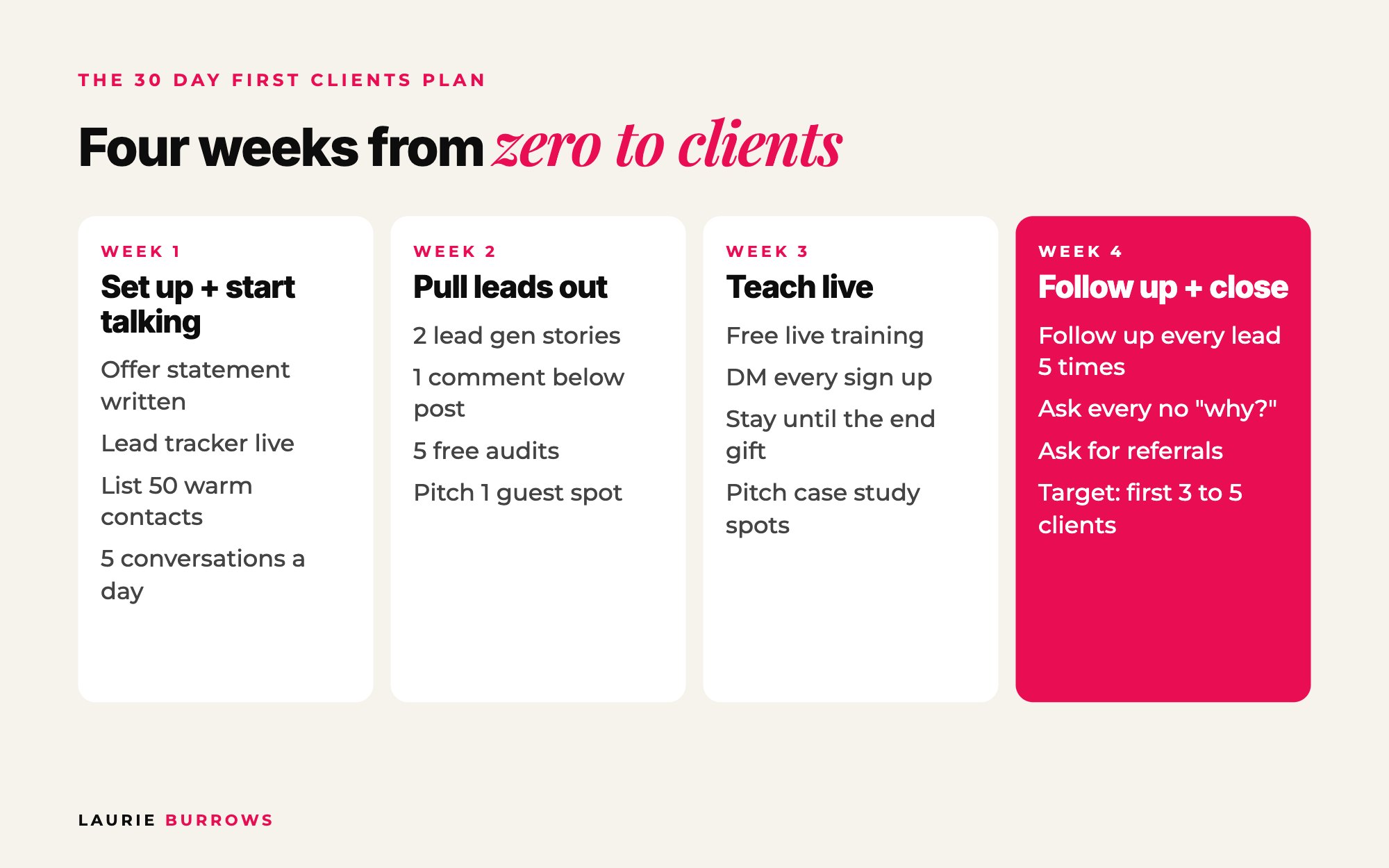
| Days | Daily actions | Targets by the end |
|---|---|---|
| 1 to 3 | Write your offer sentence. Set up your tracker. Fix your bio, link and pinned posts. List 50 people in your network and 10 communities. | Offer, tracker and profile done. Joined 3 communities. |
| 4 to 7 | Message 10 network contacts a day. 5 engagement DMs a day. 20 minutes in communities. Post one lead generation story. | 50 network messages sent. 20 conversations started. |
| 8 to 14 | Post 2 lead generation stories and 1 comment below post. Offer 5 free audits. Pitch 3 guest spots. Keep 5 DMs a day. | 30 new leads in your tracker. 5 audits delivered with a pitch. 1 guest spot booked. |
| 15 to 21 | Promote and run a free live training. DM every sign up a reminder. Use the stay until the end gift. Pitch your case study spots. | 30+ sign ups. Every attendee in the DMs. First 1 to 2 clients. |
| 22 to 28 | Follow up every lead (day 2, 4, 7, 10). Ask every no "why?". Ask new clients for referrals. Deliver your guest spot with a call to action. | Every lead followed up at least 3 times. 3 to 5 clients. |
| 29 to 30 | Review: which method brought the most conversations and sales? Do more of that next month. Start documenting client results. | A repeatable plan for month two. |
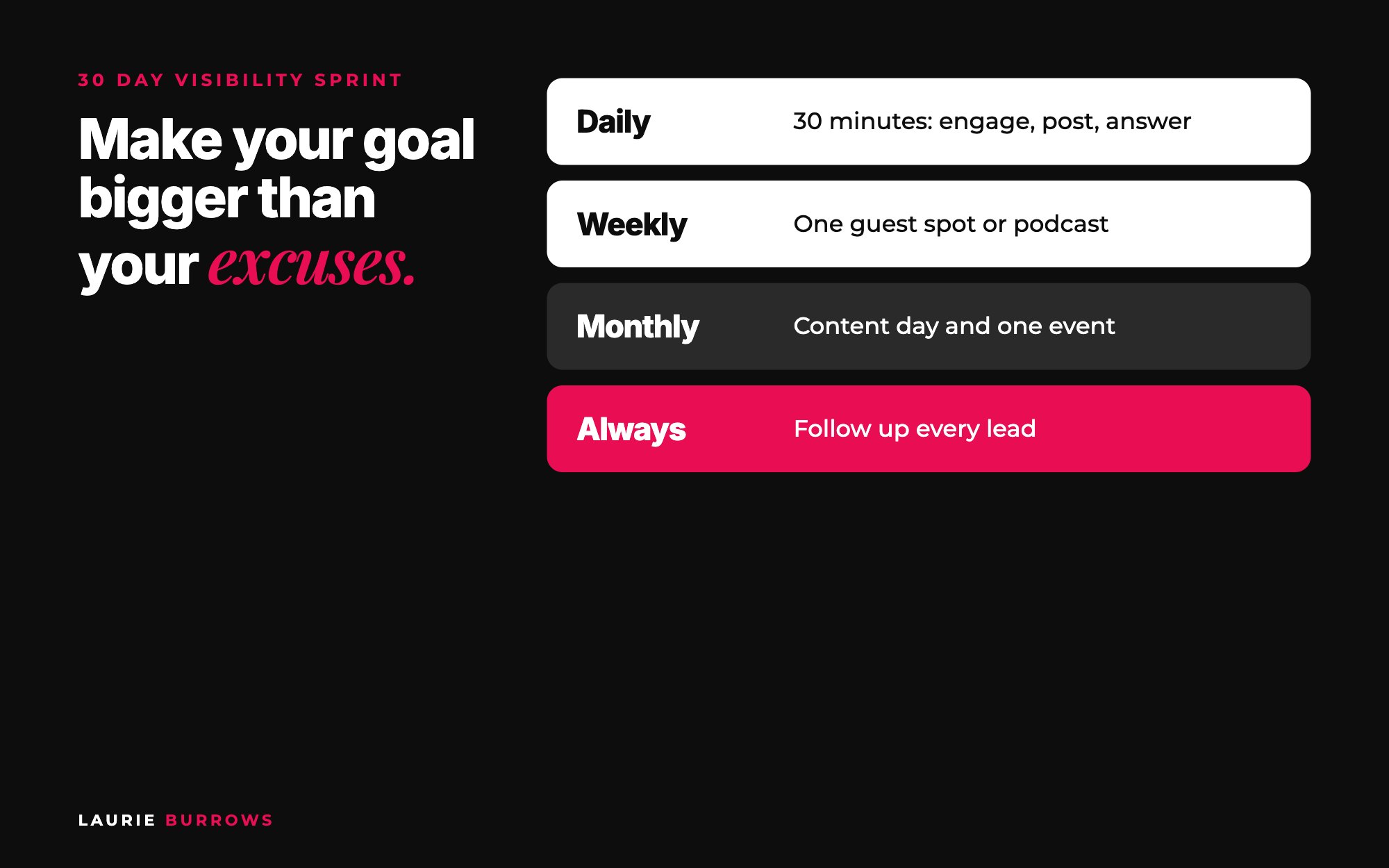
Treat this like a 30 day visibility and sales sprint. Go all in, above everything else. Make your goal bigger than your excuses. You won't have to work this way forever, but right now, if you're starting from zero or turning things around, this is what it takes.
How do I fit all this in?
People always ask me how I do it all as a single mum running multiple businesses. The answer is structure. Even before I had a team, before AI, I looked at the goal, broke down what had to happen to hit it, and time blocked it. When my little boy napped in that first year, I didn't nap. I worked. I got done in about 15 hours a week what takes a lot of people 40.
- Daily (60 minutes): 20 minutes in communities and engaging, 20 minutes of DMs and follow ups, 20 minutes posting content or a lead generation story.
- Weekly: one guest spot or podcast, one comment below post, one batch of audits.
- Monthly: one content day, one free live training, one review of your tracker.
What mistakes should I avoid when starting from zero?
- Relying on content alone. Fix: add at least one borrow activity a week and one lead generation activity a day.
- Getting visible but never asking for anything. Fix: every piece of visibility needs a next step (comment, vote, DM a word, opt in).
- Not tracking leads. Fix: the tracker, today. If they're not on it, you'll forget them.
- Pitching before you know their struggle. Fix: always ask "where are you vs where you want to be" first.
- Following up once. Fix: five follow ups, scheduled in your tracker.
- Building a complicated funnel too early. Fix: one offer, one free resource, conversations. Build the funnel once people are coming through.
- Spending on ads before anything works. Fix: build and borrow first, then use ads to amplify what's already working.
- Doing visibility in bursts. Fix: 30 to 60 minutes every day beats a frantic three days and then nothing.
Troubleshooting: if it's not working, check this
| If this is happening | Check this first |
|---|---|
| Nobody engages with your posts | Your hooks and your visibility. Are new people seeing you at all? Add communities and one guest spot a week before you blame the content. |
| People engage, but nobody votes, comments or DMs | You're not asking. Every post and story needs one clear action. Try a direct lead generation story with a positive/positive poll. |
| You get leads but conversations die | Your first message. Is it a pitch? Lead with what they did plus the "where are you now" question. |
| Conversations happen but nobody buys | Your offer and your pitch. Is the result clear, different and worth more than the price? Are you using their words? Read why is no one buying my offer. |
| People say "yes, but" | That's an objection, not a no. Answer it directly (time, money, "will it work for me"). |
| People say "not now" | Ask why, add them to your follow up list, offer the $27 first offer or a free training to keep them warm. |
| You run out of people to talk to | Your borrow activity. Book more guest spots and podcasts, and run a free live training to fill your tracker. |
| You're exhausted | Your plan. Drop to two methods you enjoy, time block 60 minutes a day, and stop everything else. |
Your action plan
Today
- Write your one sentence offer.
- Set up your lead tracker and add everyone who has ever shown interest.
- Fix your bio, link and three pinned posts.
- Send five engagement DMs.
This week
- Message 50 people in your network (10 a day).
- Join three communities and answer three questions a day.
- Post one lead generation story and one comment below post.
- Offer five free audits.
- Pitch three guest spots using the template above.
Next 30 days
- Run the 30 day first clients plan.
- Host one free live training and DM every attendee.
- Follow up every lead at least five times.
- Document every client result as evidence based content.
- Review which method worked best, then double it next month.
Once your first clients are in, the next job is making it consistent, so you're not starting from zero every month. That's what my content system is for: turning the content you post into a steady stream of leads, conversations and sales. If you'd rather grab something free first, have a look at my free resources.
Want the full system for turning content into clients?
Content To Clients® is my complete system for turning your content into repeat sales: the content, the lead generation, the DM conversations and the funnel behind it, with every tool and template I use.
Rather have it done for you?
Your first clients, with an AI marketing team behind you
Inside Ascendia OS, the Strategist maps how many leads and sales you need, the Content Creator plans and schedules your posts, the Launch Manager sets up your free live training, and the Funnel Builder builds the pages, all tracked in one CRM. 14 days free, no tech skills needed.
Frequently asked questions
How do I get my first coaching client?
Tell your existing network what you do, and start conversations with everyone who engages with you. Offering three to five case study spots at a lower rate, promoted with a lead generation story or a comment below post, is one of the fastest ways to get your first paying clients and your first results.
Do I need a big audience to get clients?
No. Conversations matter far more than follower count. Five real conversations a day, plus borrowing other people's audiences through guest spots and podcasts, will get you clients even with a tiny audience.
How many leads do I need to get clients?
On average about 3% of leads buy, which is why I work on 333 leads for every 10 sales. DM conversations usually convert higher because they're personal. Use Lead Mapping to work out your own number and where each lead will come from.
Should I do sales calls or sell in the DMs?
Either works. I've sold most of my offers through DM conversations because I didn't have time for lots of calls as a new mum, and my conversion rate went up when I opened my DMs. Use calls for higher priced offers if you enjoy them.
How often should I follow up?
At least five times. You will make most of your sales by following up, and most people stop after one message. Schedule follow ups on day 2, 4, 7, 10 and 30.
Should I run ads when I'm starting out?
Only once you have a little budget. Start with build and borrow, then add small engagement ads from around $5 a day to stay visible and retarget the people who watched your videos.
What if I feel awkward selling?
Lead with questions, not pitches. When you ask where someone is and what they're struggling with, the pitch becomes a helpful answer to what they told you, not a hard sell.
How long does it take to get clients from zero?
It depends on how hard you go at visibility and conversations. Run the 30 day first clients plan properly and most people have their first clients within the month. The more consistently you show up, the faster it comes.
Laurie Burrows is a revenue growth strategist for coaches, consultants and online service providers, with 15 years of experience in marketing and sales and a business that's generated multi-seven figures in sales. She's the founder of Ascendia OS.
Do you want to scale your business to 10K months in the next 90 days? I am looking for 10 people for my new case study program. DM me the word CASE STUDY on Instagram (@_laurieburrows) to learn more.