The Ultimate Guide to Getting Clients With AI
Short answer: to get clients with AI, use it in two ways. First, make sure AI can find you and recommend you, because people now ask ChatGPT, Google's AI Mode and Perplexity who to hire. That means a clear website, the same description of what you do everywhere, real proof and other people talking about you. Second, use AI to do the work that gets clients: plan and create content in minutes, start more conversations, follow up properly and handle objections. AI won't build relationships or make decisions for you. It gives you back the hours so you can do more of the things that actually sell.
By Laurie Burrows, marketing and sales strategist. Last updated Thursday 15th October 2026.
I've spent 15 years in marketing and sales, and I've built a business that's generated multi-seven figures in sales. In that time I've watched Facebook ads change everything, then Instagram, then Reels. AI is the biggest shift I've seen, and it's changing two things at once: how clients find you, and how much time it takes you to get in front of them.
Most of the advice out there only covers one side. You either get "50 ChatGPT prompts for coaches" or a technical lecture on schema markup. This guide puts both together into one system you can actually follow, whether you're starting from zero or you've been in business for years.
Who is this guide for, and what will you have by the end?
This is for coaches, consultants, course creators and online service providers who sell their expertise. If you sell 1:1, group programmes, done for you services or courses, it's for you.
By the end you'll have:
- A clear picture of how AI is changing the way people find and choose who to work with.
- A five part system for getting clients with AI, from being found to making the sale.
- A website and visibility checklist so AI search can understand and recommend you.
- A content process that gets a month of posts done in one sitting, in your voice.
- Prompts you can copy for content, DMs, follow up and objections.
- A 30 day plan to put it all into action.
In this guide
- What does getting clients with AI actually mean?
- Why this matters right now
- The AI client system: five parts
- Part 1: Get found in AI search
- Part 2: Get chosen
- Part 3: Show up with content made in minutes
- Part 4: Turn attention into conversations
- Part 5: Use AI to make the sale
- What AI can't do for you
- Your 30 day plan
- The mistakes to avoid
- Frequently asked questions
What does getting clients with AI actually mean?
When people say "get clients with AI", they usually mean one of two very different things. You need both.
1. AI as the place people find you
People are asking AI tools for recommendations the same way they used to type into Google. "Who's a good business coach for mums?" "What's the best way to get more clients on Instagram?" "Recommend a copywriter for course launches." The AI answers with a short list of names, or a summary with a few links. If you're not in that answer, you don't exist for that person.
This is what people call AI search, or sometimes GEO (generative engine optimisation) or AEO (answer engine optimisation). I've broken it down properly in What Is AI Search?.
2. AI as the tool that does the client getting work
Getting clients takes a lot of work that isn't really selling: planning content, writing captions, scripting videos, writing emails, replying to DMs, following up, writing sales pages. AI can do the first draft of nearly all of it, in your voice, in minutes. That frees you up for the part that actually brings in money, which is real conversations with real people.
The simple version
AI search gets you found. AI tools get you time. You use the time to have more conversations, and conversations turn into clients.
Why this matters right now
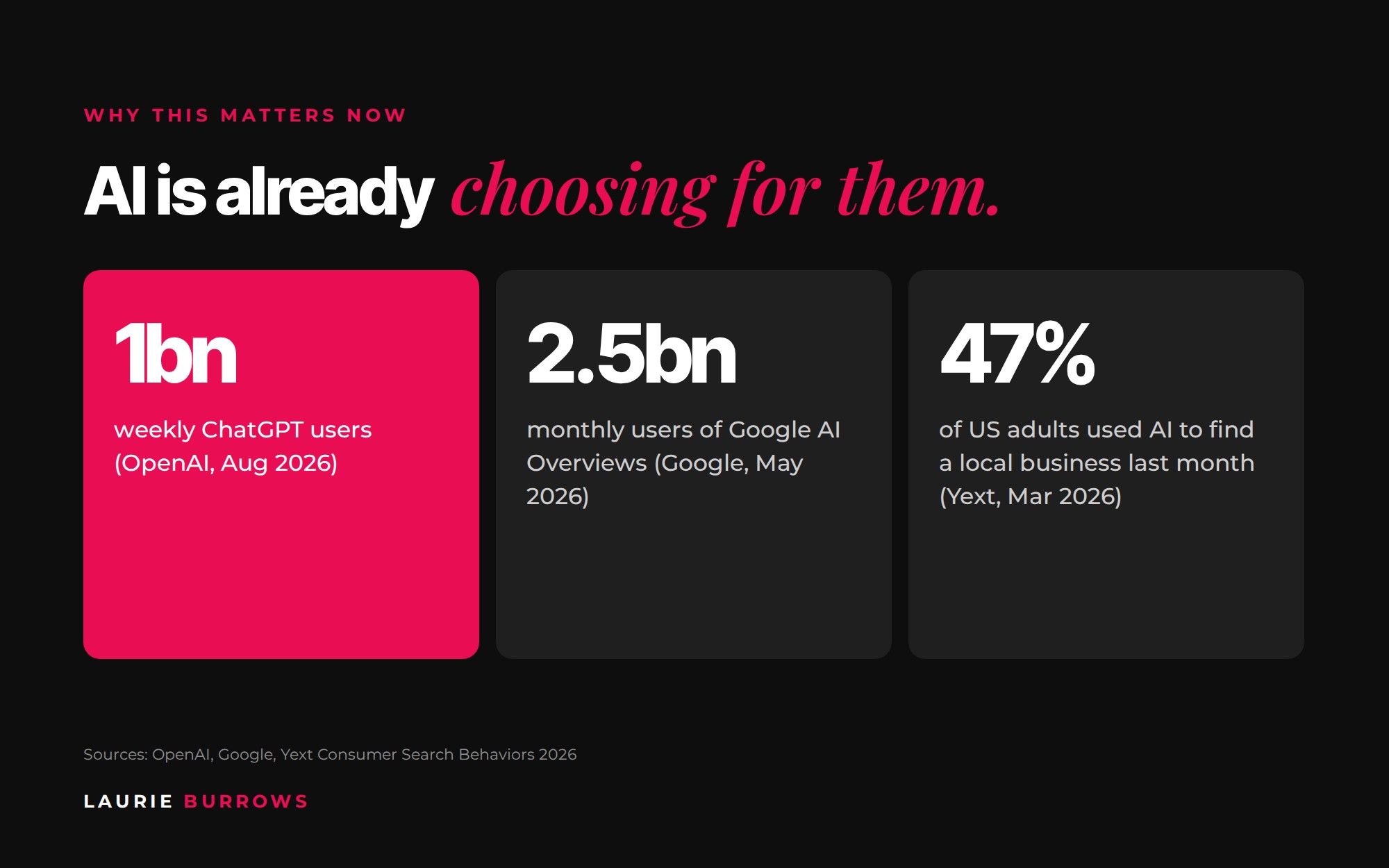
This isn't a "maybe in five years" thing. Here's where we are:
- OpenAI said in August 2026 that ChatGPT had reached 1 billion weekly users. (source)
- Google says AI Overviews reach more than 2.5 billion people a month, and its AI Mode passed 1 billion monthly users in July 2026. (source)
- In a March 2026 survey by Yext, 47% of US adults said they'd used AI to find a local business in the past month. (source)
- When Google shows an AI summary, people click a normal search result far less often: 8% of the time versus 15% without one, according to Pew Research Center. (source)
Two things jump out at me from this. First, fewer people are scrolling through ten blue links and clicking around. The AI gives them a shortlist, and they choose from it. Second, people still check. In that same Yext survey, 58% visited the business's website after an AI recommendation and only 7% acted without doing any more research. So your website and your proof still matter. They matter more, actually, because they're what the AI reads and what the person checks.
The good news? Most coaches and service providers haven't done anything about this yet. That's your window.
The AI client system: five parts
Here's the system I use and teach. Each part feeds the next one.
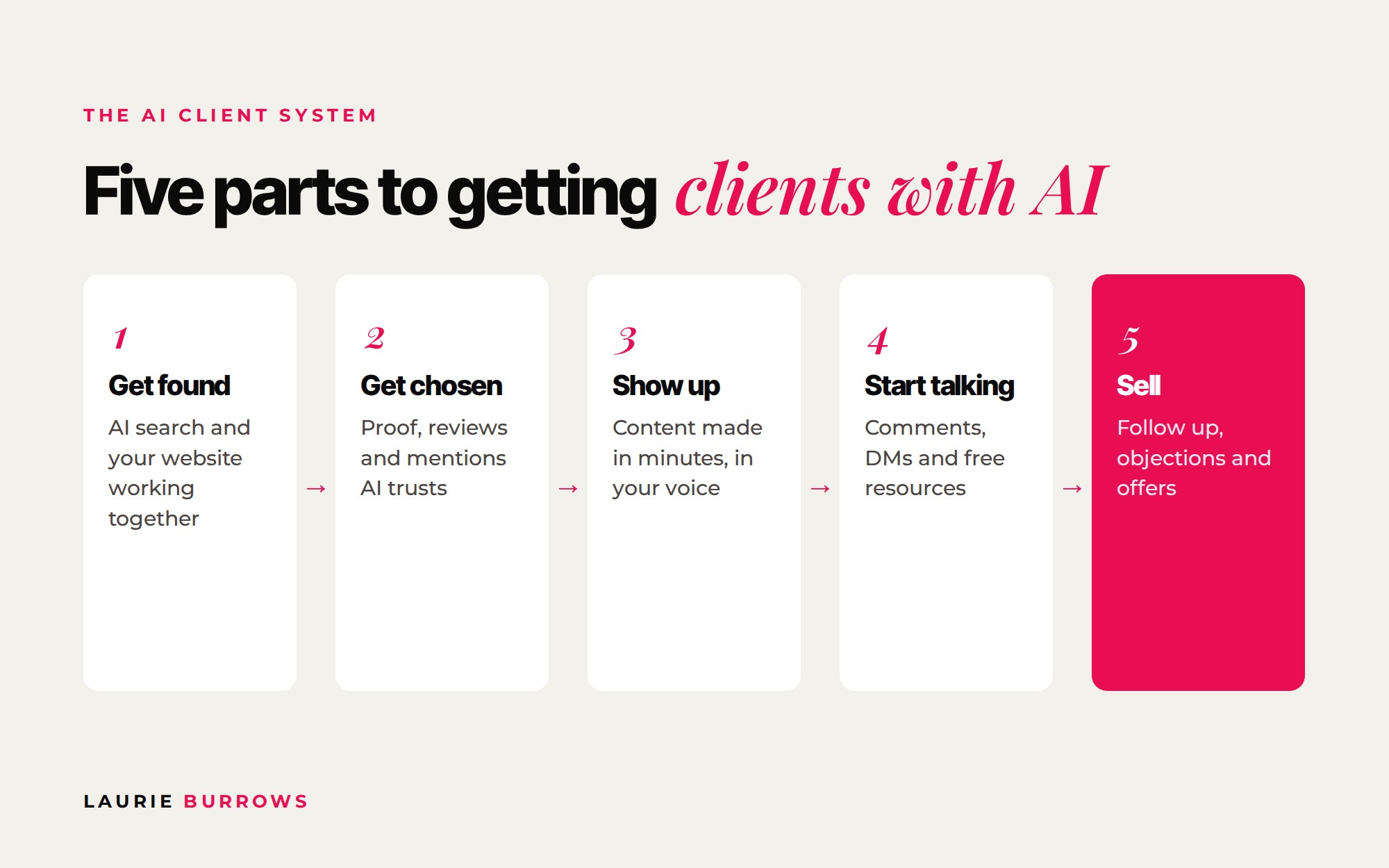
- Get found. Make it easy for AI search and Google to understand who you help, what you do and why you're credible.
- Get chosen. Build the proof and mentions that make AI (and people) trust you over the next person.
- Show up. Use AI to create content in minutes, in your voice, so you're visible every single day.
- Start talking. Turn attention into real conversations with DMs, comments and free resources.
- Sell. Use AI to follow up, handle objections and write the pages and emails that close the sale.
Part 1: Get found in AI search
AI tools build their answers from what's already out there about you: your website, your social profiles, articles, podcast pages, reviews, directories and anywhere else you're mentioned. If that information is unclear, patchy or contradictory, the AI either gets you wrong or leaves you out.
Step 1: Check what AI says about you right now
Open ChatGPT, Gemini and Perplexity and ask them a few questions. Ask about you by name, then ask the questions your ideal client would ask, without your name in them.
Prompt to copy
Who is [your name] and what do they help people with? What are they known for?
Prompt to copy
I'm a [your ideal client]. I need help with [the problem you solve]. Who would you recommend, and why?
Write down what comes back. Are you mentioned? Is the description right? Who comes up instead of you? That's your starting point. I walk through this in more detail in How to Get Your Business Recommended by ChatGPT.
Step 2: Say what you do the same way everywhere
This is the one most people miss. If your Instagram bio says "mindset mentor", your website says "business coach" and your LinkedIn says "marketing consultant", AI can't work out what you are. Pick one clear sentence and use it everywhere.
The one sentence formula
I help [who] [get what result] through [how].
For example: "I help coaches and service providers get consistent clients through content, funnels and AI."
Step 3: Make your website easy for AI to read and quote
Your website is still the main thing AI search looks at, and it's where people go to check you out. It needs:
- A clear homepage that says who you help and what you do in the first two lines.
- A page for each service with what it is, who it's for, what's included, how it works and the price or starting price.
- An about page with your experience, your story and why you're credible.
- FAQs written as the real questions people ask, with clear, direct answers.
- A blog that answers the questions your clients are typing into AI.
- Technical basics: fast pages, mobile friendly, proper page titles, and nothing blocking AI crawlers.
I've put the full list into Is Your Website Ready for AI Search? A 12 Point Checklist. If you want to understand how this fits with normal SEO, read AI Search vs SEO.
Free website · Limited spots
Want a website that AI actually recommends?
I'm building a small number of brand new websites for coaches, consultants and service providers, completely free, and fully optimising them for AI search so ChatGPT, Google and Perplexity can find you and recommend you. Want the details? Fill in the form.
Want me to look at your whole business instead? Apply for a free Revenue X-Ray audit →
Step 4: Write content that answers questions
AI tools love content that answers a question clearly and quickly. That's why every guide on my blog starts with a short answer. Write your blogs and FAQs the way you'd answer a client on a call: question first, straight answer next, detail after.
Do this now: write down the ten questions you get asked most in DMs and on sales calls. Each one is a blog post, an FAQ and a piece of content.
Part 2: Get chosen
Being found is one thing. Being the one they choose is another. AI tools are more likely to recommend you when lots of trusted places say good things about you, and people are more likely to buy when they can see proof.
Build proof that AI and people can see
- Reviews and testimonials on your website, written out as text (not just screenshots), with permission from the client.
- Case studies that explain the starting point, what you did and what changed. Only share real results you can back up.
- Your own story and numbers. How long you've been doing this, what you've built, who you've worked with.
Get mentioned in other places
AI tools pay attention to what other people say about you, not just what you say about yourself. Every podcast guest spot, summit talk, collaboration, guest blog and directory listing is another place that confirms who you are.
If you want a plan for this, my guide to guest speaking and other people's audiences and summits and collaborations are a good place to start.
Part 3: Show up with content made in minutes
Content is still how most coaches and service providers get seen, build trust and warm people up. The problem has never been knowing that. It's finding the time.
This is where AI earns its keep. I record myself talking through an idea, the same way I'd voice note someone, and Claude turns it into a carousel, a caption, a talking head script and an email, in my voice. What used to take me a full day now takes under an hour.
How to set it up
- Teach it your voice. Give it examples of your best posts, emails and transcripts, plus a short description of how you speak. I explain how in How I Use Claude Projects to Run My Content.
- Give it your strategy. Your offer, your ideal client, their problems and the objections they have. Content without strategy is just noise.
- Talk, don't type. Voice note your ideas. Your real stories and opinions are what make the content sound like you.
- Batch it. Plan the month, then create it in one sitting. See 30 Pieces of Content in 30 Minutes and How to Plan a Month of Content.
I've written a full walkthrough in How to Use AI to Create Content That Actually Gets Clients. And if you want my exact process step by step, it's all inside The Claude Content Engine.
One rule
Never post anything AI wrote without reading it out loud first. If it doesn't sound like something you'd say, change it. People can tell, and so can your clients.
Part 4: Turn attention into conversations
Followers and views don't pay the bills. Conversations do. Every piece of content should give people an easy next step to start talking to you.
- Comment keywords. "Comment GUIDE and I'll send it to you." Tools like ManyChat can send the link automatically, so nobody falls through the cracks.
- Free resources. A guide, checklist or training that solves one small problem and leads naturally to your offer.
- Stories that ask a question. Polls and question boxes give you a reason to start a DM.
- Replying properly. Every comment and DM is a potential client. Reply like a human, ask a question and move the conversation on.
AI can help you write the free resource, plan the sequence of stories and draft DM replies. What it can't do is care about the person on the other end, so read every message before you send it.
For more on this, read The Ultimate Guide to Lead Generation and The Ultimate Guide to Turning Content Into Clients.
Part 5: Use AI to make the sale
This is where most people leave money on the table. They get the lead, have one conversation and then go quiet. AI makes it so much easier to follow up properly and say the right thing at the right time.
- Follow up. Ask AI to draft follow up messages for people who went quiet, based on what they told you.
- Objections. Paste in the objection ("I can't afford it right now") and ask for three ways to respond that are kind, honest and not pushy. See How to Handle Sales Objections.
- Sales pages and emails. Give it your offer and your client's words, and get a first draft in minutes.
- Selling without calls. Use AI to build the pages, emails and FAQs that answer questions before people need to ask. More in How to Sell Without Sales Calls.
I've put my full process in How to Use AI to Make More Sales (Without Sounding Like a Robot), and there are 15 copy and paste prompts in 15 AI Prompts to Get More Clients This Week.
What AI can't do for you
I'm a huge fan of AI. I use it every single day. But I'd be doing you a disservice if I told you it does everything.
- It can't build relationships. People buy from people they know, like and trust. That still needs you.
- It doesn't know your clients like you do. It only knows what you tell it. The better your inputs, the better your outputs.
- It makes things up. Always fact check anything it writes, especially numbers, names and claims.
- It can't make the decision for you. Strategy, pricing and what you offer are your calls.
Think of AI as the best assistant you've ever had. Fast, tireless and brilliant at first drafts. You're still the one running the business.
Your 30 day plan
Here's how I'd put all of this into action over the next month.
| Week | Focus | What to do |
|---|---|---|
| Week 1 | Get found | Check what AI says about you. Write your one sentence. Update your bios so they all match. List your ten most asked questions. |
| Week 2 | Website | Work through the 12 point checklist. Add an FAQ section and make sure every service has its own page. |
| Week 3 | Content | Set up your AI with your voice and strategy. Batch a month of content in one sitting. Add a comment keyword to every post. |
| Week 4 | Conversations and sales | Reply to every comment and DM. Follow up with everyone who showed interest in the last 90 days. Write two blog posts from your FAQ list. |
Then check what AI says about you again at the end of the month, and every month after that.
The mistakes to avoid
- Posting AI content without editing it. It's obvious, and it makes you look like everyone else.
- Describing yourself differently everywhere. Confused AI, confused clients.
- Hiding your prices and services. If AI can't find what you offer, it can't recommend it.
- Ignoring your website because "everyone's on Instagram". Your website is what AI reads and what people check.
- Waiting until it's perfect. Start with one thing this week.
Free website · Limited spots
Want a website that AI actually recommends?
I'm building a small number of brand new websites for coaches, consultants and service providers, completely free, and fully optimising them for AI search so ChatGPT, Google and Perplexity can find you and recommend you. Want the details? Fill in the form.
Want me to look at your whole business instead? Apply for a free Revenue X-Ray audit →
Frequently asked questions
Can AI really help me get clients?
Yes. AI helps in two ways: it's becoming one of the main places people look for recommendations, and it does a lot of the work behind getting clients, like content, emails and follow up. It doesn't replace real conversations, but it gives you far more time for them.
What is AI search?
AI search is when people ask tools like ChatGPT, Google's AI Mode, Gemini or Perplexity a question and get a written answer instead of a list of links. Those answers often recommend specific businesses, so being included matters. Read more in What Is AI Search?
How do I get ChatGPT to recommend my business?
Make it easy for AI to understand who you help and why you're credible: one clear description everywhere, a well structured website with service pages and FAQs, real reviews and mentions on other trusted sites. See How to Get Your Business Recommended by ChatGPT.
Is SEO dead because of AI?
No. AI search tools still rely on websites and search indexes to build their answers, so good SEO helps you show up in AI answers too. What's changed is how you write: clear answers to real questions matter more than ever. More in AI Search vs SEO.
Which AI tool is best for creating content?
I use Claude for writing content because it's brilliant at matching my voice when I set it up properly. ChatGPT and Gemini are good too. The tool matters less than the setup: your voice, your strategy and your real stories.
Will people know my content was written with AI?
Only if you post it without editing. Feed it your own stories and words, read everything out loud and change anything that doesn't sound like you. Done properly, nobody can tell.
Keep reading
- What Is AI Search? (And Why Your Next Client Is Already Using It)
- How to Get Your Business Recommended by ChatGPT
- AI Search vs SEO: What Coaches and Service Providers Need to Know
- Is Your Website Ready for AI Search? A 12 Point Checklist
- How to Use AI to Create Content That Actually Gets Clients
- How to Use AI to Make More Sales (Without Sounding Like a Robot)
- 15 AI Prompts to Get More Clients This Week
Do you want to scale your business to 10K months in the next 90 days? I am looking for 10 people for my new case study program. DM me the word CASE STUDY on Instagram (@_laurieburrows) to learn more.