Why 20 Minute Trainings Sell Better Than 2 Hour Masterclasses
Short answer: 20 minute trainings sell better because more people actually watch them to the end, and the people who watch are the people who buy. Long sessions lose a chunk of your audience every day, so by the time you pitch there's hardly anyone left. A short training with one aha moment and one action step builds trust faster, gets people a small result and keeps them coming back for the pitch.
Most of us were taught that more value means more sales. So we plan a two hour masterclass, or a five day challenge with 90 minutes of teaching every day, and we pour everything we know into it.
Then we wonder why only a handful of people are still there when we get to the offer.
I've done the long version. I used to run three day challenges because, honestly, five days of going live for 45 minutes or more completely drained me. Now I run five day experiences where each day is around 20 minutes, pre-recorded. They convert far better. Here's why, and then exactly how to build your own 20 minute training, with a script outline you can copy, the numbers to aim for and an action plan.
This is part of my ultimate guide to webinars that sell, which covers the full structure from the first 60 seconds to the pitch.
Why do long trainings lose sales?
Your audience is time poor
Your ideal client is busy. Most of them are trying to get time back, not give more away. I don't have an hour a day spare to watch someone's training, let alone two hours a day for five days. Neither do your clients. When the session is too long, they put it off until later, and later never comes.
Every day, people drop off
Any multi-day launch has a drop off rate. People commit with the best of intentions on day one, then life happens. As a rough example, you might have 100 people on day one, 80 on day two, 60 on day three, and fewer and fewer by day five. The longer each session is, the bigger that drop gets.
In the live launches I've run and reviewed, show up might be 25% on day one, 20% on day two and 15% on day three. If you pitch on day three, you're pitching to a fraction of the people who signed up.
The people who watch are the people who buy
This is the bit that changed how I build everything. On one masterclass launch, 500 people signed up and 50 watched live. Overall, around 2.5% of sign-ups bought. But of the people who actually watched live, around 25% bought.
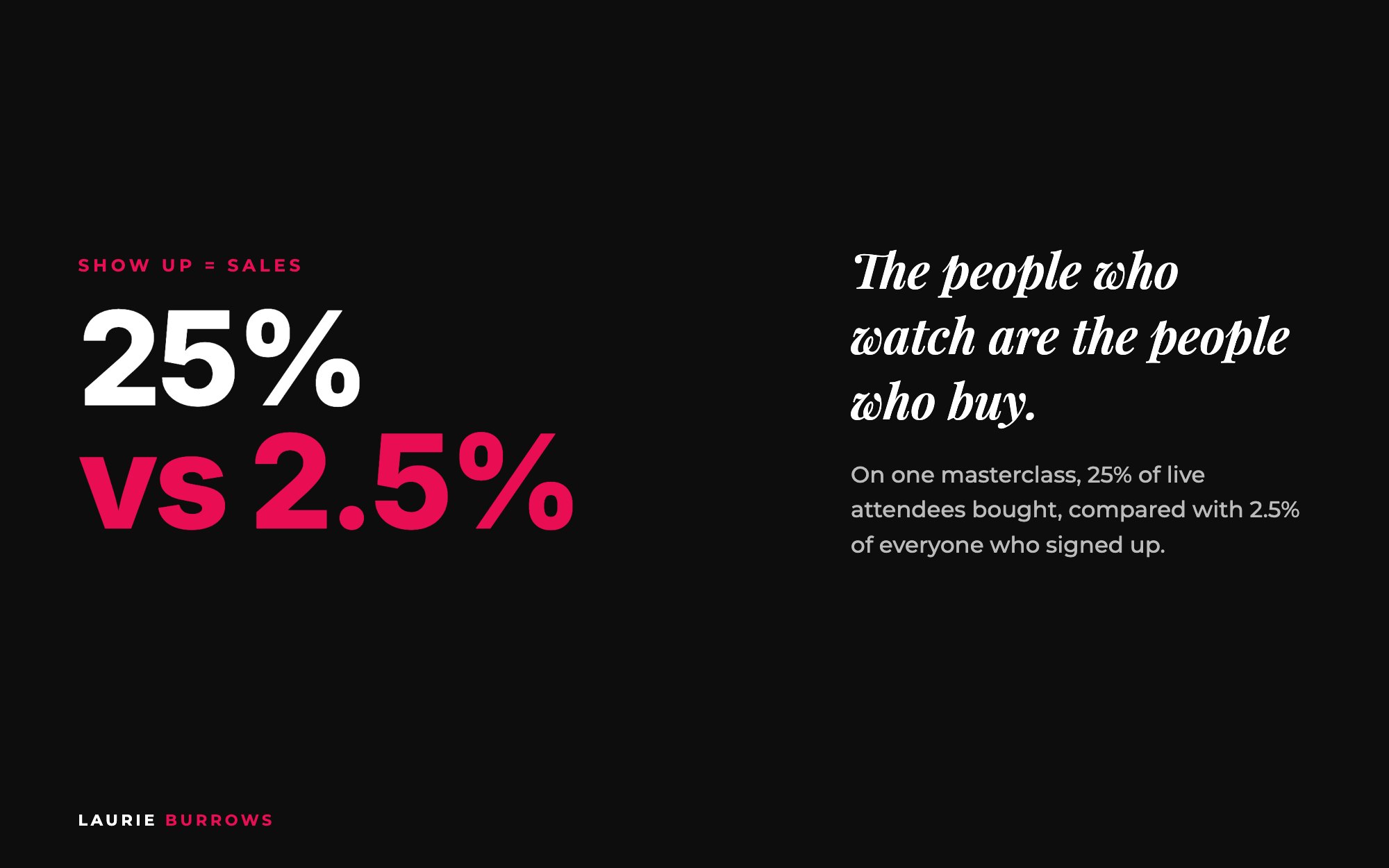
That's ten times more. So the single best thing you can do for your sales is get more people watching all the way through. And the simplest way to do that is to make it short enough that they actually do. I go deeper on this in why live attendees buy 10 times more.
Does a shorter training mean less value?
No. It means more focused value.
A two hour training often tries to teach everything, including all of the how. That's overwhelming, people don't implement it, and a lot of it is stuff they'd get in your paid offer anyway. A 20 minute training teaches the what: what's missing, what's going wrong, what needs to change. You give enough of the how for them to take one step, not the whole programme for free.
Value isn't measured in minutes. It's measured in the moment someone goes "oh, that's why it isn't working." You can create that moment in 20 minutes if you plan for it.
What makes a 20 minute training sell?
Every short training I create has the same engine inside it.
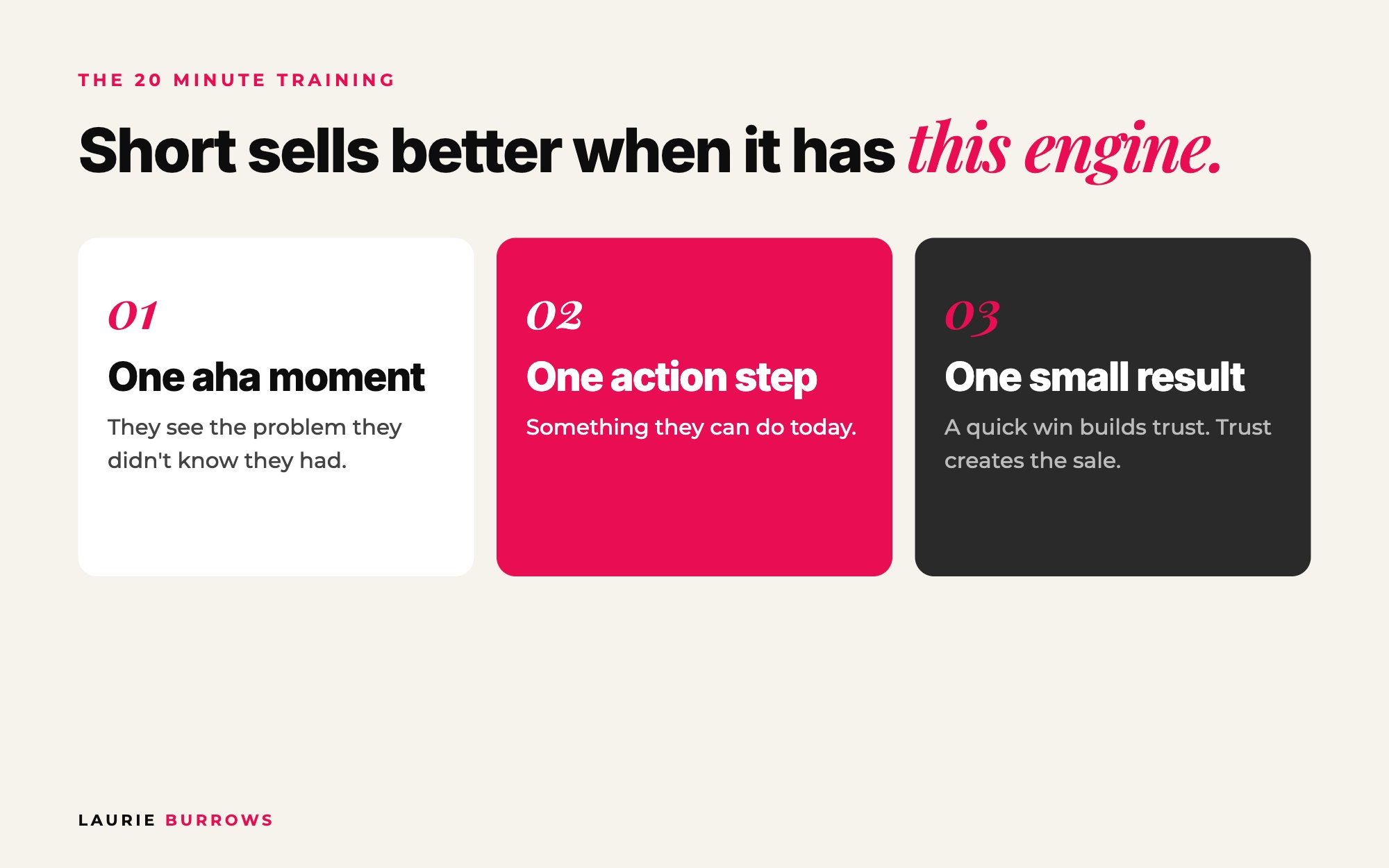
- One aha moment. They learn the problem they didn't know they had, and why they need your solution. That's what shifts them from "interested" to "I need this."
- One action step. Something they can do today. When they implement and get even a small result, it builds trust. Trust creates the sale.
- One promise. The whole training (or the whole five days) delivers a smaller version of the same end result your paid offer delivers. Same promise, smaller scope.
In my own five day experience, each day had a short training, an aha moment and an action step that had people using the actual product. One day was offers: what makes an offer sell, so they could see the missing gap in theirs. The action step was to fix that gap right there and then. By day three, they'd already experienced what it was like to work with me. That's what makes pitching easy.
How to build a 20 minute training that sells, step by step
Step 1: Write your one promise
Your free training should deliver a smaller version of the same end result your paid offer delivers. Same promise, smaller scope. If your programme helps people sign five clients, the training might help them get their first client conversation this week. Write it as one sentence: "By the end of this you'll [small result] so you can [bigger result]."
Time: 15 minutes. Done when: you have one sentence that links the free result to the paid result.
Step 2: Pick one aha moment per session
List the three to five things your ideal client gets wrong before they reach the result. Each one becomes a session. The aha is the moment they realise "oh, that's why it isn't working." One per session, not five.
Time: 30 minutes. Done when: each session has one sentence that starts "The reason this isn't working is...".
Step 3: Script it in six blocks
You don't need to time it to the second. Do not panic if you go over or under. Twenty minutes is a guide, and the point is bite-sized and absorbable. This is roughly how I'd structure it:
- Hook (1 to 2 minutes): the end result they want and what you'll cover today.
- Who you are (2 to 3 minutes, mainly day one): your story and your results, so they know why to listen to you.
- The aha (8 to 10 minutes): the one thing that's stopping them, taught clearly. The what, not every single how.
- Proof (2 minutes): a story or result that shows this works. If you don't have client results yet, use your own journey and become your own evidence.
- Action step (2 minutes): one task to do today.
- What's next (1 minute): what's coming tomorrow, or on pitch day, your offer.
Copy and paste: 20 minute training outline
Hook: "By the end of today you'll know why [problem] keeps happening and you'll have done [action step], so you're one step closer to [end result]."
Who I am: "I've [your result or journey in one line]. I'm sharing this because [why you care]."
The aha: "Most [ideal clients] think the problem is [what they think]. It isn't. It's [the real problem]. Here's why: [explain the what in three points]."
Proof: "When I [changed this], [what happened]."
Action step: "Before tomorrow, I want you to [one task, under 20 minutes]. Post your answer in the community so I can see it."
What's next: "Tomorrow we're covering [next aha]. You won't want to miss it."
Time: 1 hour per session to script. Done when: each session is written in the six blocks and reads out loud in around 20 minutes.
Step 4: Make the action step doable today
The action step is where trust is built, so it has to be small enough that people actually do it. "Write your offer statement" works. "Rebuild your business model" doesn't. Ask people to post their answer in the community, so you can see who's engaged and follow up with them.
Time: 10 minutes per session. Done when: every action step takes under 20 minutes and has a place to share it.
Step 5: Record, set a start date and deliver it
Record each session in one take if you can. Then set a start date so everyone goes through it together, and send each day's session by email and WhatsApp at the same time each day.
The scheduling is the fiddly part. If you'd rather not set it all up yourself, the Launch Manager inside Ascendia OS plans the event from first email to cart close, and the Email Marketer writes the daily reminders and follow up so every session lands on time.
Time: One afternoon to record five sessions. Done when: everything is recorded and scheduled, with a reminder going out on each day.
Step 6: Measure watch-through and sales
After the event, look at how many people opened or watched each day, how many did the action steps, and how many bought. If day one to pitch day loses more than half the room, shorten the sessions or add reminders. If people watch but don't buy, work on the pitch.
Time: 1 hour after the event. Done when: you know your drop off by day and the one thing you'll change next time.
Do this now: take your current free training or masterclass and write down the one aha moment you want people to leave with. Cut anything that doesn't serve that moment, then add a single action step. If it's still over 30 minutes, split it into two days.
But don't people need hours with you before they buy?
Yes, and this is where people get confused. Google's research found that people need around seven hours of content, 11 touch points and four platforms before they buy. A 90 minute masterclass is a long way from seven hours.
But those seven hours don't have to come from one marathon session. They build up across touch points: five short trainings, the community, the daily emails and WhatsApp messages, your social content, your stories, your lives. Five 20 minute sessions people actually watch, plus everything around them, beats one two hour session most people never finish.
This is also why I run short trainings over five days rather than one long one. Five days means five touch points, five chances to build trust and more opportunities to sell.
When does a longer masterclass still make sense?
Long isn't always wrong. It depends on who you're talking to.
- Warm or hot audience: a 60 to 90 minute masterclass works well, because they already know and trust you. They don't need five days of nurture.
- Cold audience: short sessions over several days, so you have more touch points to take them from cold to hot.
- High ticket to a cold audience: a full day event can work, because people are setting aside the time deliberately.
If you do run a 90 minute masterclass, mention halfway through that there's a way to work with you, give a few details that get people excited, then share the rest at the end. You want them watching to the end.
Short trainings are also better for you
One more thing. Short, pre-recorded trainings are something you can rinse and repeat. Create them once, run them again and again, tweak them after each round. My team can run my launches without me being on Zoom for hours every day. That's how you grow without growing your hours.
If you want to see how this fits into a full launch, read the ultimate guide to a 6 figure course launch or what to teach on each day of a challenge.
Worked example: turning a 2 hour masterclass into five 20 minute sessions
Example (illustrative): a business coach selling a $997 programme on getting clients from social media has a two hour masterclass that covers everything. Here's how it splits:
- Promise: "By the end of five days you'll have your first client conversation booked."
- Day 1: aha: you're posting to be seen, not to start conversations. Action: rewrite your bio with one clear call to action.
- Day 2: aha: your content has no next step. Action: write one post that ends with "comment WORD below".
- Day 3: aha: the money is in the DMs, not the post. Action: send three DMs using a script. Pitch today, with a 48 hour bonus.
- Day 4: aha: follow up is where most sales happen. Action: follow up with everyone from day three.
- Day 5: aha: this is a system you repeat weekly. Action: plan next week. Final pitch.
Using my own masterclass numbers as a guide: 500 sign-ups at 2.5% is around 12 sales, or roughly $12,000. If shorter sessions mean double the people are still there on pitch day, and around a quarter of those buy, sales go up without a single extra sign-up.
Benchmarks for short trainings
| Number | What to aim for |
|---|---|
| Session length | Around 20 minutes, 30 at most |
| Live attendees who buy | Around 25%, vs around 2.5% of all sign-ups |
| Typical live show up | 25% day one, 20% day two, 15% day three (what shorter sessions are fighting) |
| Content before buying | Around 7 hours, 11 touch points, 4 platforms (built across the whole experience) |
| Pitch | Day three of five |
| Conversion rate | Industry 1 to 3%. My launches 10 to 12%. |
Common mistakes (and the fix)
- Mistake: Teaching every single how. Fix: Teach the what and enough how for one step. The full how is your paid offer.
- Mistake: Three aha moments in one session. Fix: One aha per session. Save the rest for another day.
- Mistake: An action step that takes a weekend. Fix: Make it doable in under 20 minutes, today.
- Mistake: No start date for pre-recorded sessions. Fix: Set a start date so everyone goes through it together.
- Mistake: Measuring sign-ups only. Fix: Track watch-through by day and who did the action steps.
Your action plan
Day 1
- Write your one promise sentence.
- List three to five aha moments, one per session.
Day 2 to 3
- Script each session using the six block outline above.
- Cut anything that doesn't serve the aha.
Day 4
- Record all sessions and write the action steps.
Day 5 to 7
- Set your start date, reminders and community.
- Write your day three pitch.
- Promote the event and track sign-ups daily.
- Read the ultimate guide to webinars that sell to plan the pitch session.
If you want the pitch at the end mapped out for you, The 5-Figure Webinar Formula gives you my 10-step framework, the slide template and the pitch script.
Want the training and pitch structure done with you?
The 5-Figure Webinar Formula is my 10-step webinar framework for $27, with the slide deck template, the pitch script and the objection handling slides, so you can build an event that sells without starting from a blank page.
Rather have it done for you?
Let Ascendia OS set up your short training event for you
The Launch Manager plans your five short sessions and the cart close, the Email Marketer writes the daily reminders, and the Funnel Builder builds the sign-up page and checkout. 14 days free, no tech skills needed.
Frequently asked questions
How long should a free training be to sell an offer?
Around 20 minutes per session works well for a multi-day experience. It's long enough for one aha moment and one action step, and short enough that people actually finish it and are still there when you pitch.
Do longer webinars convert better?
Not usually for a cold audience. Longer sessions have bigger drop off, so fewer people see your pitch. A 60 to 90 minute masterclass can work well for a warm or hot audience who already trust you.
How can I give enough value in only 20 minutes?
Focus on the what, not every how. Teach the one thing that's stopping them, show proof it works, and give one action step. Value is the shift in their thinking and the small result they get, not the number of minutes.
Why do people stop showing up to my challenge?
Usually because the sessions are too long for busy people, there aren't enough reminders, or there's no community pulling them back in. Shorter sessions, email and WhatsApp reminders, and an active community all help.
Should a 20 minute training be live or pre-recorded?
Either works. Pre-recorded lets people watch at a time that suits them and lets you rinse and repeat it. If you go pre-recorded, set a start date so everyone goes through it together.
Laurie Burrows is a revenue growth strategist for coaches, consultants and online service providers, with 15 years of experience in marketing and sales and a business that's generated multi-seven figures in sales. She's the founder of Ascendia OS.
Do you want to scale your business to 10K months in the next 90 days? I am looking for 10 people for my new case study program. DM me the word CASE STUDY on Instagram (@_laurieburrows) to learn more.