The Ultimate Guide to Webinars That Sell
Short answer: a webinar that sells takes people on a deliberate journey in 10 steps: hook them in the first few seconds, remind them why they're there, show them what's possible, prove the webinar can help, share your story, teach the what and the why (but not the how), reignite desire, remind them where they are, invite them to take the shortcut, then pitch. The pitch names the solution, explains what's included and why it matters, stacks the value, reveals the price with confidence, uses a belief close and answers objections. Then you follow up, because most sales happen after the webinar ends.
One high converting webinar, recorded once, can be one of the most valuable assets in your business. It's one of the few marketing tools that can take a cold audience and turn them into buyers in under an hour. And when it's pre-recorded, it can generate leads, nurture them and convert them into your core offer every single day.
But most webinars don't sell. They open with "Hi everyone, welcome to my webinar", teach for an hour, then rush the offer in the last three minutes. That isn't a sales webinar. That's a free course with an awkward ending.
I've spent 15 years in marketing and sales, and webinars and masterclasses have been part of how I've sold for a long time. This is my High Converting Webinar formula, step by step, with the words I use at each step, so you can build yours this week.
Who this guide is for (and what you'll have by the end)
This is for coaches, consultants and online service providers who want a webinar or masterclass that actually sells a paid offer, whether you run it live, pre-recorded or as part of an evergreen funnel. By the end you'll have:
- A complete webinar outline using the 10 steps, with example wording for each one.
- Your opening hook, written from one of six hook formulas.
- A slide-by-slide plan you can drop straight into your slide deck.
- A full pitch script, including the value stack, the belief close and objection slides.
- A promotion plan to fill the webinar and get people to show up.
- A follow up sequence of emails and DMs for the days after.
- A 30 day plan to go from blank page to a webinar that's selling.
Why does webinar structure matter so much?
Because the people watching probably don't know you yet. If you're driving new traffic to your webinar, a lot of them are meeting you for the first time. In the space of an hour you need to build authority and trust, activate desire, handle objections before they're spoken (especially on a pre-recorded webinar where you can't answer the chat), and make it feel safe to decide.
That doesn't happen by accident. It happens through structure. I think of it as taking people on an emotional roller coaster: down into where they are, up into what's possible, back down to reality, and up again into the solution. People buy on emotion first and justify with logic later, so your webinar needs both.
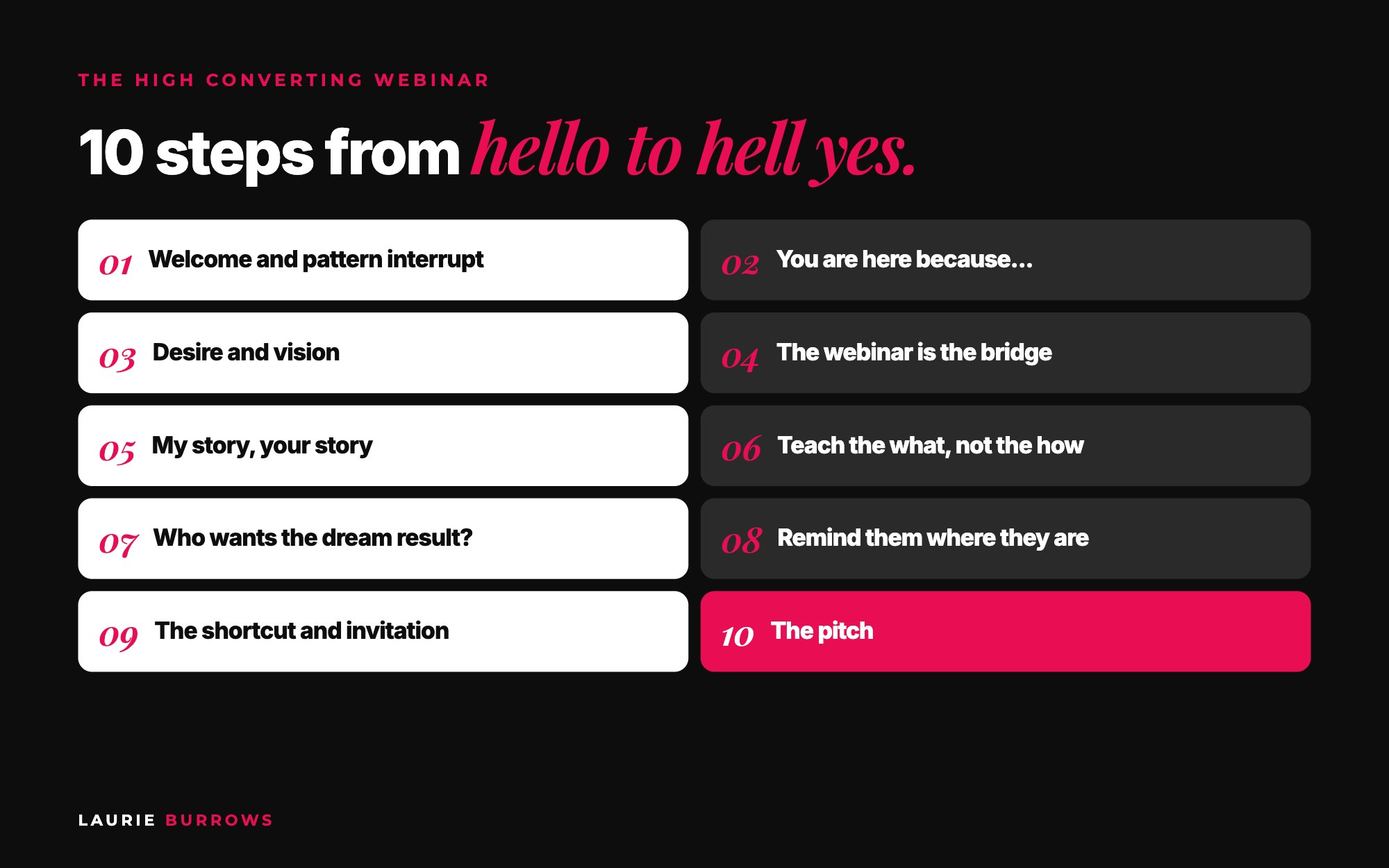
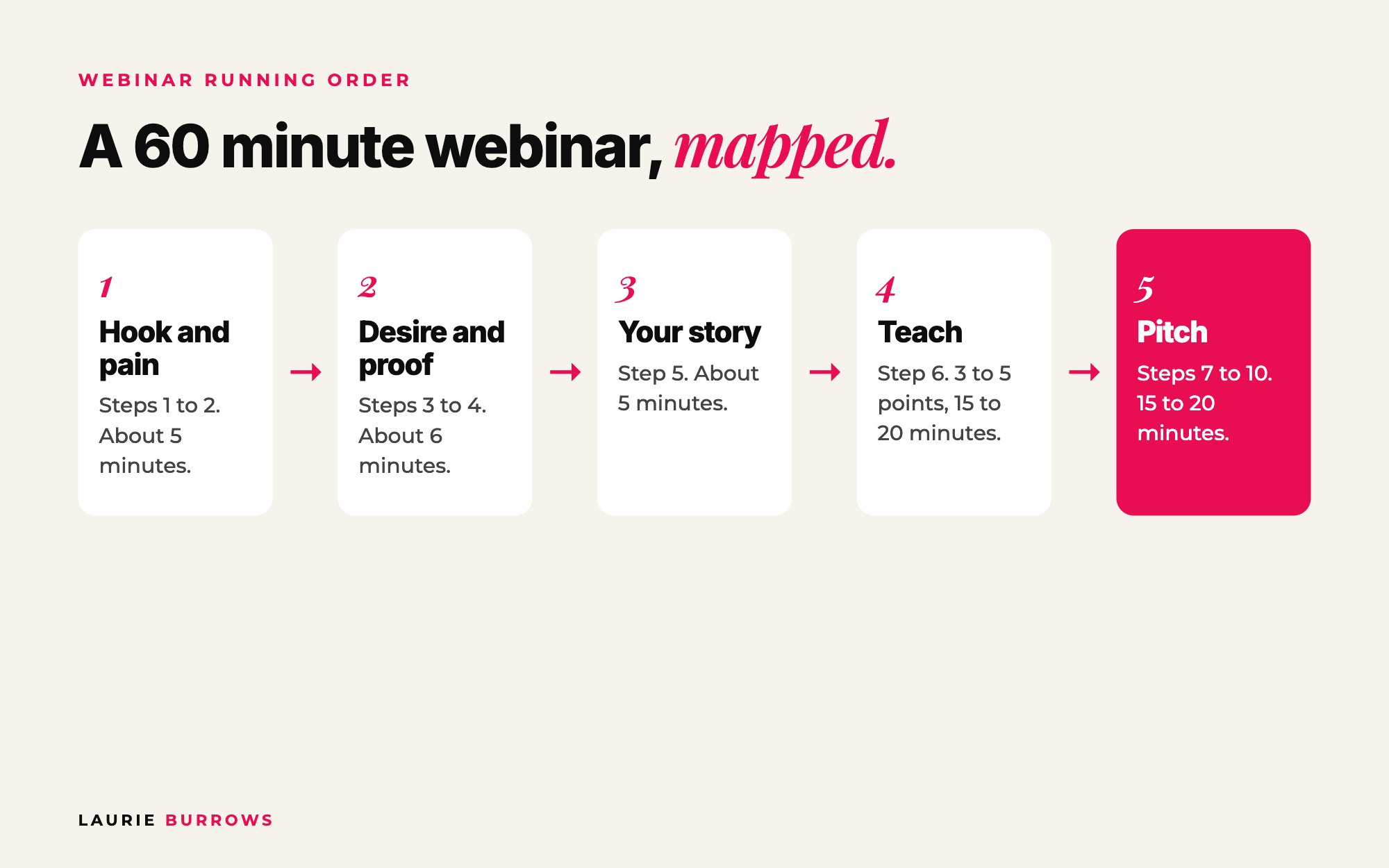
Here's the whole formula at a glance, with a rough running order for a 45 to 60 minute webinar:
| Step | What it does | Roughly |
|---|---|---|
| 1. Welcome and pattern interrupt | Grabs attention and promises the payoff | 1 to 2 min |
| 2. "You are here because..." | Names their pain so they feel understood | 3 to 4 min |
| 3. Desire and vision | Shows them what's possible | 3 to 4 min |
| 4. The webinar as the bridge | Proof this training gets them there | 2 to 3 min |
| 5. My story, your story | Positions you as the trusted guide | 4 to 5 min |
| 6. Teach your framework | 3 to 5 aha moments: the what and why, not the how | 15 to 20 min |
| 7. "Who wants the dream result?" | Lifts the energy after teaching | 1 to 2 min |
| 8. Remind them where they are | Reopens the need for the how | 2 min |
| 9. The shortcut and invitation | Turns teaching into selling without a hard sell | 1 to 2 min |
| 10. The pitch | Offer, value, price, belief close, objections, final call | 12 to 18 min |
Before you start: three things to prepare
Ten minutes of prep here saves you hours of rewriting later.
- Your offer's end result. One sentence: "[Offer] helps [who] get [result] without [what they don't want]." Your webinar promises a smaller version of the same result.
- Your objections list. Write down every question and objection you get: time, money, "will it work for me", "I don't have a big audience", "I need to ask my partner". You'll handle them all inside the webinar, before anyone asks.
- Your proof bank. Screenshots, numbers, stories and, if you have them, client results. No client results yet? Use your own story and results. Become your own evidence.
Copy and paste: webinar title formula
How to [end result] in [timeframe] without [thing they hate]
The [number] [mistakes / steps / gaps] stopping you from [end result]
Example: How to make sales every single day without launching or living in the DMs
Talk to the end result, not the problem. Buyer A knows their problem, Buyer B doesn't. Both want the result, so lead with that.
Time: 30 minutes. Done when: you have an end result sentence, a title, an objections list and at least five proof points.
Step 1: Welcome and pattern interrupt
Most people arrive at a webinar distracted. They're scrolling, thinking about their to-do list or what to have for tea. Your opening has one job: break that default scroll mode and position you as someone worth listening to. So don't open with "Hi everyone, welcome." Open with something bold, surprising or emotional, then preview the payoff so they stay to the end.
Six hook formulas you can use
| Formula | Example |
|---|---|
| The surprising reason | "What if I told you the reason you're not making more sales is because your audience thinks you're too available?" |
| The bold promise | "The next 45 minutes could make you more money than the last three months combined, if you're willing to see things differently." |
| The "most people" truth | "Most people build funnels that look good but don't sell. I'm going to show you why that happens and exactly how to fix it." |
| The direct question | "Why did you sign up to this training today? You're here for a reason, and I want you to think about what that reason is." |
| The "even if" | "By the end of this session you'll know exactly how to turn scattered content into a sales machine, even if you've tried before and nothing has worked." |
| The goal question | "Write down your goal for the next 12 months. Now, what was your goal 12 months ago, and did you hit it?" |
Copy and paste: opening (first 60 seconds)
[Hook from the formulas above.]
Over the next [45] minutes I'm going to show you [promise], even if [biggest objection].
Stay until the end, because that's where I put it all together and show you [the payoff, for example the exact plan to do this in the next 90 days].
Grab a pen. You're going to want to write some of this down.
I go much deeper on openings in webinar hooks that stop people leaving.
Step 2: "You are here because..."
Now build connection and relevance. Remind them why they showed up, and show them you understand exactly what they're going through. You want them thinking "that's exactly how I feel", as if you understand their situation better than they could explain it themselves. I usually paint a picture of around three pain points. In my webinar on making sales every day, they sound like this:
- You're posting all day, every day, constantly tweaking your messaging and content pillars, and your sales are still stuck.
- You're launching offer after offer. You finally create the one you can feel in your bones is the one, you announce it, and you hear crickets.
- You're running launch after launch. 100 people sign up to your challenge, 10 show up live, and by day three there's barely anyone there.
As you describe it, they're remembering when it happened to them last month. That's when they know they're in the right place.
Copy and paste: pain points script
You're here because right now you're [pain one, described as a scene they'd recognise].
You've tried [what they've tried], and still [result they keep getting].
And if you're honest, it's left you feeling [emotion: exhausted, frustrated, wondering if it's you].
Step 3: Desire and vision
At this point they're feeling, honestly, a bit rubbish. Good. Now lift them. Paint a vivid picture of their dream outcome so they emotionally step into their future before you've introduced your solution. Use specifics. In my own webinar I don't stop at "make sales every day". I show my calendar and photos from trips, and ask: what if you could make sales every day while your calendar looks like this? Because my ideal client doesn't just want money. They want money with time freedom.
The goal maths exercise
This one works brilliantly. Ask them to write down their goal for the next 12 months, then visualise hitting it. Then ask what their goal was 12 months ago, and whether they hit it. Then break the new goal down for them:
| Example | |
|---|---|
| Yearly goal | $100,000 |
| Per month | $8,333 |
| Offer price | $1,000 |
| Sales needed per month | 8 to 9 |
| Sales needed per week | Around 2 (one every three to four days) |
Ask them to get their calculator out and work out their own number. Suddenly the goal feels possible, and they want to know how.
Copy and paste: desire script
Imagine if instead [their dream scenario, in vivid detail: waking up to sales notifications, DMs full of people asking how to work with you].
What if you could do that and [lifestyle desire: take the school holidays off, travel, finish at 3pm]?
And what if it only took [simple version: one core offer, one strategy]?
Step 4: Position the webinar as the bridge
They've felt seen (step two) and inspired (step three). Now anchor this webinar as the bridge between the two. This is your proof and positioning section. You're not selling yet, but you're helping them commit mentally to what you're about to teach. It's what I call evidence based content: it shows you don't just talk the talk.
Use your proof to quietly handle objections too. If you know people will think "but I don't have a big audience", share a result from someone who didn't. They won't notice you've handled an objection. They'll just stop worrying about it.
Copy and paste: bridge script
You're here. You want to be there. This training is the bridge, and I'm going to show you exactly what's been missing.
I know some of you are thinking [objection, for example "but I don't have a big audience"]. [Proof that handles it: your result or a story where that wasn't needed.]
By the end of this webinar you'll have [tangible outcome], whatever your niche or experience level.
Step 5: My story, your story
Now they believe the webinar can help. Next they need to trust you. Share your story, but as a carefully structured narrative, not a word vomit of your life story. Stories create emotion, emotion makes you memorable, and memorable means you're who they think of when they're ready to buy. This step answers the biggest subconscious objection of all: will this work for me?
Copy and paste: story in five parts
The before: When I started, I was [struggles that mirror theirs: jumping from course to course, launch after launch, posting and hearing crickets].
The turning point: Then [moment]. I knew something had to change, because [stakes].
The transformation: When I started doing [your method], [real numbers and lifestyle changes, ideally with a screenshot or photo].
Who I help now: Now I help [who] do the same, across [industries or types of business].
The invitation to believe: If you feel like you've tried everything, I did too. This changed everything, and I'm going to show you how it works.
Step 6: Teach your unique framework
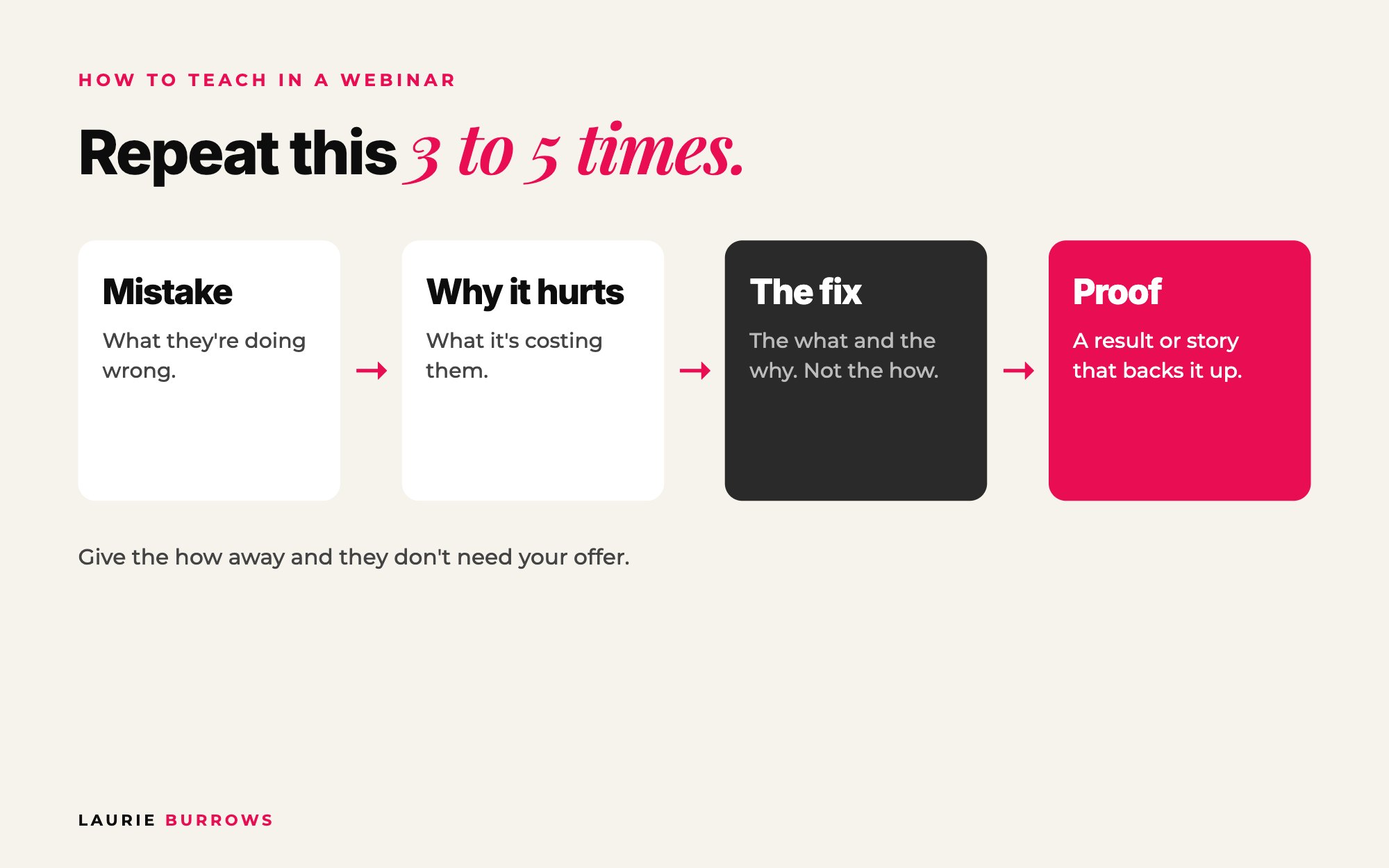
This is where you give value and create the aha moments. But here's the rule: give the what and some of the why, not the how. If you give them every how, they can go and do it without you, and they don't need your offer. You want to inspire them into action, not hand over your whole programme.
People buy when they realise they're doing something wrong and it's costing them, when they see there's a better way, when they believe you have that better way, and when they see proof it works. This section creates all four belief shifts. Structure it as three to five short segments, using one of these patterns:
- Steps: this is what you need to be doing, this is why, here's proof.
- Mistakes: this is the mistake you're making, this is why it's hurting you, this is what to do instead, here's proof.
- Gaps: this is the gap in your strategy, this is how to fix it, here's proof.
Copy and paste: teaching segment
Mistake number [one]: you're [mistake]. Right now [what that looks like in their week].
The reason that's hurting you is [why, in one or two simple sentences].
What you need instead is [the fix, the what and the why, not the step-by-step how].
When I [or a client] did this, [short story with a number].
For example: "Mistake one: you're not focusing on lead generation. You're putting offers out there and no one's buying, because you've got no leads to sell to." Then the fix, then a short story. I often teach this part on a whiteboard, drawing out my framework as I talk. You don't have to. Slides work perfectly well.
Step 7: "Who wants the dream result?"
After teaching, energy dips. People are mentally tired from learning and nodding along. So lift them again and reignite the desire before you pitch.
Copy and paste: energy lift
Who here wants to [dream result, for example wake up to daily sales notifications, leads coming in automatically and clients messaging you asking how to work together]?
Imagine knowing [it's working for you] even while you're [with your family / taking a day off]. No more guessing. No more starting from scratch.
Step 8: Remind them where they are
Then bring them back down to reality, one more time. Remind them what they came for, and that they haven't solved it on their own yet. If they were already getting the results they want, they wouldn't be on this webinar. This softens the ground for the pitch and removes the "I'll figure it out on my own" objection.
Copy and paste: reality check
But right now you're still [current reality]. You've tried [what they've tried].
Today I've shown you what's missing. What I haven't given you is the how. And to get to [result], you need the how.
So you have two choices. Option one: carry on as you are. Imagine another 12 months, still stuck exactly where you are today. How would that feel? Option two: take the shortcut.
Step 9: The shortcut and the invitation
This is the pivot from teaching to selling, without it feeling like a hard sell. Position your offer as the shortcut to the result, with less trial and error. Then give people permission to leave. It sounds counterintuitive, but it makes the pitch feel exclusive and creates curiosity. Nobody wants to miss the shortcut, and anyone who isn't your ideal client wasn't going to buy anyway.
Copy and paste: invitation
For those of you who want [result] set up in [short timeframe] and [bigger result] in [90 days], I have an invitation for you.
This is only for those of you who want a shortcut. If you don't want the shortcut, I give you permission to leave now. No hard feelings.
But if you stay, I'm going to show you the fastest way to [end result] without [what they don't want].
Step 10: The pitch
This is where your audience is most primed to buy. They've had the insight, the clarity and the value. Now you guide them to a yes that feels both logical and emotional, a hell yes that feels inevitable.
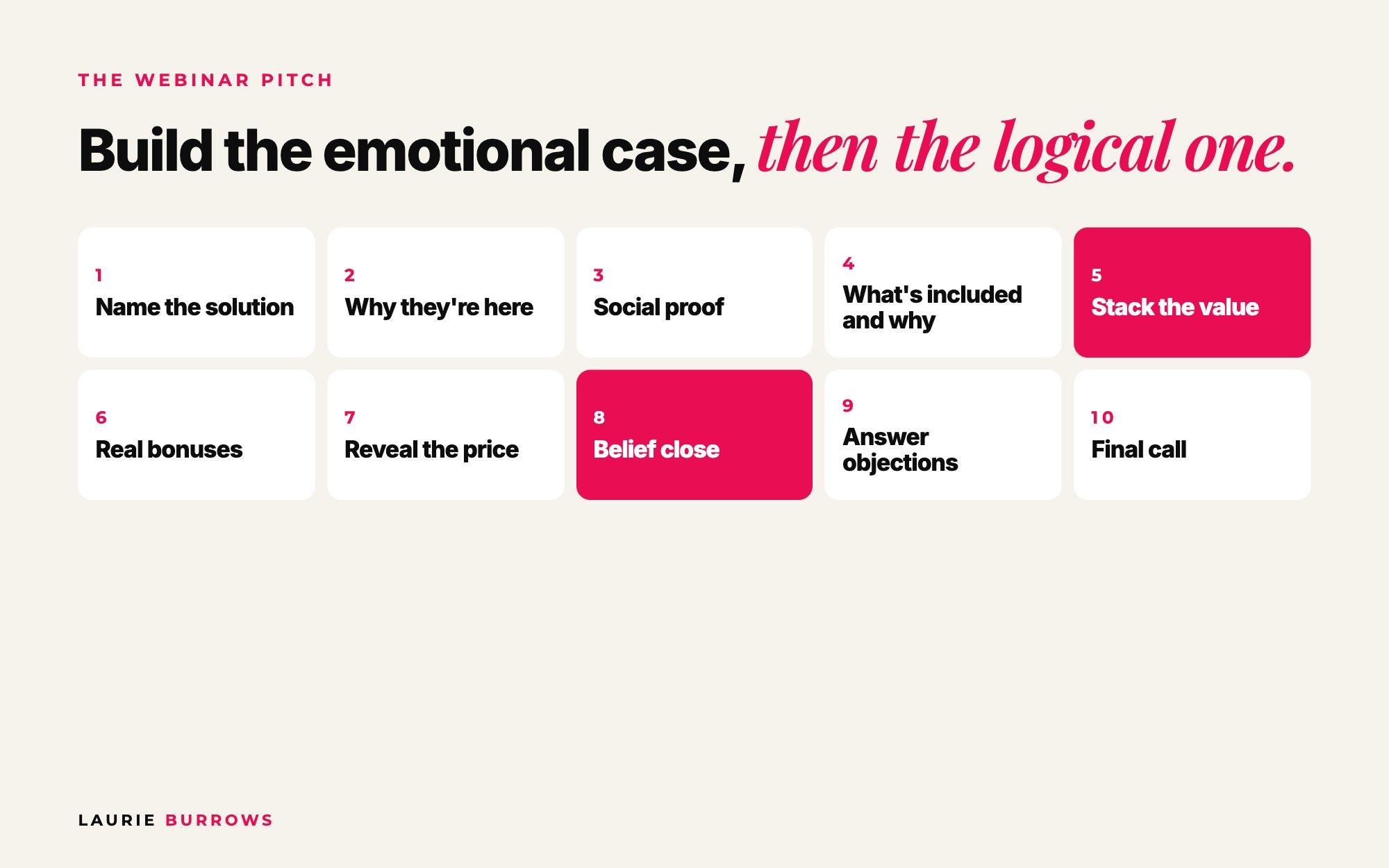
- Name the solution. Clear and grounded. Don't oversell.
- Reaffirm why they're here. Use their exact language. Repetition locks in urgency.
- Social proof. One to three stories: they were where you are, now they're here.
- Bridge into how it works. You've built the emotional case. Now build the logical one.
- What's included, strategically. Not "you get eight modules". What it is, why it matters and how it gets them closer to the outcome.
- Stack the value. Recap everything with a value next to each piece.
- Add bonuses. Real ones only, with a 48 hour deadline, each with a reason it matters.
- Reveal the price with confidence. Hesitation discounts the transformation.
- The belief close. A question that shows the result is worth more than the price.
- Optional final incentive. Money towards their tuition, not a discount.
- Handle objections. One slide per objection.
- Final call. Two choices, the deadline, exactly what to do next.
The full pitch script
Copy and paste: webinar pitch script
This is the solution that will help you finally [desire]. It's called [offer name].
You're here because you want [result]. You're done with [pain]. And you're ready for [desire].
[Proof: one to three short stories of people who were where they are and got the result. Or your own.]
So how do we get there? Let me show you how [offer name] works.
You get [component one]. This isn't just training, it's [what it does for them], so you'll finally [outcome]. You get [component two], because [why it matters]. You get [component three], which means [outcome].
Let's recap. [Component one] (worth $[x]). [Component two] (worth $[x]). [Component three] (worth $[x]).
And if you join in the next 48 hours, you also get [bonus one], so you can [outcome], and [bonus two], which [outcome]. That brings the total value to over $[total].
You're not going to pay that today. Your investment is $[price], or [payment plan].
Let me ask you a question. Do you believe that with this system, and my support, you could [modest result that more than covers the price] in the next 90 days? If that's a yes, the investment has already paid for itself.
[Optional:] And because I want to remove any barrier, if you join in the next 48 hours I'm going to give you $[amount] towards your tuition.
Let me answer the questions I always get. [Objection slide one + answer.] [Objection slide two + answer.] [Objection slide three + answer.]
So you've got two choices. Keep guessing and spinning your wheels for another 12 months, or take the shortcut. The link is [where]. The bonuses end in 48 hours. I can't wait to see you inside.
Worked example: the value stack and belief close
Here's how this sounds in one of my own webinars. I walk through everything inside the programme and explain why each part matters. Then I add the fast action bonuses and explain why each one is a must. Then I show the total value, which is well over five figures, and say: you're not going to pay that today. The investment is $1,997.
Then the belief close: "Do you believe that with this sales system you could sell at least one $2,000 offer in the next 90 days?" If they're still watching, they do believe it, and they've just worked out for themselves that one sale covers the investment. Then I remind them we're not aiming for one sale. We're building a system that sells every day.
Then the optional final incentive. I don't say "I'll knock $500 off". I say "if you join in the next 48 hours, I'm going to give you $500 towards your tuition." Same maths, but it doesn't reduce the perceived value the way a discount does.
More on building this part in how to build a value stack, and if any of it makes you squirm, read how to pitch without feeling icky. A strong pitch isn't pushy. It's clear.
If you want the whole thing ready to adapt, The 5-Figure Webinar Formula ($27) gives you the 10-step framework, a slide deck template, the pitch script and objection handling slides.
Your slide-by-slide outline
Use this as your deck. Big text, one idea per slide, and no slide you have to apologise for. Around 30 slides is plenty for a 45 to 60 minute webinar.
| Slides | What goes on them |
|---|---|
| 1 | Title: the end result promise |
| 2 to 3 | Your hook, then "by the end of this you'll..." |
| 4 to 6 | Pain point one, two and three (one per slide, a short line each) |
| 7 to 9 | The dream: a vivid picture, your lifestyle proof, the goal maths |
| 10 to 11 | The bridge: "you're here, you want to be there" plus one proof slide |
| 12 to 14 | Your story: before, turning point, transformation (with a screenshot) |
| 15 to 22 | Teaching: 3 to 5 points, each with a "mistake / why / fix" slide and a proof slide |
| 23 | "Who wants...?" the dream result |
| 24 | Two choices |
| 25 | The shortcut invitation |
| 26 to 28 | The offer: name, what's included and why, the value stack |
| 29 | Bonuses, total value, price, belief close |
| 30 to 32 | One objection per slide |
| 33 | Final call: the link, the deadline, how to ask questions |
Do this now: open a blank document and write one line for each of the 10 steps of your next webinar: your hook, three pain points, the dream outcome, your proof, your story in five sentences, three teaching points, your energy lift, your two choices, your invitation and your offer. That's your webinar outline.
How long should a sales webinar be?
Long enough to do all ten steps properly, and no longer. 45 to 60 minutes works well for most offers. A 60 to 90 minute masterclass works for a warm audience who already know you. For a cold audience, the more time they spend with you the better, but long sessions also lose people, so keep the teaching tight and focused on the what, not every how. If you're running a 90 minute live masterclass, mention halfway through that there's a way to work with you, give a few details to build excitement, and save the full pitch for the end so people stay.
Live or pre-recorded?
Both work. A live webinar lets you interact and answer questions in the moment, and live attendees buy far more. A pre-recorded webinar can run every day as part of an evergreen funnel, generating and converting leads while you get on with your life. If it's pre-recorded, you have to anticipate objections and answer them in the recording, because you can't answer the chat. That's exactly why the objections list in your prep matters. Many businesses run both: a live round to test and refine, then the recording becomes the engine of their evergreen funnel.
How to promote your webinar (and get people to show up)
The best structured webinar in the world won't sell to an empty room. Start with your numbers. If you want 10 sales and expect 3% of sign-ups to buy, you need 333 sign-ups. Then work out where those people come from, which I call Lead Mapping: your email list, your content, guest spots in other people's audiences, collaborations, partners and ads.
| When | What to do |
|---|---|
| 7 to 14 days before | Open registrations. Opt-in page with a headline about the end result. Announcement email, post and stories. |
| Every day until the webinar | One piece of content a day with the webinar as the call to action. Personal invites to warm contacts. |
| Straight after sign-up | Thank you page with "add to calendar" and a reason to show up live (a live-only bonus or Q&A). |
| Day before | Reminder email and WhatsApp: what they'll walk away with. |
| Morning of | Reminder: "Today at [time]". |
| 1 hour before | Reminder with the link. |
| Going live | "We're live, come in" email and message. |
That's a registration page, a thank you page and seven or more messages before you've said a word. If you'd rather not build it all yourself, the Funnel Builder inside Ascendia OS builds your registration and thank you pages in your account, and the Launch Manager plans the webinar from first email to cart close, then sets it up to run again.
Copy and paste: webinar reminder
Subject: Today at [time]: [end result]
Hi [name], in [x hours] I'm going live with [webinar title].
You'll walk away with [three tangible things].
Come live if you can. I'll be answering questions at the end and there's [live-only bonus] for everyone who stays to the end.
[Join the webinar]
Live attendance matters more than almost anything else. On one of my masterclass launches, around 2.5% of everyone who signed up bought, but around 25% of the people who showed up live bought. That's ten times more. I break this down in why live attendees buy 10 times more, and the opt-in page itself in how to write an opt-in page that converts.
The follow up sequence (where most sales happen)
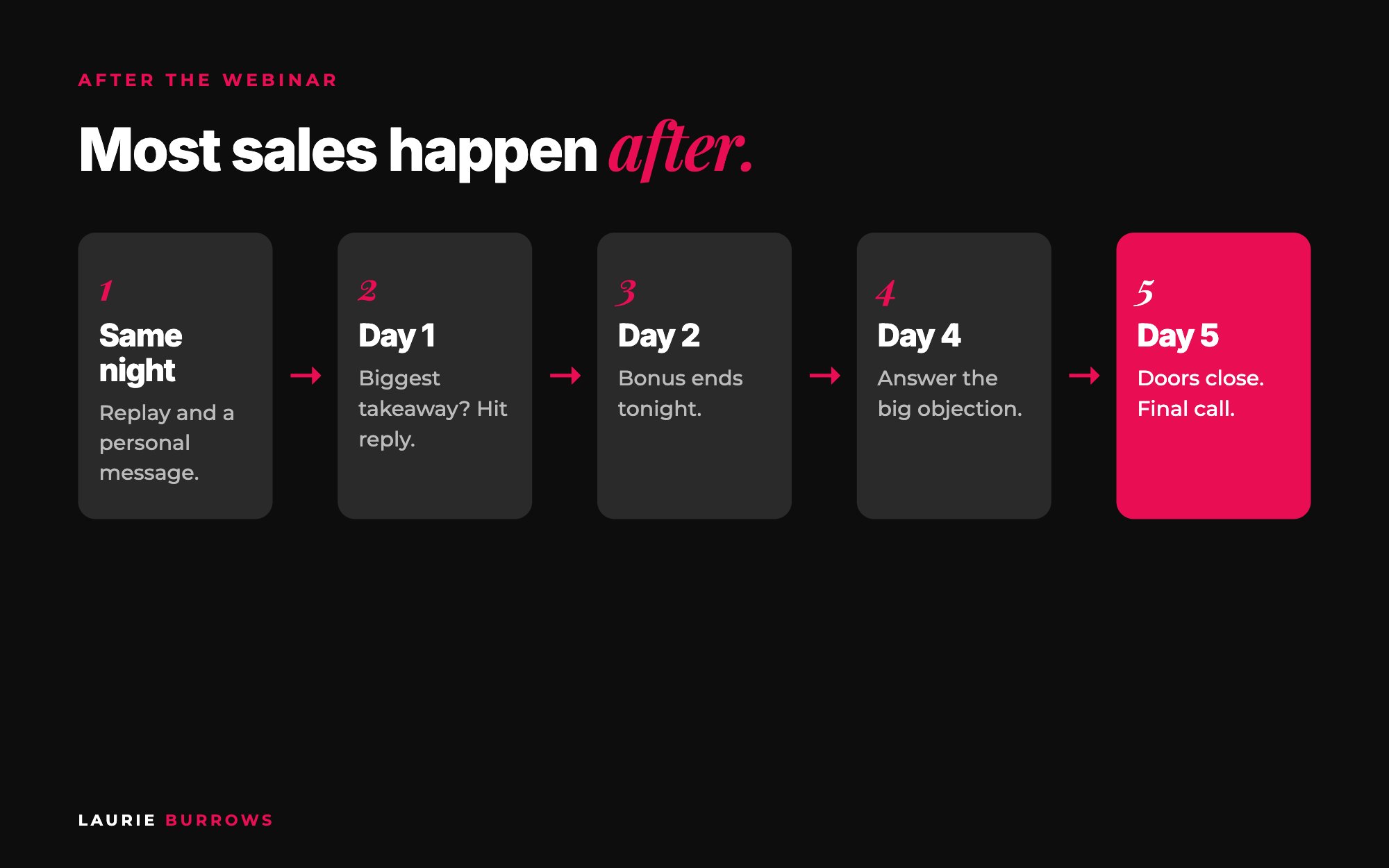
Don't stop when the webinar ends. People want conversations, reminders and answers before they buy, and around 80% of conversions happen on the fifth follow up. Here's a simple five day sequence for a 48 hour bonus and a cart that closes on day five. The emails can be written and scheduled by the Email Marketer in Ascendia OS so your time goes on the personal follow up, which is the part only you can do.
| When | Personal follow up | |
|---|---|---|
| Same night | Replay for anyone who missed it, plus the offer link | DM or WhatsApp everyone who attended live |
| Day 1 | Your biggest takeaway? (hit reply) | Voice notes to people who asked questions |
| Day 2 | Bonus ends tonight (AM and PM) | Message everyone who clicked the sales page |
| Day 3 | Story or result email: what's possible | Check in with engaged non-buyers |
| Day 4 | Objection email (time or money) | Answer every reply personally |
| Day 5 | Doors close today, final call | One last personal message to warm leads |
Copy and paste: follow up emails
Same night. Subject: The replay (and what I'd do next) Hi [name], thank you for coming tonight. If you missed it, here's the replay: [link]. If you're ready to [result], [offer name] is open and the bonuses end in 48 hours: [link].
Day 1. Subject: What was your biggest takeaway? Hi [name], I'd love to know: was it [teaching point one], [two] or [three]? Hit reply and tell me. I read every message.
Day 2. Subject: Your bonus ends tonight Hi [name], quick one. If you join [offer name] before midnight you also get [bonus], which helps you [outcome]. After tonight it's gone. [Join here]
Day 4. Subject: "I can't afford it right now" Hi [name], let's break it down. [Price] over [length of programme] is about $[x] a day. Less than a coffee. What's the cost of another 12 months where nothing changes? [Join here]
Copy and paste: follow up DM
Hey [name]! So good to have you on the webinar tonight. What was the biggest thing you took from it?
[After they reply:] Love that. Is [offer name] something you're thinking about, or is now not the right time? Either way I'm happy to answer anything.
Message attendees the same night, while it's fresh. More on this in how to follow up after a masterclass and how to handle the 5 most common sales objections.
Benchmarks to aim for
| Number | Benchmark |
|---|---|
| Sign-up to sale (average) | Around 1 to 3%; plan with 3% if you have no data |
| Leads needed for 10 sales at 3% | 333 |
| Live attendees vs all sign-ups | Around 25% vs around 2.5% on one of my masterclass launches |
| Teaching segments | 3 to 5 |
| Fast action bonus | 24 to 48 hours |
| Conversions from follow up | Around 80% happen on the fifth follow up |
| My own launches | 10 to 12% conversion |
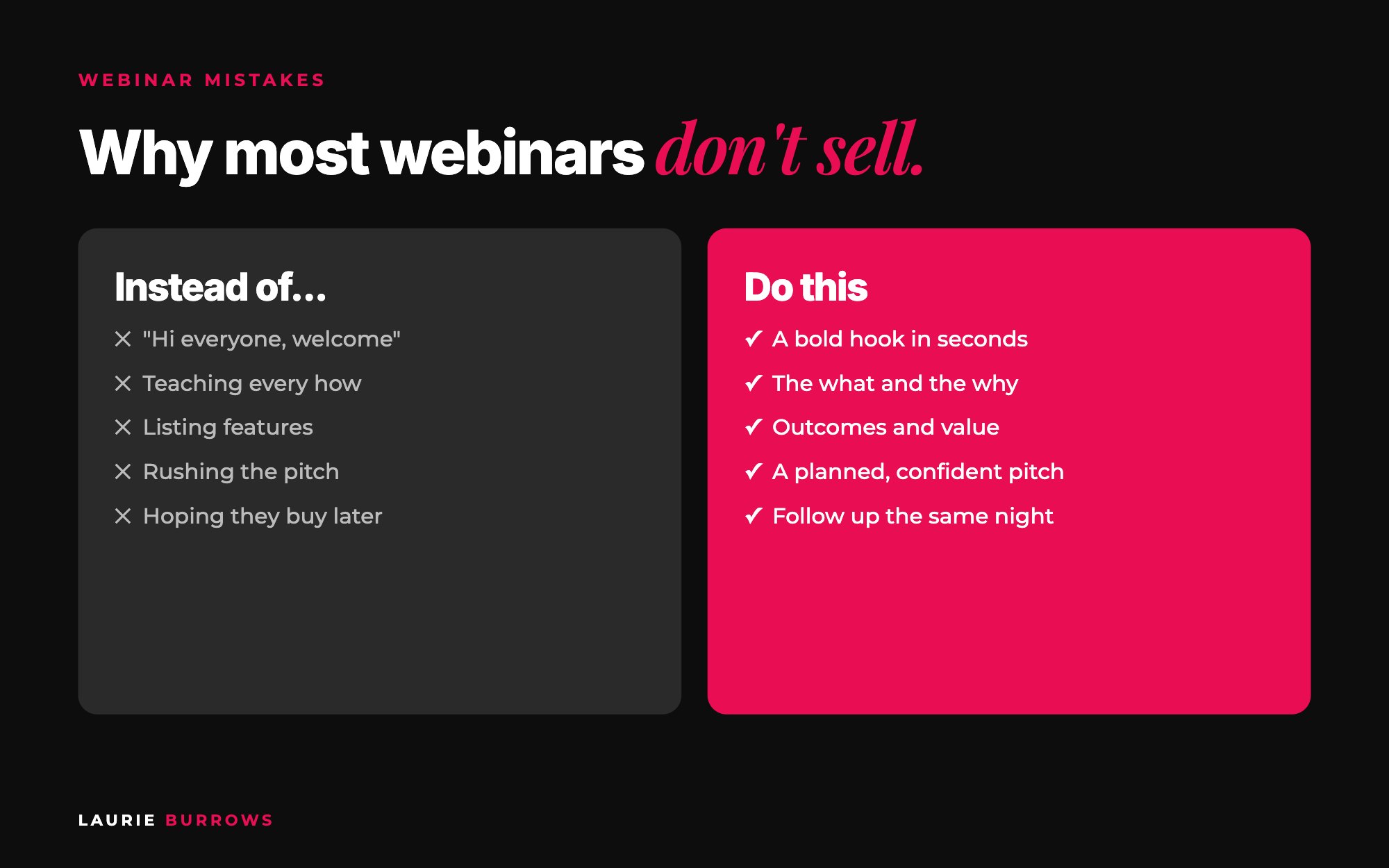
The most common webinar mistakes (and the fix)
- Opening with "Hi everyone, welcome". Fix: hook them in the first few seconds.
- Teaching all of the how. Fix: give the what and the why. The how is what they pay for.
- No proof. Fix: back up every teaching point with a result or a story.
- Rushing the pitch. Fix: plan the pitch as carefully as the teaching. It's 12 to 18 minutes, not 3.
- Listing features. Fix: tie every part of your offer back to the outcome.
- Ignoring objections. Fix: one slide per objection, answered before anyone asks.
- No follow up. Fix: the five day sequence above, plus personal messages.
Troubleshooting: if your webinar isn't selling
| If this is happening | Check this first |
|---|---|
| Low sign-ups | Your title and opt-in headline. Is it about the end result? Is your Lead Map realistic for the number you need? |
| Sign-ups but nobody shows up | Your reminders (email, WhatsApp, calendar) and whether there's a reason to come live. |
| People leave in the first 10 minutes | Your hook. Cut the intro, open with a formula from Step 1 and preview the payoff. |
| People leave before the pitch | Teaching length. Tighten to 3 to 5 points and teach the what, not every how. |
| They stay but don't buy | Your pitch: proof, value stack, a confident price and a belief close. Then your objection slides. |
| Lots of questions about price | Break the price down, show the value against it, and use the belief close. |
| Sales only on the night | Your follow up. Add personal messages and the five day email sequence. |
Your 30 day plan
| Week | Focus | Done when |
|---|---|---|
| Week 1 | Prep and outline: end result, title, objections list, proof bank, the 10 step outline | Every step has at least one line |
| Week 2 | Write and build: script the hook, story, teaching and pitch, build the slides and opt-in page | You've rehearsed it once out loud |
| Week 3 | Promote: 7 to 14 days of content, emails and invites; reminders scheduled | You've hit your sign-up target |
| Week 4 | Deliver and follow up: run it live, five day follow up, analyse the numbers | You know your show up rate and conversion rate |
Your action plan
Today
- Write your end result sentence and your webinar title.
- List your top five objections and five proof points.
- Pick your hook formula and write your first 60 seconds.
This week
- Outline all 10 steps using the scripts above.
- Build your slides from the slide-by-slide plan.
- Write your pitch, including the value stack and belief close, and say it out loud.
Next 30 days
- Set your sign-up target and build your Lead Map.
- Promote for 7 to 14 days and schedule every reminder.
- Run the webinar live, then follow up for five days by email and DM.
- Review show up rate, sales and questions, improve one thing, and turn the recording into your evergreen webinar.
Guessing and hoping isn't a strategy, and neither is winging your webinar. Structure it once, properly, and it can sell for you again and again.
Want the webinar framework done with you?
The 5-Figure Webinar Formula is my 10-step framework with a slide deck template, the pitch script and objection handling slides, so you can build a webinar that sells without starting from a blank page. It's $27.
Rather have it done for you?
Let Ascendia OS build, promote and follow up your webinar
The Launch Manager plans your webinar from first email to cart close, the Funnel Builder builds the registration page and checkout, the Copywriter writes the sales page, and the Email Marketer handles the reminders and follow up sequence. 14 days free, no tech skills needed.
Frequently asked questions
What is the best structure for a sales webinar?
Hook, reality check, desire, proof that the webinar will help, your story, three to five teaching points with proof, reignite desire, remind them where they are, the shortcut invitation, then the pitch. That sequence builds trust and handles objections before you sell.
How much should I teach in a webinar?
Teach the what and the why, not every how. Give enough for real aha moments and belief shifts, but keep the full implementation for your paid offer, otherwise there's no reason to buy.
How long should the pitch be?
Usually 12 to 18 minutes of a 45 to 60 minute webinar. That's enough to name the solution, share proof, explain what's included and why, stack the value, reveal the price, use a belief close and answer objections.
How do I pitch at the end of a webinar without being salesy?
Position your offer as the shortcut, give people permission to leave, then walk through the solution, proof, what's included and why it matters, the value, the price and a belief close. Clear and confident is not the same as pushy.
Should I use a discount in my webinar pitch?
Bonuses usually work better than discounts because they increase perceived value. If you do offer money off for fast action, frame it as money towards their tuition rather than a discount.
Can a pre-recorded webinar convert as well as a live one?
It can work very well if it's structured properly and handles objections in the recording, and it can run every day in an evergreen funnel. Live attendees do buy far more, so many businesses run live rounds and use the recording evergreen.
How many people need to sign up for my webinar?
Divide the number of sales you want by your conversion rate. For 10 sales at 3%, that's 333 sign-ups. Then map where every one of those sign-ups will come from before you start promoting.
What should I do after my webinar?
Follow up personally. Message attendees the same night asking for their biggest takeaway, send the replay to non-attendees, and keep following up by email, DM and WhatsApp until the bonus and cart close.
Laurie Burrows is a revenue growth strategist for coaches, consultants and online service providers, with 15 years of experience in marketing and sales and a business that's generated multi-seven figures in sales. She's the founder of Ascendia OS.
Do you want to scale your business to 10K months in the next 90 days? I am looking for 10 people for my new case study program. DM me the word CASE STUDY on Instagram (@_laurieburrows) to learn more.