Live vs Pre-Recorded Programmes: Which Should You Sell?
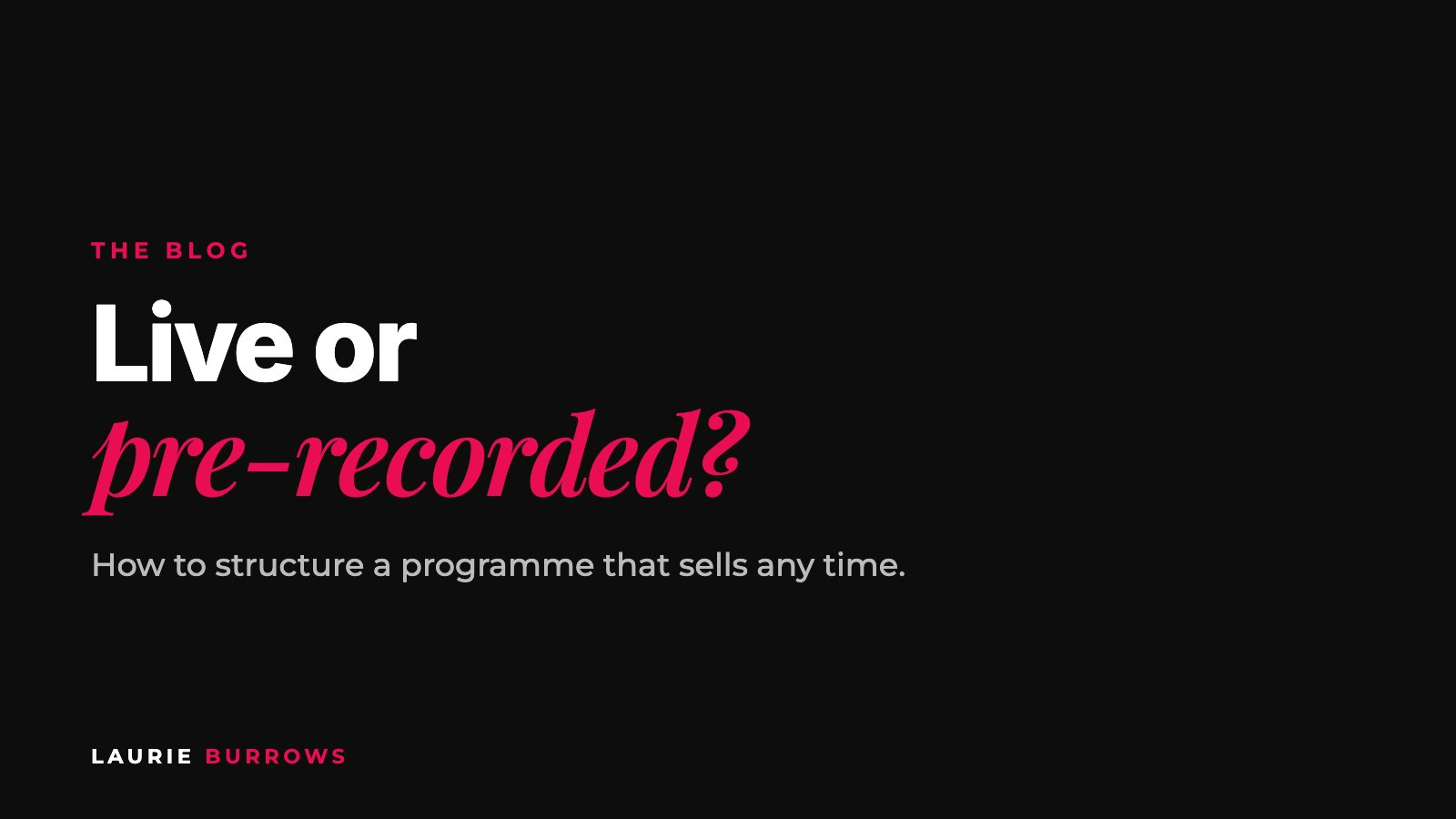
Short answer: for most coaches, the best answer is neither fully live nor fully pre-recorded, but a hybrid. Fully live programmes let you charge more and get better completion, but you're always delivering and people can only join on set dates. Fully pre-recorded programmes scale and sell any time, but there's no support, completion drops and you can't charge as much. A hybrid (pre-recorded curriculum, templates and AI support, plus live Q&As and community) gives you the best of both.
"Should my programme be live or pre-recorded?" is one of the most common questions I get, especially from coaches who want to move away from one to one without losing what makes their work special.
Before you decide, ask yourself a bigger question: what lifestyle do you want this offer to give you? Some of you want more time with your family. Some want to run your business from anywhere in the world. Some want an offer that sells any day of the week. How you structure delivery decides whether you get that, or a glorified nine to five with more people in it.
This is part of my ultimate guide to creating an offer that sells, where how you deliver is one of the choices that shapes the whole offer.
The pros and cons of a fully live programme
Pros
- You can charge more. People get more access to you, so they'll pay more for it.
- Better completion. Live sessions create accountability and momentum.
- Real time feedback. You hear exactly where people get stuck and can keep improving your method.
- Stronger relationships. People go on the journey with you, which makes them far more likely to stay on or buy your next offer.
Cons
- You always have to deliver. Every session needs you, switched on, every time.
- It has a start and end date. If your framework is taught one step per week, someone who finds you in week four has already missed four weeks.
- You can't sell it any time. People who are ready now have to wait for the next cohort, which could be months away. Most won't wait. They'll buy from someone else.
The pros and cons of a fully pre-recorded programme
Pros
- Create once, sell again and again. No extra work for each new buyer.
- Sell any time. It can sit in an evergreen funnel and sell every day.
- Saves you huge amounts of time. It's the closest thing to passive revenue.
Cons
- No support. When people get stuck, there's nobody to help.
- Lower price. Without support, most buyers won't pay a premium.
- Completion drops. Self paced often means never finished, which means no results and no testimonials.
- Harder to retain clients. With no touch points, it's harder to sell them into your next offer.
The hybrid: what I recommend
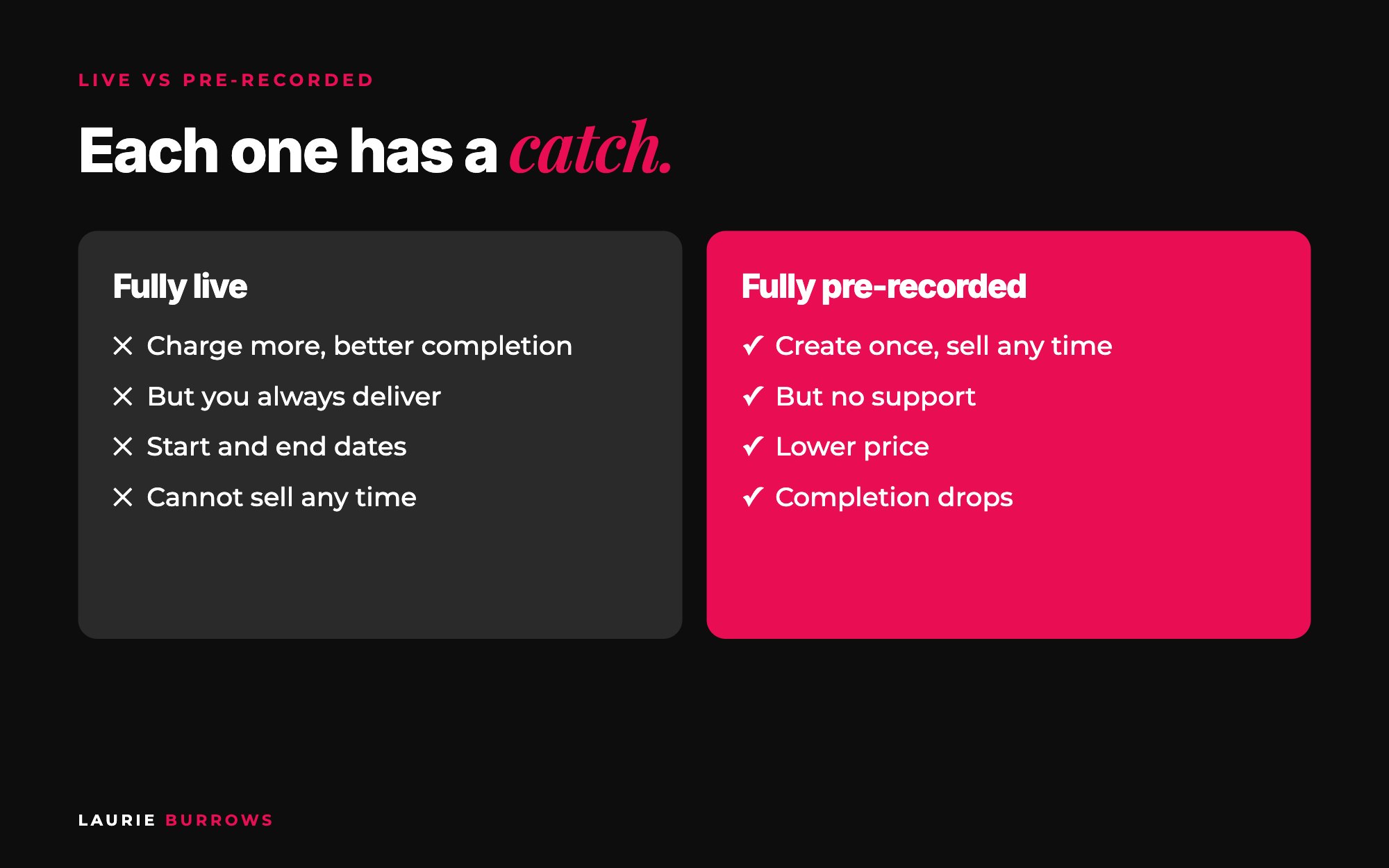
I want the pros of both, so I use a hybrid in our offers. Here's how it's structured:
- Pre-recorded curriculum. Your framework, step by step, ready from day one, so people can join any time and move through at their own pace.
- Templates and resources. So nobody starts from a blank page.
- AI support trained on your method. People ask questions and get instant help with their action steps, which saves you and your team loads of delivery time.
- Live Q&As and trainings. Regular sessions anyone can join, whether they're on module one or module ten.
- Specialist calls. We run tech calls, for example, for the bits people find hardest.
- A community. Daily support where people ask questions and help each other.
The live elements aren't tied to a particular week of the curriculum, so it doesn't matter when someone joins. And because the live support doesn't all have to be delivered by me, team members can run Q&As and calls too. That means I don't have to be switched on 100% of the time, and the offer is easily scalable.
How I did this as a new mum
When I launched my signature programme in 2020, I was pregnant and knew I'd soon have very limited time. So I pre-recorded all of the training and added a weekly live Q&A and check in, which held people accountable and answered their questions. In between, there was a Facebook group for questions, feedback and support. When I noticed lots of questions on one topic, I'd do an extra live session on it. As it grew, I brought in co-coaches to answer questions and run extra calls.
That structure is what let me sell the programme to hundreds of people while looking after a newborn. It was the hybrid before I called it the hybrid.
One more decision: how long?
Whatever you choose, think carefully about how long people get support. When you give someone 12 months, it takes them 12 months. When you give them 12 weeks, they get it done in 12 weeks. A shorter container means people take action, get results faster, and arrive at the end ready for your next offer.
A good middle ground is lifetime access to the pre-recorded curriculum with a fixed period of live support. The lifetime access raises perceived value. The fixed support creates urgency to actually do the work.
Do this now: list every part of your programme's delivery. Next to each one, write whether it could be pre-recorded, turned into a template, handled by AI, or delivered by someone else. Whatever is left is the live element that genuinely needs you. Protect that, and systemise the rest.
Which should you choose?
- Choose fully live if you love delivering, want to charge a premium, and you're happy running in cohorts with start and end dates.
- Choose fully pre-recorded for low priced offers where support isn't expected, like a mini course or masterclass.
- Choose a hybrid for your core offer if you want to sell any time, charge a good price and still give people an amazing experience without being always on.
Delivery is only one part of building an offer people want. For the rest, read the ultimate guide to creating an offer that sells. If your programme used to sell and has slowed down, why traditional courses and programmes stopped selling will help, and for how to sell a hybrid offer every day, see evergreen vs live launch. You'll find more in my free resources.
How to build a hybrid programme, step by step
If you've decided a hybrid is right for you, here's exactly how to set one up so people can join any time, get real support and you aren't switched on 100% of the time.
Step 1: Map your framework into modules
Take your signature framework (your A to B Method) and make each step a module. Under each module, list the lessons someone needs to complete that step. Keep lessons short, ideally 10 to 20 minutes, and end every lesson with one action to take.
Time: 1 to 2 hours. Done when: every module has a clear outcome and every lesson has an action.
Step 2: Record the curriculum once
Record the lessons in batches. Don't wait for perfect lighting or editing. Clear and useful beats polished. Add a worksheet or template to each module so people can implement as they go.
Time: 1 to 3 weeks, in batches. Done when: the full curriculum is uploaded and someone could start module one today.
Where you host it matters more than you'd think. Ascendia OS hosts your courses and community in the same place as your funnels, email and calendars, so your curriculum, your live session reminders and your members' space sit under one login and one bill.
Step 3: Set a weekly live rhythm that works for every module
Choose live sessions that are useful whether someone is on module one or module ten: a weekly Q&A, a monthly training or hot seat, and (if your offer is technical) a tech call. Fix the days and times so people can plan around them, and record them for anyone who can't make it.
Time: 30 minutes to plan. Done when: your live sessions are in the diary for the next 12 weeks.
Step 4: Decide how long support lasts
Give lifetime (or long) access to the curriculum, but a set length of live support. For most offers, 12 weeks works well: it gives people a deadline to take action, gets them results faster and gives you a natural moment to offer the next step, like extended support or a VIP upgrade.
Time: 10 minutes. Done when: you can say "you get the curriculum plus 12 weeks of live support".
Step 5: Take yourself out of the bottleneck
Decide which live sessions a team member or co-coach could run, and what questions templates, a community or an AI trained on your method could answer. The goal is that the programme still runs brilliantly in a week you are ill, on holiday or busy with your family.
Time: 1 hour. Done when: at least one part of the support no longer depends on you.
Step 6: Sell it any time
Because people can join any day, you can sell it through an evergreen funnel and your daily content, not just through launches. Open the doors permanently and use launches as boosts rather than the only way in.
Time: Ongoing. Done when: someone can buy and start on a random Tuesday without waiting for a cohort.
Selling any time means your pages and emails have to work without you. The Funnel Builder in Ascendia OS builds your sales page and checkout, and the Email Marketer writes the welcome sequence and nurture emails, so a buyer on a random Tuesday gets the same experience as a launch buyer.
Copy and paste: hybrid programme plan
Programme: [name] | End result: [result] in [timeframe]
Pre-recorded: [number] modules, one per framework step | Lessons of 10 to 20 minutes | One worksheet per module
Live: weekly Q&A on [day, time] | monthly training or hot seat on [day, time] | tech call on [day, time] (if needed) | all recorded
Support length: [12] weeks live support + [lifetime / 12 months] curriculum access
Run by someone else: [which session or support] | Answered without me: [templates, community, AI]
How it sells: [evergreen funnel / daily content / launches as a boost]
Example: turning a live cohort into a hybrid
This is an illustrative example. A coach runs a fully live 8 week cohort at $1,500, three times a year. She delivers 16 live calls per cohort and anyone who finds her between cohorts has to wait months. She moves to a hybrid: 6 pre-recorded modules, a weekly Q&A, a monthly hot seat and 12 weeks of support from the day each person joins. Her co-coach runs the monthly hot seat. She keeps the price at $1,500 because people still get live support, and now she can sell it every day through her funnel instead of three times a year. Her live delivery drops from two calls a week to one.
Benchmarks to aim for
| Element | Aim for |
|---|---|
| Lesson length | 10 to 20 minutes, one action per lesson |
| Live support | One weekly session plus one monthly, recorded |
| Support length | Around 12 weeks for most offers |
| Your live hours | No more than you can sustain in your worst week |
Common mistakes (and the fix)
- Live sessions that only make sense for one module. Fix: run Q&As and hot seats that help everyone wherever they are.
- Lifetime support with no end date. Fix: give a set length of live support so people take action and you can offer the next step.
- Recording hours of content to look valuable. Fix: keep lessons short and focused on the next action.
- Still running it like a launch only offer. Fix: sell it every day through your funnel and content.
Your action plan
Today
- Decide whether live, pre-recorded or hybrid suits your time and price.
- Map your framework into modules.
This week
- Plan your lessons and worksheets.
- Fix your weekly and monthly live sessions in the diary.
- Set your support length.
Next 30 days
- Record the curriculum in batches.
- Hand off one live session or support task.
- Open the doors so people can join any time.
- Finish the rest of your offer with the ultimate guide to creating an offer that sells.
Want help structuring and selling your programme?
In the 90 Day Revenue Growth Accelerator I help you structure your programme, price it and build the plan to sell it every month.
Rather have it done for you?
Sell your hybrid programme every day
Your course and community live on the same platform as your funnels, the Funnel Builder builds your always-open sales page and checkout, and the Email Marketer writes the welcome sequence and nurture emails. 14 days free, no tech skills needed.
Frequently asked questions
Is a live or pre-recorded course better?
Neither is better on its own. Live gives more access, higher prices and better completion. Pre-recorded scales and sells any time. Most coaches get the best results from a hybrid of pre-recorded training with live support.
Can I charge a high price for a pre-recorded programme?
It's harder without support, because buyers usually pay more for access to you. Adding live Q&As, community, templates or AI support raises the perceived value and lets you charge more.
How do I stop people dropping off a pre-recorded course?
Give them a fixed support period, regular live sessions to turn up to, a community and clear action steps. Implementation days and AI support that answers questions instantly also help people keep going.
Do I have to run the live sessions myself?
No. In a hybrid model, team members or co-coaches can run Q&As and support calls, which is what makes it scalable without you always being switched on.
Can a hybrid programme be evergreen?
Yes. Because the curriculum is pre-recorded and the live sessions aren't tied to a particular week, people can join any time, so you can sell it through an evergreen funnel as well as live launches.
Laurie Burrows is a UK-based marketing and sales strategist who has built a business that's generated multi-seven figures in sales through social media and digital marketing. Today, Laurie helps business owners use social media, content and digital marketing to get seen, attract more clients and make more sales. She's also the founder of Ascendia OS.
Do you want to scale your business to 10K months in the next 90 days? I am looking for 10 people for my new case study program. DM me the word CASE STUDY on Instagram (@_laurieburrows) to learn more.