How to Turn Content Into Clients (Step by Step)
Short answer: to turn content into clients, give every post a job and a next step. Use value content (educational, story and evidence) to build trust, add a small "comment below" call to action so readers become leads, start a real conversation with every person who raises their hand, and make your offer in stories, emails and DMs. Then review your analytics every month and do more of the top 20% that's working.
Most people think the answer to "my content isn't selling" is more content. Another reel. Another carousel. Another trending audio. And then they're exhausted, the sales still aren't coming, and they start to wonder if content even works anymore.
It does. But content doesn't turn into clients on its own. It turns into clients when it's part of a simple system. Below is the exact system I use, step by step, with the scripts, the numbers to aim for and a 30 day plan you can start today.
This is part of my ultimate guide to turning content into clients. This post is the quick version of the system. The guide goes deeper on every step.
Why doesn't my content turn into clients?
Because your content is usually doing one job when it needs to do three. Every strategy has three stages, Attract Nurture Convert, and your content needs to play a part in each. What I see most is people either posting nice value with no next step, or posting sales content every day and wondering why nobody engages.
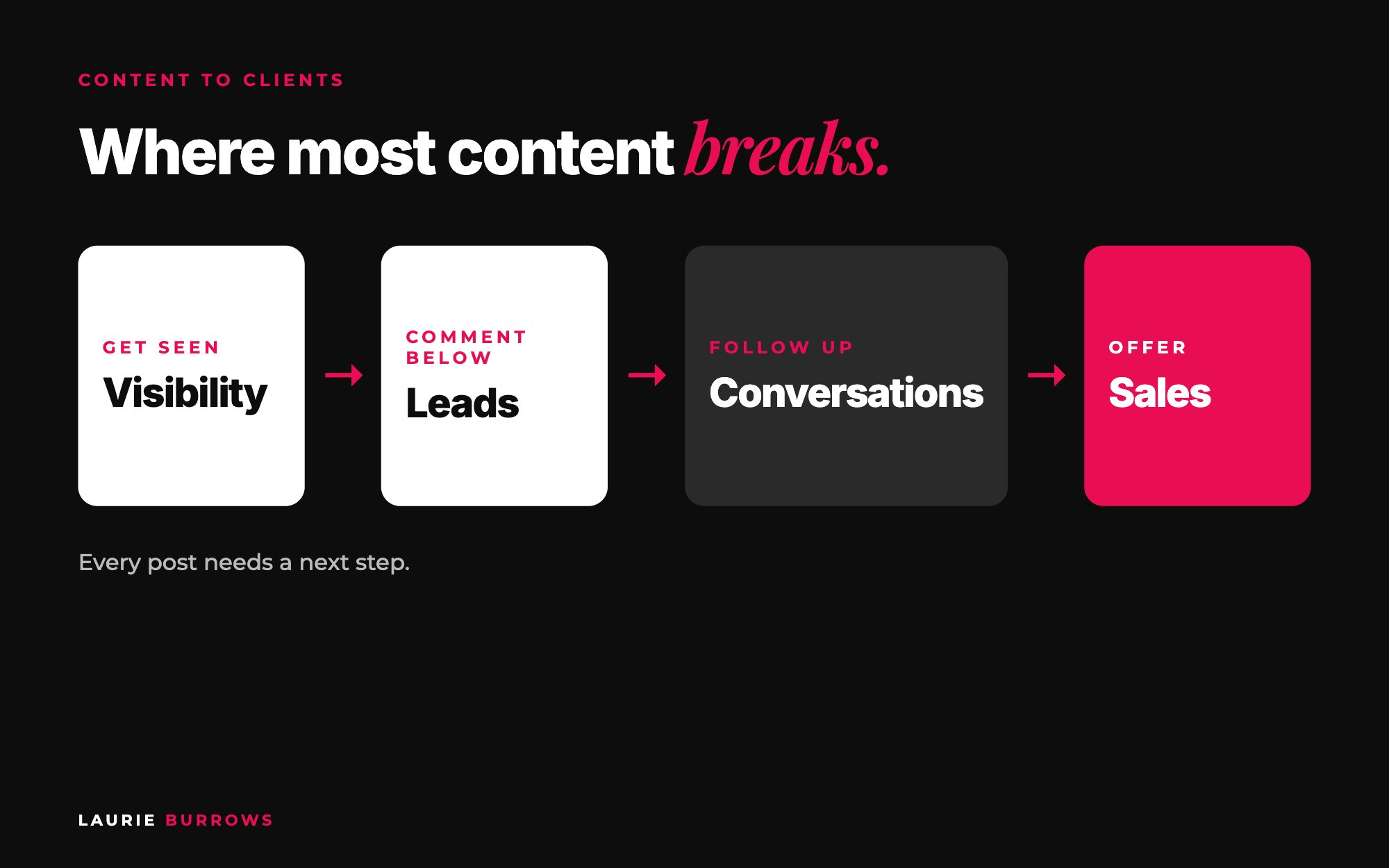
The chain looks like this: visibility leads to leads, leads lead to conversations, and conversations lead to sales. If your content gets seen but never turns into leads, the chain breaks at step two. If you get leads but never talk to them, it breaks at step three. Fix the broken link and the sales follow.
Free 5 day event · 12th to 16th October
The 6 Figure Game Plan
Want your content tied to a real number? Join my free 5 day event and map your strategy to 6 figures, then get the plan, content and pages created for you.
The numbers to aim for
Before the steps, here are the benchmarks I use, so you know what "working" looks like.
| What | Benchmark |
|---|---|
| Value vs promotion on your feed | Roughly 80% value, 20% promotion (more promotion during a launch) |
| Lead generation posts | A few times a week, every week |
| Leads to sales (average) | Around 3% of leads buy, so 100 leads is roughly 3 sales |
| Leads needed for 10 sales | 333 at a 3% conversion rate |
| Opt-in page conversion | Aim for 40% or more of visitors opting in |
| Thank you page offer | 8 to 10% of new opt-ins buying |
| Time on visibility and engagement | 20 to 30 minutes a day |
| Content review | Once a month: keep the top 20% |
Step 1: Decide what each post is for
Before you create anything, ask: is this post here to attract new people, nurture the people who already follow me, or convert them? If you can't answer, don't post it yet.
Then check it relates to what you're selling. If you spend the month talking about mindset and then promote a course on launching, your content hasn't warmed anyone up for that offer. Your content pillars (the three to five topics you want to be known for) keep you on track. More on that in how to find your content pillars.
- Attract: lead generation posts, short reels, entertaining or shareable content, guest spots.
- Nurture: educational posts, stories, day in the life, behind the scenes.
- Convert: evidence, offer stories, FAQs about your programme, direct "who wants this?" posts.
Time: 15 minutes per week. Done when: every post in next week's plan has the word attract, nurture or convert next to it, and links back to the offer you are selling this month. If planning is the bit that never happens, the Content Creator inside Ascendia OS plans your month around the offer you're selling, writes the posts in your voice and schedules them straight to Instagram, Facebook, LinkedIn and more.
Step 2: Make your educational content a mini masterclass
The biggest mistake I see with educational content is that it sounds like everyone else's. "Three reasons you're not at $10k months: you don't know your ideal client, you don't have content pillars, you're not generating leads." Your ideal client has heard it a thousand times.
Treat every educational post like a mini masterclass. Give one aha moment or one action step. If I post "how to get a sale in the next 24 hours" and give the steps, and someone goes and gets a sale, I've just built trust from free content. They're going to wonder what my paid content is like.
Keep it a soft teaching, not a hard teaching. A soft teaching tells a story, shows the why and gives one or a few steps. A hard teaching hands over your whole system, which overwhelms people and makes them scroll on.
Copy and paste: mini masterclass post
Hook: [Result] in [timeframe], without [thing they hate].
Line 2: Most [ideal clients] try [common approach]. That's why [problem keeps happening].
Line 3 to 6: Here's what to do instead. 1. [Action]. 2. [Action]. 3. [Action].
Line 7: Do step 1 today and tell me how it goes.
PS. Want my free [guide or training] on this? Comment [WORD] below and I'll send it over.
Time: 30 to 45 minutes per post. Done when: a reader could take one action from the post today without buying anything.
Step 3: Use stories and evidence to build trust
Educational content solves a problem. Story content connects. Stories create human connection, which feels like a relationship even when you've never met. They create emotion, and people buy on emotion. And emotion makes your content memorable, which keeps you in the mind of your ideal client when they're ready to buy.
My core brand stories get rinsed and repeated: starting my business in January 2020 and finding out a couple of weeks later that I was pregnant, then hitting nearly $200,000 in my first year as a new mum. People relate to it because a lot of my audience are growing businesses around a family.
Then there's evidence based content: testimonials, results, screenshots, case studies. It shows you can walk the walk, not just talk the talk. If you don't have client results yet, become your own evidence by documenting your journey. When I came into the online space, that's exactly what I did.
Time: 1 hour, once. Done when: you have a list of 3 to 5 brand stories and 3 pieces of evidence (or "documenting my journey" posts) you can reuse every month.
Step 4: Add a small call to action to every value post
This is the simplest change with the biggest effect. At the end of an educational post, a story or a piece of evidence, add a small PS.
I shared a story about changing my business model, and at the bottom I added: "PS. If you want a training on this, comment TRAINING below." I shared a strategy I'd use to get to $10k months, gave the steps, and at the end said comment STRATEGY. Sixteen people commented on that one post, and every one of them got sent a training.
The post is still 90% value. It doesn't feel like selling. But now it generates leads. (Brand story structures are in storytelling formulas for written posts that sell.)
Copy and paste: PS lines for value posts
PS. If you want my free [guide] on this, comment GUIDE below and I'll send it straight to you.
PS. I've recorded a short training that walks you through this step by step. Comment TRAINING and it's yours.
PS. I'm running a free live [masterclass or challenge] on this on [date]. Comment LIVE for the link.
Time: 2 minutes per post. Done when: every value post this week ends with one PS line and one keyword.
Step 5: Post lead generation content a few times a week
Lead generation content exists purely to get people to raise their hand. We post it a good few times a week:
- Comment below reels: a short video with text on screen, like "POV: you're gifting 100 business owners access to a free 10 day live programme. Comment below for the link."
- Comment below posts on Facebook, often a short post with a coloured background.
- Story polls: "I've made a free guide on how to make sales every day. Want it?" with "hell yes" as an option. Anyone who votes is a lead.
An automated reply sends each person the link, they opt in, and now they're on your email list where you can nurture them. Comments also help the algorithm push the post out further, so lead generation content gets you seen as well.
Send people to something free first, like a guide, a training or a live event, because in our testing free generates more leads than sending people straight to a paid offer. Then put a low priced offer on the thank you page. That's how a single comment can become a buyer within minutes.
Copy and paste: lead generation reel and story poll
Reel text on screen: POV: you just found the [free guide or training] that shows you how to [result] in [timeframe]. Comment [WORD] and I'll send it to you.
Caption: I put everything I use to [result] into one free [guide]. Comment [WORD] below and it's yours.
Story poll: I've made a free [guide] on [result]. Want it? Options: "Hell yes" / "Not right now".
Time: 20 minutes per post, 3 posts a week. Done when: you have 3 lead generation posts scheduled for the week and an automated or manual reply ready for each keyword.
Step 6: Have the conversation
A lead is not a client. A conversation turns one into the other.
When someone comments or votes, follow up like a human. Use their name, mention what they did and ask a question. My favourite is "where are you now compared to where you want to be?" because they'll usually tell you exactly what they're struggling with. That lets you tailor your offer to their words.
Copy and paste: first DM after a comment
Hey [name], I've just sent the [guide] over to you. Can I ask what made you grab it? Tell me a little bit about where you are in your business at the moment compared to where you want to be.
If they reply with a struggle: That makes total sense, and it's exactly what [offer] helps with. It's [one sentence on the result]. Would you like the details?
If they go quiet (2 to 3 days later): Hey [name], just checking you got the [guide] OK? Any questions, I'm right here.
Some people will say yes when you mention your offer, some will say "yes, but" (which is an objection you can help with), and some will say no. No is fine. I always ask "can I ask why?" because it's brilliant feedback, and sometimes the no becomes a yes. For the full DM process, read getting in the DMs without being salesy.
Time: 20 minutes a day. Done when: every person who commented or voted in the last 48 hours has had a personal message.
Step 7: Sell where selling works
It used to take someone around 19 times seeing the same message before they took action. So yes, you need to talk about your offer more than once.
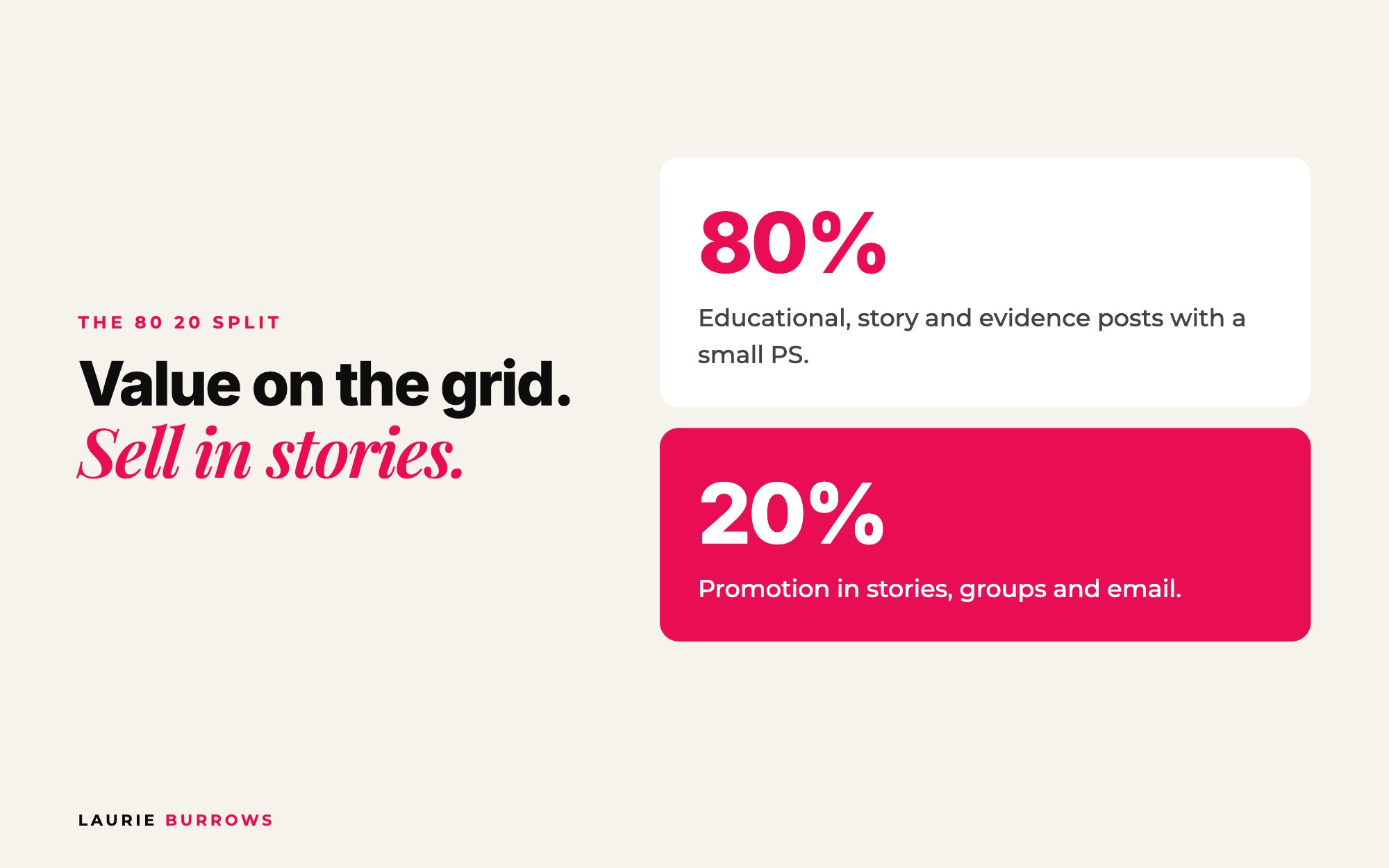
But in our account, posting sales content on the Instagram grid every day dropped the reach of everything else. So we keep the grid for value and lead generation, and do most of our selling in stories (some of our story slides look like a mini sales page), in our Facebook group and by email. Roughly 80% value, 20% promotion, with promotion going up when we're in a launch.
Copy and paste: 5 story sales sequence
Story 1: The problem. "If you're [struggle], this is for you."
Story 2: The result. "Imagine [result] in [timeframe]."
Story 3: The offer. "[Offer] is [what it is] for [who]. Here's what's inside: [3 things]."
Story 4: The proof. A testimonial, a screenshot or your own result.
Story 5: The call to action. Poll: "Want the details?" Yes / Not yet. Then DM everyone who votes yes.
Time: 15 minutes a day, 3 to 4 days a week. Done when: your offer has appeared in your stories, an email and at least one post this week.
Step 8: Review the top 20% every month
At the end of every month we look at our analytics, take the top 20% of our content and make more of it. Then we repurpose. One talking head video becomes a carousel, a single image with the caption, and a B roll reel with text over the top. Same message, four different formats, posted a few weeks apart. Nobody remembers what you posted last month.
Time: 1 hour, once a month. Done when: you have a list of your top 20% posts and a plan to repurpose each one into at least two new formats next month.
Worked example: a business coach selling a $997 programme
Example: a business coach wants 10 new clients for a $997 programme next month. Here's how the system plays out.
- The maths: at a 3% conversion rate she needs around 333 leads for 10 sales. That's about 11 new leads a day.
- Attract: 3 lead generation reels a week with the keyword PLAN, sending people to a free "first 10 clients" guide. Plus 30 minutes a day engaging with ideal clients.
- Thank you page: a $27 offer. If 8% of 333 opt-ins buy, that's around 26 buyers, roughly $700 that covers her time and tools.
- Nurture: 2 educational posts and 2 stories a week, each with a PS line. A 5 email sequence to everyone who opted in.
- Convert: a DM to every person who comments, the 5 story sales sequence twice a month, and an email offer to the list.
- Result to aim for: 10 sales at $997 is $9,970, plus the low priced offer sales, from content she was already posting. The difference is the system around it.
Common mistakes (and the fix)
- Value posts with no next step. Fix: add a PS line and keyword to every value post.
- Selling on the grid every day. Fix: keep the grid for value and lead generation, sell in stories, email and DMs.
- Collecting comments but never messaging people. Fix: 20 minutes a day of DMs to everyone who raised their hand.
- Content that sounds like everyone else's. Fix: one unique angle and one action step per post.
- Content that has nothing to do with the offer. Fix: plan content backwards from what you're selling this month.
- Never checking the numbers. Fix: a monthly review of your top 20%.
If you want every template, script and tracker for this in one place, my course Content To Clients® is my full system for turning content into repeat sales.
Your action plan
Today
- Choose the one offer your content will sell this month.
- Add a PS line and keyword to your three best recent posts and repost one of them.
- Message everyone who has commented or voted in the last week using the first DM script.
This week
- Post 3 lead generation pieces (a reel, a comment below post and a story poll).
- Write your 3 to 5 brand stories and post one of them.
- Run the 5 story sales sequence once.
- Spend 20 to 30 minutes a day engaging with ideal clients.
Next 30 days
- Track leads, conversations and sales every week against the benchmarks above.
- Add a low priced offer to your thank you page if you don't have one yet.
- Review your top 20% at the end of the month and repurpose each into two new formats.
Want the bigger picture? Read the ultimate guide to turning content into clients, and if you're posting every day and still not selling, this one is for you.
Want the whole content to clients system done with you?
Content To Clients® is my full system for turning your content into repeat sales: the content, the lead generation, the DMs and the offers, with every tool and template.
Rather have it done for you?
Let your AI marketing team turn your content into clients
Inside Ascendia OS, the Content Creator plans and schedules your posts, the Copywriter writes your PS lines, DMs and story sales sequences, and the Funnel Builder builds the opt-in page your comment below posts send people to. 14 days free, no tech skills needed.
Frequently asked questions
How do I get clients from social media without being salesy?
Lead with value and add a small call to action, like "comment below for the guide". People who comment have raised their own hand, so following up with them feels like help, not a pitch.
What is lead generation content?
It's content designed to get people to show interest, such as comment below posts, reels and story polls. Everyone who responds is a lead you can send to a free resource, an event or an offer.
How much of my content should be sales content?
Around 20% promotion and 80% value works well as a rule of thumb. Increase the sales content when you're in a launch, and do most of your direct selling in stories, email and DMs.
Why do my value posts get likes but no clients?
Usually because there's no next step. Likes are nice, but a post needs a call to action that turns interest into a lead, and then a conversation that turns the lead into a client.
How many leads do I need to get clients from content?
Use 3% as a starting average: 100 leads is roughly 3 sales, and 333 leads is roughly 10. Track your own numbers for a month and use them instead.
Laurie Burrows is a UK-based marketing and sales strategist who has built a business that's generated multi-seven figures in sales through social media and digital marketing. Today, Laurie helps business owners use social media, content and digital marketing to get seen, attract more clients and make more sales. She's also the founder of Ascendia OS.
Do you want to scale your business to 10K months in the next 90 days? I am looking for 10 people for my new case study program. DM me the word CASE STUDY on Instagram (@_laurieburrows) to learn more.