Storytelling Formulas for Written Posts That Sell (With Templates)

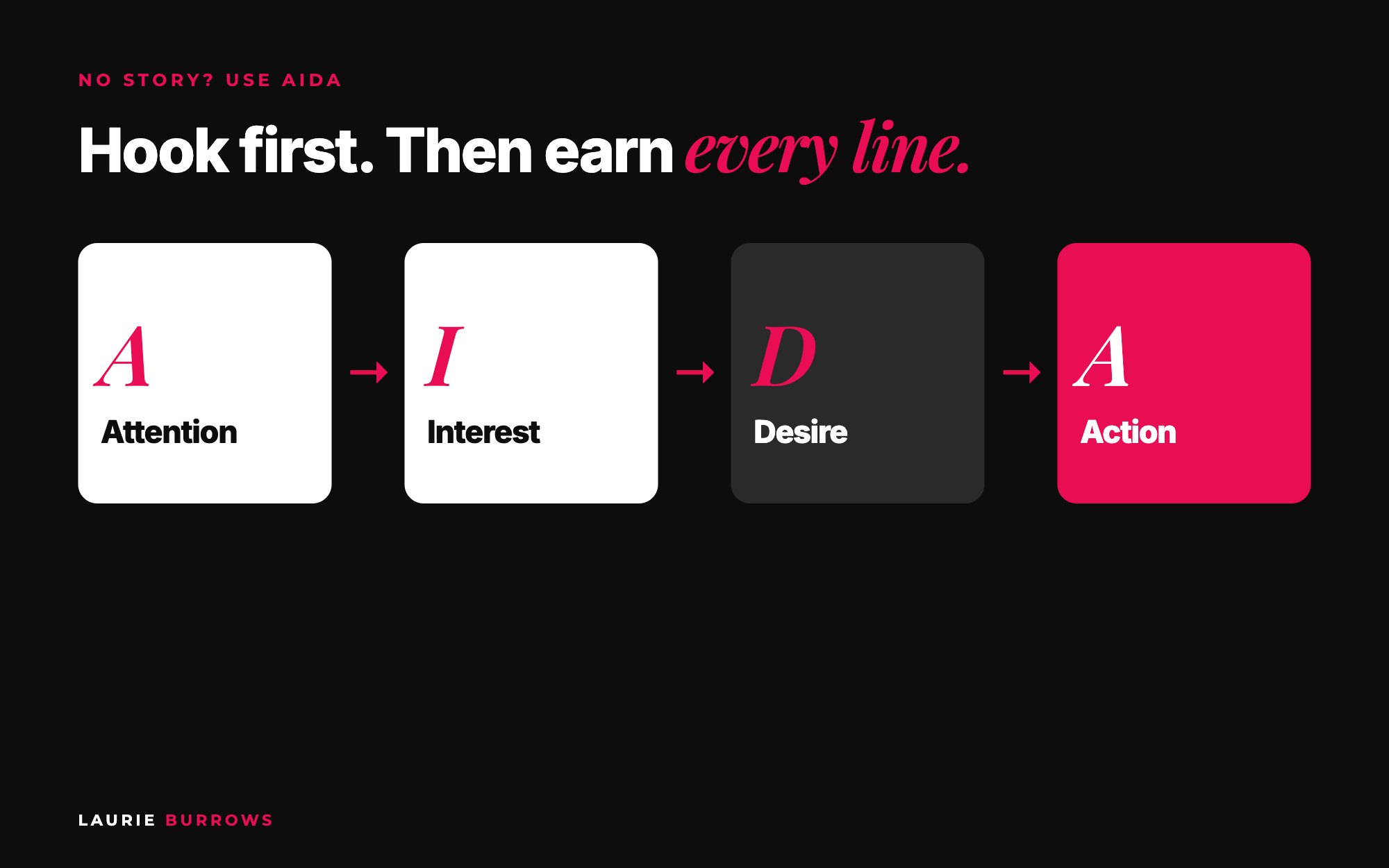
Short answer: the storytelling formulas I use for written posts are Story Lesson Offer (tell a relatable story, pull out the lesson, make an offer), the Hero's Journey (your reader is the hero and you're the mentor) and the Magic Formula (incident, action, benefit). For posts that don't need a story, use the 1 2 3 Formula or AIDA (attention, interest, desire, action). Whatever the formula, the first line is your hook and it has to earn the second line.
Stories are one of the most powerful things you can put in your content. They make you relatable, they create emotion, and they make you memorable, which matters because people buy on emotion and buy from the person they remember.
But a story without structure is just a diary entry. Below you'll get each formula as a fill-in-the-blanks template, a worked example of the same story written three ways, and a 7 day plan to put them to work.
This is part of my ultimate guide to turning content into clients. Story posts are where people start to feel they know you, which is what makes them buy later.
Before you write: soft teaching vs hard teaching
A hard teaching hands over your entire system. It can overwhelm, exhaust or bore people, and it makes you look like a how-to guide rather than an expert someone remembers. A soft teaching creates connection and builds a bit of tension by telling a story, showing the why and giving one or a few of the steps. That's what you want in a written post.
And before you hit post, read it as your ideal client. If this popped up in your feed, would you keep reading? Would you take action? Would you want more? If not, it needs work.
Step 1: Build your story bank
You can't use a formula if you can't think of a story. So build a bank once and draw from it every week. Write one line for each of these:
- A time you nearly gave up, and what made you carry on.
- A mistake that cost you money, time or a client, and what you do differently now.
- The moment something clicked (your "aha").
- Where you were before vs where you are now.
- A client moment (no names, and only with permission for any details).
- A small everyday moment that taught you something (the school run, a supermarket queue, a holiday).
Your stories don't have to be your deepest, darkest moments. They need to be relevant to your ideal client's pain points.
Time: 30 minutes, once. Done when: you have at least 10 one-line story ideas saved somewhere you'll see them.
Step 2: Pick the right formula
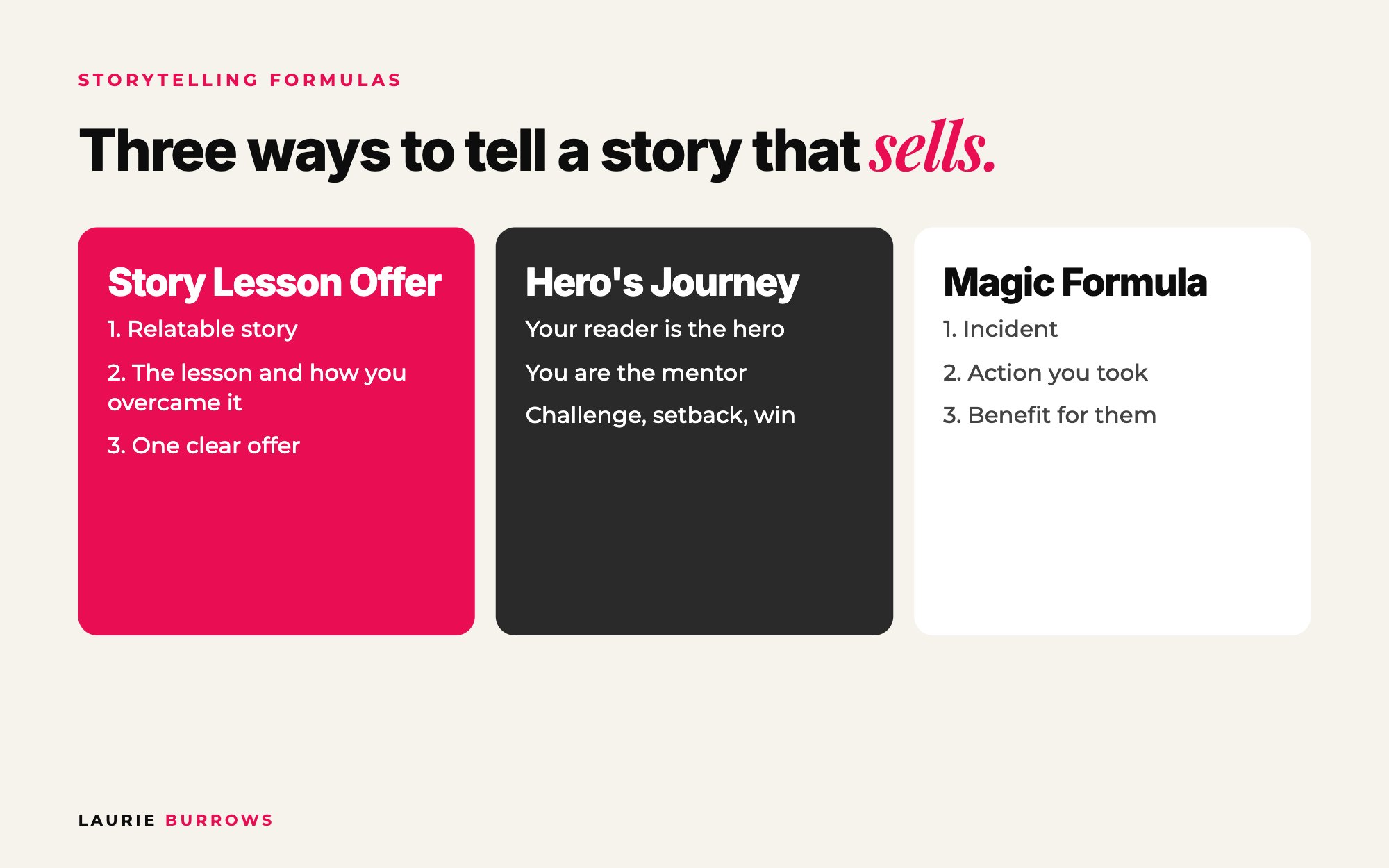
Story Lesson Offer
This is the simplest formula and the one I use most. Tell a story your ideal client can relate to, share what you learned and how you overcame it, then end with a call to action relevant to the lesson. One of the stories I've shared is how I kept giving up on my business and going back to a corporate job, over and over again. So many people in my audience have been at the point of wanting to give up, so they keep reading.
Copy and paste: Story Lesson Offer
Hook: [Drop them into the moment in one line.]
Story: [3 to 5 short lines. What happened, how it felt, what was at stake.]
Lesson: Here's what I learned: [the lesson]. And here's what I did about it: [how you overcame it].
Offer: If you're [in the same place], [call to action: comment WORD for my free X / join my free training / the doors to Y are open].
The Hero's Journey
So many of our favourite films follow the same structure because it works. The hero is living a normal life, something changes everything, they're afraid but accept the call, they realise they need a mentor, they face challenges and are tempted to give up, then they win thanks to what they've learned. The key: your reader is the hero, not you. You're the mentor handing them the tools.
Copy and paste: Hero's Journey
Normal life: You're [their current situation], doing everything you're told to do.
The change: Then [the moment that tells them something has to change].
The fear: You want to [goal], but [the fear holding them back].
The mentor: This is where [your method or offer] comes in. [One line on what it gives them.]
The challenge: It won't all be smooth. [The obstacle they'll face] is normal.
The win: But on the other side is [the world they want]. [Call to action.]
The Magic Formula
Three parts, quick to write: incident (a personal experience relevant to your audience), action (what you did to overcome it) and benefit (what changed because you took that action, and what it could do for them).
Copy and paste: Magic Formula
Incident: [What happened to me.]
Action: [What I did about it.]
Benefit: [What changed, and what it could change for you.] [Call to action.]
For posts without a story: the 1 2 3 Formula and AIDA
The 1 2 3 Formula asks four questions: what have I got for my audience, what's in it for them, who am I to teach this, and what do I want them to do next? Your audience sees tens of thousands of marketing messages a day, so tell them what's in it for them first.
AIDA is attention (a hook that stops the scroll), interest (something different or unique), desire (why they'd want it, with emotion) and action (exactly what to do next).
Copy and paste: 1 2 3 Formula
I've put together [what you've got].
It's full of [what's in it for them], so you can [result].
I've used this to [your credibility in one line].
Want it? [Call to action.]
Time: 2 minutes per post. Done when: you've chosen one formula before you start writing.
Step 3: Write a hook that earns the second line
Whatever formula you use, the first sentence is your hook. If the first line is "Happy Monday everyone!", most people are gone. Three hooks that work with every formula:
- Start in the middle: "Three times I handed in my notice. Three times I went back."
- Paint the world they want: "Imagine opening your laptop to sales that came in while you were on the school run."
- Say what they're thinking: "If you've been posting every day and still hearing crickets, read this."
Time: 5 minutes per post. Write 3 hooks, keep the best. Done when: your first line makes you want to read line two.
Step 4: End with one clear call to action
Match the call to action to the lesson. If the story was about filling your diary, the call to action is your free guide on filling your diary, not your unrelated membership. One action per post. Comment a word, click the link or send a DM.
Time: 2 minutes. Done when: the post ends with exactly one thing to do.
Once your story bank is written, you don't have to turn every story into a post by hand. The Content Creator inside Ascendia OS writes posts in your voice from your own stories and schedules them, so your best stories get rinsed and repeated without you starting from scratch each time.
Worked example: one story, three formulas
Example: a coach whose story is "I kept going back to a corporate job".
- Story Lesson Offer: "Three times I handed in my notice. Three times I went back." The story of the cycle, the lesson (it wasn't the business, it was having no plan for leads), the offer (comment PLAN for a free 30 day lead plan).
- Magic Formula: Incident: went back to corporate for the third time. Action: did the mindset work and built a simple plan for getting leads every day. Benefit: the business finally grew, and the call to action invites readers to start the same plan.
- Hero's Journey: written to the reader: "You're in a job that pays the bills but it's not the life you want..." with the free plan as the mentor's tool.
Same story, three posts, posted weeks apart. Then compare comments and saves to see which formula your audience responds to.
Common mistakes (and the fix)
- Background first. Fix: start in the moment, fill in context after.
- Making yourself the hero. Fix: in the Hero's Journey, the reader is the hero and you're the mentor.
- A lesson with no "how". Fix: always share how you overcame it, so they believe you can help.
- An unrelated call to action. Fix: match the offer to the lesson.
- Hard teaching. Fix: one or a few steps, not your whole system.
Your action plan
Day 1
- Write your story bank of 10 one-line stories.
Day 2
- Draft one Story Lesson Offer post using the template.
Day 3
- Write the same story as a Magic Formula post.
Day 4
- Write a Hero's Journey post with your reader as the hero.
Day 5
- Write three hooks for each and pick the strongest.
Days 6 to 7
- Post the first one, reply to every comment and DM everyone who used your keyword. Schedule the other two for the coming weeks.
Stories are one of the 6 types of content every coach needs, and they do their best work inside a plan, see the ultimate guide to turning content into clients. If you'd like Claude to turn your story bank into posts using these formulas, in your own voice, that's exactly what The Claude Content Engine is built for.
Want your stories turned into posts in your voice?
The Claude Content Engine sets Claude up to sound like you, with prompts for carousels, reels and captions and a monthly content sprint. Feed it your story bank and it drafts posts using formulas like these.
Rather have it done for you?
Turn your story bank into a month of posts
The Content Creator in Ascendia OS writes your story posts in your voice and schedules them across Instagram, Facebook, LinkedIn and more, and the Copywriter turns your best stories into emails and sales posts. 14 days free, no tech skills needed.
Frequently asked questions
What is the best storytelling formula for social media posts?
Story Lesson Offer is the easiest to use daily. Tell a relatable story, share the lesson and how you overcame it, then give a call to action that matches the lesson.
How long should a story post be?
As long as it stays interesting. Every line should earn the next. If a section doesn't build tension or add value, cut it.
Do I have to share personal stories?
No. Your stories need to be relevant, not your deepest, darkest moments. Business lessons, client moments and behind the scenes all work.
Do these formulas work for videos and emails?
Yes. Write the story once and you can turn it into a talking head, a carousel, a voiceover over B roll or an email. Some people love reading and some only watch reels, so use more than one format.
Laurie Burrows is a UK-based marketing and sales strategist who has built a business that's generated multi-seven figures in sales through social media and digital marketing. Today, Laurie helps business owners use social media, content and digital marketing to get seen, attract more clients and make more sales. She's also the founder of Ascendia OS.
Do you want to scale your business to 10K months in the next 90 days? I am looking for 10 people for my new case study program. DM me the word CASE STUDY on Instagram (@_laurieburrows) to learn more.