How to Plan a Launch: The Questions to Answer First
Short answer: before you plan any launch content, answer the core questions first: what you're selling and at what price, your revenue goal and leads goal, which type of launch suits that price and audience, how long you'll promote, how long the event runs, where you'll host it, which day you'll pitch, how long cart stays open and what happens afterwards. Then map the launch week by week, ideally around three months ahead, and list every asset you need with a deadline.
Most launch overwhelm doesn't come from the launch itself. It comes from making decisions at the last minute. Writing the opt-in page the night before promotion starts. Designing graphics on day one. Working out the bonus while you're pitching.
Your launch can be as simple or as complicated as you like. But whatever it looks like, it needs content, graphics, emails, pages and a plan. Do it in advance and the launch feels calm. Do it last minute and you'll burn out before cart even opens.
This is exactly how I plan mine, in five steps, with a launch brief and asset checklist you can copy, a worked example and an action plan.
This is part of my ultimate guide to a 6 figure course launch. Plan it here first, then use the guide to run it.
Step 1: Pick your launch window (around three months out)
For a big launch, I start around three months in advance. That gives me time to get everything together without burning out.
We now know our big launches for the year ahead, because we've got previous years of data showing which months have always been our best for launching. If you've launched before, look back at yours. If you haven't, start a record now so next year's planning is easier.
Can you plan a launch in a month? Yes. Just be honest about how much time and support you've got.
Time: 20 minutes. Done when: your launch month is in the calendar and you know how many weeks you have to prepare.
Free 5 day event · 12th to 16th October
The 6 Figure Game Plan
Want help answering these questions with a plan that adds up? Join my free 5 day event (12th to 16th October). You'll map your strategy to 6 figures and get the plan, content and pages created for you.
Step 2: Answer the nine launch questions
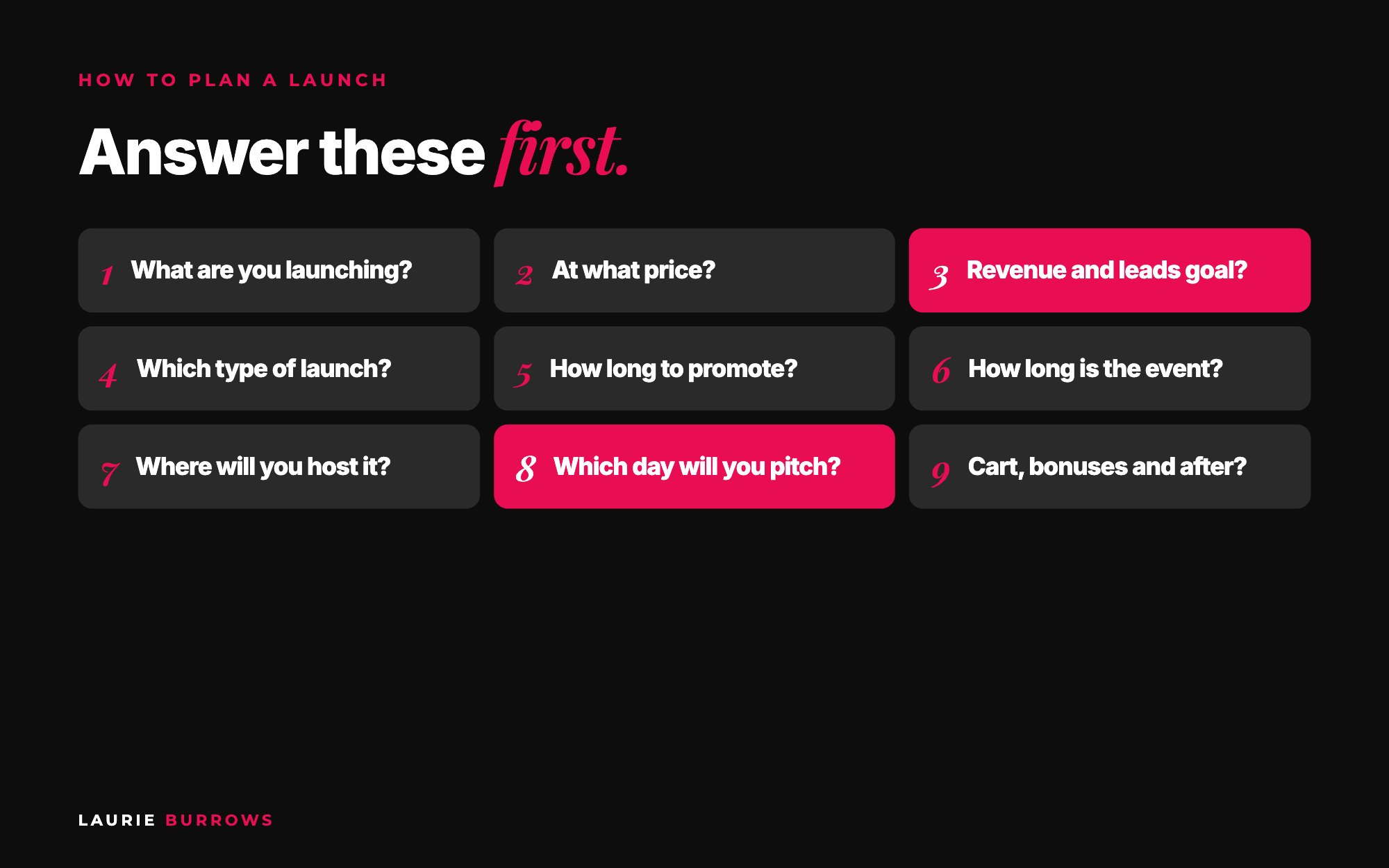
1. What are you launching, and at what price?
Be specific about the offer and the price. Consider whether you'll have tiers or a VIP option, where people can pay more for extra access or extra support. Different price points sell best with different types of launch, so this decision drives everything else.
2. What's your goal, and how many leads do you need?
Set your revenue goal, divide it by your price for your sales target, then divide that by your conversion rate (use 3% if you've never launched) for your leads goal. Then map where those leads will come from. I walk through the maths in how to have a 6 figure launch.
3. Which type of launch suits this offer?
In my business:
- Mid level offers around $1,000 to $3,000 sell really well from a 3 to 5 day challenge, because that gives people enough time to go from cold to hot.
- Higher ticket offers usually sell best from a masterclass targeted at my warm audience, who already know and trust me.
The higher the price, the more trust people need and the fewer people will be ready, so think about how warm your audience is. If you're unsure whether you even need a live launch, read evergreen vs live launch.
4. How long will you promote the free event?
Usually one to two weeks. Maybe you've promoted for one week before and it wasn't enough, or for three and it was too much. Use what you learned last time. The more leads you need, the longer you'll want.
5. How long is the event itself?
A 90 minute masterclass? A three day workshop? A five day challenge? Live or pre-recorded?
6. Where will you host it?
A pop up Facebook group, your existing community, Zoom, or a mix. One lesson from my early days: I used to send people straight to a pop up Facebook group with no opt-in page. The problem is you can't collect their emails, so you can't send reminders. Always use an opt-in page.
7. Which day will you pitch?
Day two of a three day event, day three of a five day event, or the end of a masterclass (with a mention halfway through).
8. How long will cart be open, and what are the bonuses?
Decide your fast action bonus, any pay in full bonus, when each one ends and when cart closes.
9. What happens after cart closes?
An encore, a masterclass or a low priced down sell for everyone who didn't buy. If you run a follow up masterclass with a bonus, make it slightly smaller than the main launch bonus and give it to everyone who joined in the main launch too. You never want anyone feeling misled.
Copy and paste: launch brief
Offer and price: [offer], $[price], tiers or VIP: [yes/no]
Goal: $[revenue] ÷ $[price] = [sales] sales ÷ [3%] = [leads] leads
Launch type: [3 day workshop / 5 day challenge / masterclass], [live / pre-recorded]
Promotion: [start date] to [end date] ([1 or 2] weeks)
Hosted in: [community / Zoom], opt-in page: [link]
Pitch day: [day], fast action bonus: [bonus] until [date and time]
Cart: opens [date], closes [date and time]
After: [encore / masterclass / low priced offer] on [date]
Time: 1 hour, in one sitting. Done when: every line of the brief is filled in. Anything you can't answer goes to the top of your to-do list.
Step 3: Map your launch week by week
Once the questions are answered, I split the launch month into weeks, starting on the Monday of each week, and give each week a theme. Here's an example for a three day workshop:
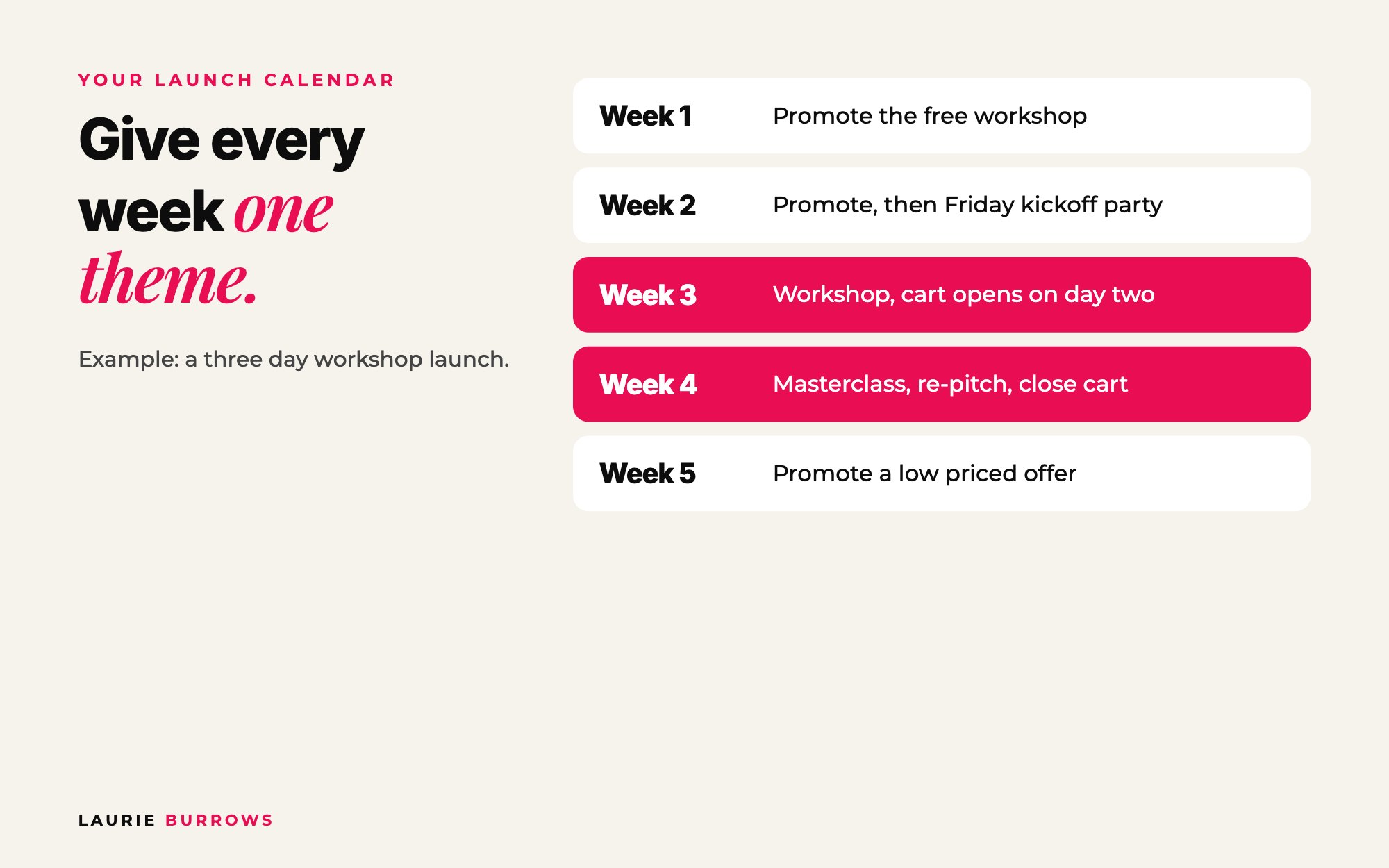
- Week one: promote the free workshop every day.
- Week two: keep promoting. On the Friday, open the group and run the kickoff party.
- Week three: run the workshop Monday to Wednesday, open cart on day two, bonus until the end of the week.
- Week four: promote a masterclass for a few days, run it midweek, pitch again with a smaller bonus for around 48 hours, then close cart.
- Week five: promote a low priced offer.
I start in a simple document, then move it onto a project board with a calendar view so every date and task is visible to the team. Use whatever works for you: pen and paper, a document or a board. The tool doesn't matter. Having the dates does.
Time: 30 minutes. Done when: every week of the launch month has a theme and every key date (kickoff party, pitch, bonus end, cart close) is in the calendar.
Step 4: List every asset and work backwards
Now that you have dates, work backwards. When do you need:
- the opt-in page and thank you page?
- the promo graphics?
- two weeks of promotional content?
- the reminder emails and WhatsApp messages?
- the community open and ready?
- the sessions recorded or planned?
- the sales page and checkout?
- the bonuses ready to deliver?
- the cart open emails and content?
Give each one a deadline before it's needed, not on the day. The first time is the hardest. After that you duplicate your pages, emails and plan, and tweak them based on what happened last time.
Copy and paste: asset deadline checklist
[ ] Opt-in page and thank you page: ready 3 days before promotion starts
[ ] Promo graphics: ready 3 days before promotion starts
[ ] Two weeks of promo content: written before promotion starts
[ ] Reminder emails and WhatsApp messages: scheduled before promotion starts
[ ] Launch partner swipe copy: sent 1 week before promotion starts
[ ] Community set up: ready before the kickoff party
[ ] Sessions recorded or planned: done 1 week before day one
[ ] Sales page and checkout: tested 3 days before pitch day
[ ] Bonuses: ready to deliver before cart opens
[ ] Cart open emails and content: scheduled before pitch day
Looking at that list and wondering where the time is coming from? This is exactly what the Launch Manager inside Ascendia OS is for. It plans your launch from first email to cart close, the Copywriter writes the sales page and launch emails in your voice, and the Funnel Builder builds the pages and checkout. You approve it rather than starting every asset from a blank page.
Time: 1 hour to list, then work through it over the prep weeks. Done when: every asset has an owner and a deadline that's at least a few days before it's needed.
Step 5: Review it the week after
The plan isn't finished when cart closes. Look at your numbers at every stage: sign-ups, show up, sales, and where people dropped off. Write down what went well, what didn't and what you'll change. That's what makes the next plan better, and it's how a launch that flops becomes one that sells. For the full launch process, read the ultimate guide to a 6 figure course launch.
Worked example: a $1,500 programme launched from a 3 day workshop
Example (illustrative): a consultant plans a March launch of a $1,500 programme, starting the planning in December.
- Goal: $30,000 ÷ $1,500 = 20 sales. At 3%, that's around 667 sign-ups.
- Launch type: a pre-recorded 3 day workshop, because a mid level offer needs a few days for people to go from cold to hot.
- Week 1 (Monday 1st March): promote the free workshop every day. Around 48 sign-ups a day over 14 days.
- Week 2 (Monday 8th March): keep promoting. Kickoff party on Friday 12th March.
- Week 3 (Monday 15th March): workshop Monday to Wednesday. Pitch and open cart on day two, fast action bonus for 48 hours, cart open until the end of the week.
- Week 4 (Monday 22nd March): masterclass on Wednesday 24th March, smaller bonus for 48 hours (given to earlier buyers too), cart closes.
- Week 5 (Monday 29th March): promote a low priced offer to everyone who didn't buy.
- Prep in January and February: pages and graphics by mid February, content and emails written by the end of February, sessions recorded the week before promotion starts.
Launch planning benchmarks
| Decision | What I use |
|---|---|
| Planning lead time | Around three months for a big launch, one month for a small one |
| Promotion | One to two weeks |
| Offer around $1,000 to $3,000 | 3 to 5 day challenge or workshop |
| Higher ticket | Masterclass to a warm audience |
| Pitch | Day two of three, day three of five, end of a masterclass |
| Conversion rate to plan with | 3% (industry 1 to 3%, my launches 10 to 12%) |
Common launch planning mistakes
- Mistake: Making decisions during the launch. Fix: Answer all nine questions before you create anything.
- Mistake: No opt-in page. Fix: Always collect emails so you can send reminders.
- Mistake: Deadlines on the day an asset is needed. Fix: Set them days earlier, so there's room for things to go wrong.
- Mistake: One event and nothing after. Fix: Plan the masterclass or low priced offer for non-buyers from the start.
- Mistake: Starting from scratch every time. Fix: Duplicate last launch's pages, emails and plan, then tweak.
Your action plan
Today
- Pick your launch month.
- Fill in the launch brief above.
This week
- Map the launch month week by week with every key date.
- Copy the asset checklist and give everything a deadline and an owner.
- Write your pitch outline, because it shapes everything else.
Next 30 days
- Build the opt-in page, thank you page and graphics.
- Book guest spots and launch partners from your Lead Map.
- Batch two weeks of promo content and all reminder emails.
- Read the ultimate guide to a 6 figure course launch before you go live.
The one asset most people leave until last is the pitch, and it's the one that makes the money. The 5-Figure Webinar Formula gives you my 10-step framework, slide deck template and pitch script for $27, so it's done before promotion starts.
Want your launch pitch sorted before you promote?
The 5-Figure Webinar Formula is my 10-step webinar framework for $27, with the slide deck template, the pitch script and the objection handling slides, so you can build an event that sells without starting from a blank page.
Rather have it done for you?
Let Ascendia OS plan your launch and create the assets
The Strategist sets your goal and works out how many sales and leads you need, the Launch Manager maps the launch week by week, and the Copywriter, Email Marketer and Funnel Builder create the pages, emails and checkout on your asset list. 14 days free, no tech skills needed.
Frequently asked questions
How far in advance should I plan a launch?
For a big launch, around three months gives you time to create everything without burning out. A smaller launch can be planned in a month if you have the time and support.
What type of launch should I do for a $2,000 offer?
In my experience, offers between around $1,000 and $3,000 sell really well from a 3 to 5 day challenge or workshop, because it gives a new audience enough time to build trust with you.
Do I need an opt-in page for my launch?
Yes. Sending people straight to a Facebook group means you can't collect their email addresses, so you can't send reminders. An opt-in page lets you follow up by email and WhatsApp.
What should a launch plan include?
The offer and price, your revenue and leads goals, the launch type, promotion length, event length, where it's hosted, pitch day, cart open dates, bonuses, what happens after, and a week by week calendar with every asset and its deadline.
How do I know which months are best to launch?
Look at your past launch data. Over time you'll see which months consistently perform best, and you can plan your big launches for the year around them.
Laurie Burrows is a UK-based marketing and sales strategist who has built a business that's generated multi-seven figures in sales through social media and digital marketing. Today, Laurie helps business owners use social media, content and digital marketing to get seen, attract more clients and make more sales. She's also the founder of Ascendia OS.
Do you want to scale your business to 10K months in the next 90 days? I am looking for 10 people for my new case study program. DM me the word CASE STUDY on Instagram (@_laurieburrows) to learn more.