Building a Business Through the Hardest Years of My Life
Short answer: I built my business through the hardest years of my life by getting very clear on my priorities, working on myself every single day, and building simple systems that could keep the business running when I couldn't. One core offer, one core strategy, launches that don't need me to be live, the right support around me and a daily habit of asking "how does future me show up today?" That's what carried me through losing my dad and my grandparents while raising my little boy as a single mum. At the end of this post is the exact step by step plan I'd give anyone running a business through a hard season.
People often ask how I do it all. Two businesses, a little boy, a life that hasn't always been kind. And when they ask, they're usually expecting a strategy answer. A funnel. A launch model. A tool.
The honest answer is that strategy is only half of it. The other half is how you hold yourself together when life is throwing everything at you, and how you build a business that can keep going when you need to step back.
This post sits alongside my ultimate guide to a 6 figure year. The guide is the plan. This is how I kept going when life made the plan hard.
The story so far
I officially launched my business in January 2020, after years in corporate marketing and sales. I'd had enough of watching the clock, living for the weekend and asking permission to go on holiday.
On the 23rd of January 2020, the same day I made my first sale, I found out I was pregnant. Six weeks later, COVID hit and we went into lockdown. The following year, I lost my dad.
Since then I've been through a lot of grief. After my dad, I lost my nan, then my pops, and at the end of 2025 my granddad. I call 2025 the most painful year of my life. There were points where I had to step back from the business completely.
And yet, through all of it, I built a business that's generated multi-seven figures in sales, made nearly $200,000 in my first year as a new mum, and in 2026 launched a brand new software company. I'm not sharing that to impress you. I'm sharing it because if you're going through something hard right now, I want you to know a business can survive it. You can survive it. But it takes a different approach to the one most people teach.
What actually got me through
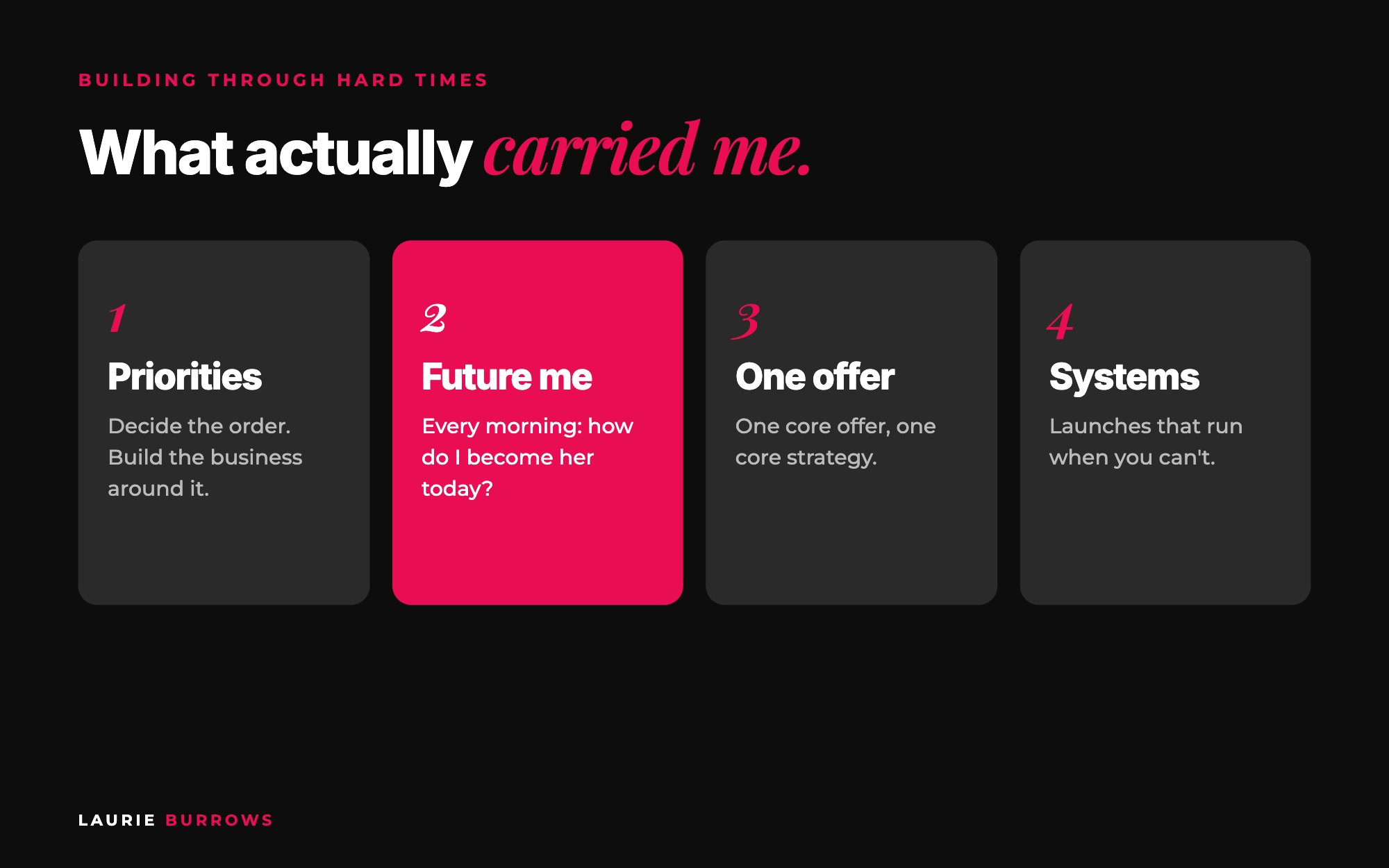
1. I decided my priorities, then built the business around them
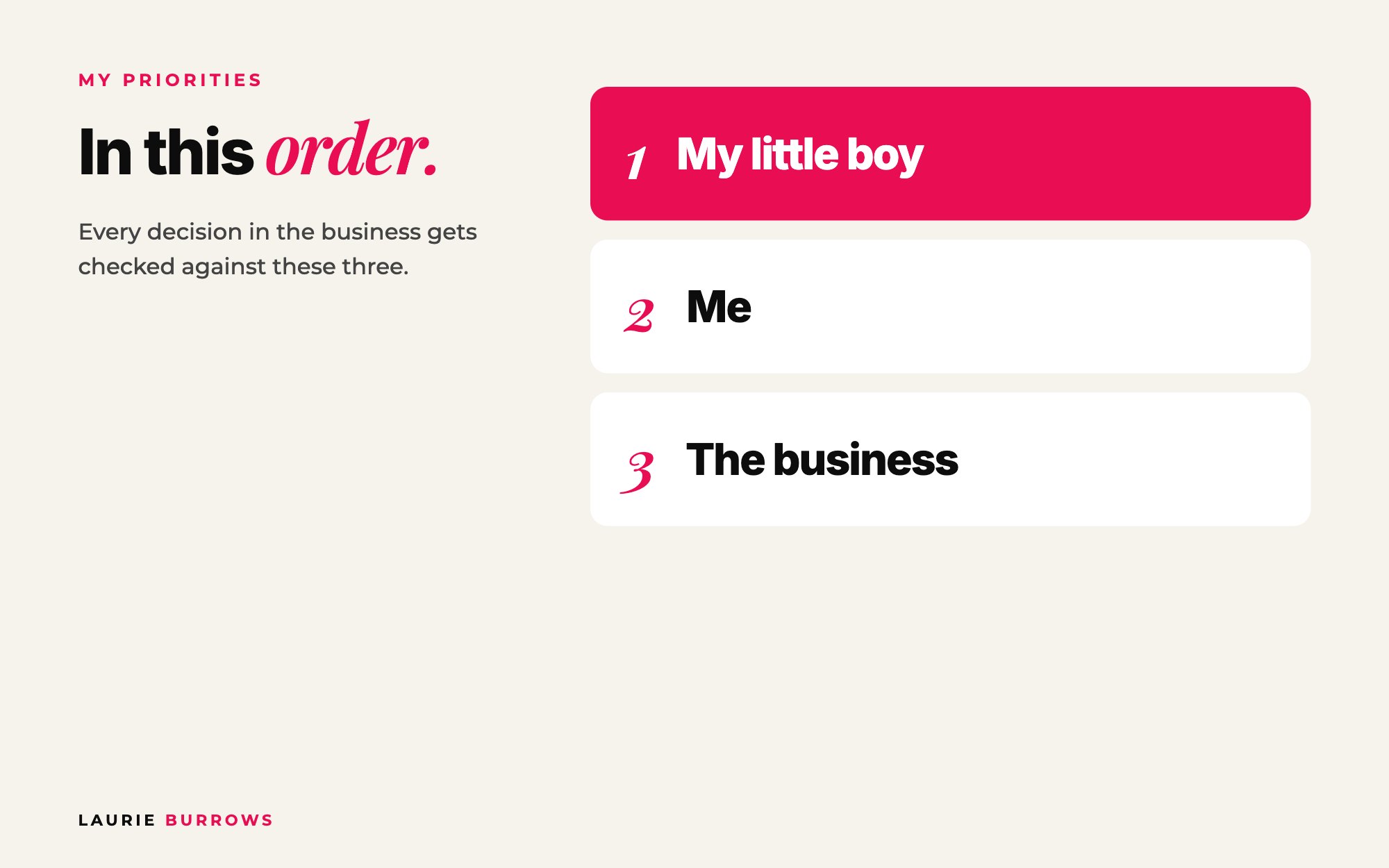
I have three priorities, in this order: my little boy, then me, then the business. That order decides everything. It's why I've turned down speaking invitations all over the world, why my working hours fit around the school day, and why, in my first year, I grew the business on less than 20 hours a week. When you know your priorities, you stop asking "could I do this?" and start asking "does this fit the life I'm building?"
2. I worked on myself every single day
Every morning I think about future me. Where is she? What is she doing? How does she show up? What habits does she have? I write it down, then ask: how do I become her today? On the worst days, that question gave me something to hold on to. It turned "I can't cope with all of this" into "what's one thing future me would do right now?" Sometimes the answer was a big business decision. Sometimes it was five minutes that were only about me.
3. I got support and stopped trying to do it all alone
I've invested in mentors and coaches, and over time I built a team. People who can hold the business steady when you can't make all the difference. Even one person helping with the parts that drain you changes how much you can carry.
4. I kept to one core offer and one core strategy
When your time and energy are limited, you can't afford to spread yourself thin. In my first year, I focused on one core offer, one core platform and one core strategy, and I rinsed and repeated it. I still work this way. With my new software company, we're focused on one product and one launch strategy until it's perfected.
5. I built systems that work when I can't
For years I sold through live launches, live every day for a week. When life fell apart, I couldn't be live every day. So I looked at everything I did in a launch and asked: what could I create once and run again and again? Now my launches are pre-recorded: short daily trainings, an action step each day, a pitch on day three, an encore the following week. My team can run it. It converts at 10 to 12%. And the business keeps going on the days I need to be somewhere else.
6. I gave myself permission to step back and rethink
So much grief in such a short time made me look hard at what I did and didn't want. I'd felt disconnected from parts of my business for a while, but they brought in money, so I'd been scared to change them. Life is too short. I quietly stopped relaunching some programmes and launched a brand new company. I call 2026 my best year after my worst year.
Your hard season business plan, step by step
If you're in the middle of it right now, here's exactly what I'd do. Each step is small on purpose.
Step 1: Write your priorities in order
Three things, ranked. Then look at next week's diary and remove or move one thing that doesn't fit them.
Time: 15 minutes. Done when: your three priorities are written somewhere you'll see daily, and one thing is gone from next week.
Step 2: Start a five minute daily future self practice
Use the prompts in the template below every morning. Five minutes. Not a perfect routine, just a daily moment where you come first.
Time: five minutes a day. Done when: you've done it seven days in a row.
Step 3: Define your minimum viable week
Decide the three business actions that keep things alive even in your worst week. For most founders that's one piece of content, one email and one sales conversation. On good weeks you do more. On hard weeks, these three are enough, and you let go of the guilt.
Time: 20 minutes. Done when: you have three non-negotiable weekly actions written down.
Step 4: Cut back to one offer and one strategy
List everything you sell and every way you sell it. Keep the one offer that sells best and the one strategy that has worked before. Everything else goes into an ideas bank for later.
Time: 30 minutes. Done when: you can name your one offer and one strategy, and you've paused the rest.
Step 5: Build one system that runs without you
Pick the single thing that would keep money coming in if you stepped away for two weeks: an email sequence after your free resource, a pre-recorded version of your launch, or a month of batched content. Build just that one. I break down how in how to scale without working more hours.
Time: one to two weeks, in small chunks. Done when: one income generating thing works without you being live.
When I couldn't be live, systems carried the business. That's a big part of why I built Ascendia OS. The Email Marketer writes your sequences and follow up, and the Launch Manager sets a launch up to run again on repeat, so something keeps working on the weeks you can't.
Step 6: Ask for help with one thing
Choose the task that drains you most and hand it to someone: a VA, a freelancer, a team member or a mentor who can see your business clearly when you're too close to it.
Time: one conversation. Done when: one draining task is no longer yours.
Step 7: Batch your visibility on good days
When things are hard, visibility is often the first thing to go. But visibility keeps leads coming in. On a good day, batch two weeks of content. Say yes to one guest spot a month. Let a simple $5 a day ad keep new people finding you.
Time: one good day. Done when: two weeks of content is scheduled.
Step 8: Review every 90 days
Ask three questions: what went well, what didn't, what can be improved. Then ask a fourth: is this still the business I want? It's allowed to change.
Time: one hour a quarter. Done when: you've written the answers and chosen one change for the next 90 days.
Worked example: a coach with 10 hours a week
Example only. A coach is caring for a family member and can give her business around 10 hours a week for the next three months. Her plan:
| Area | Plan for the hard season |
|---|---|
| Priorities | family, herself, the business |
| Daily | 5 minutes of future self journalling, 20 minutes of DMs and replies |
| Minimum viable week | one post, one email, one sales conversation |
| Offer | one programme only, other offers paused |
| System | email sequence after her free guide, written in two afternoons |
| Support | a VA for 5 hours a week on inbox and scheduling |
| Visibility | two weeks of content batched on good days, one guest spot a month |
| Review | end of the quarter: what worked, what didn't, what next |
Nothing on that list needs her to be at full capacity. That's the point.
Copy and paste templates
Copy and paste: future self morning prompts
Where is future me? What is she doing today?
How does she show up? What's her mindset like?
What habits does she have that I don't yet?
What's one thing future me would do today?
What's five minutes I can give myself today, just for me?
Copy and paste: hard week plan
This week my capacity is: [low / medium / full]
My three non-negotiables: 1. [one piece of content] 2. [one email] 3. [one sales conversation]
What runs without me this week: [email sequence / scheduled content / ads]
What I'm handing off: [ ]
What I'm letting go of without guilt: [ ]
Copy and paste: message to clients if you need to step back
Hi [name], I wanted to let you know I'm taking some time this week for a family matter. Your [programme / support] carries on as normal: [what continues and who to contact]. I'll be back on [date]. Thank you for your understanding.
Benchmarks I lived by
- Less than 20 hours a week: how I grew my first year.
- Five minutes a day: the minimum time for yourself.
- One core offer, one core strategy until it's working.
- 10 to 12%: what my pre-recorded launches convert at, without me being live.
- Every 90 days: step back and review.
Common mistakes in a hard season
- Mistake: Trying to keep everything going at full capacity. Fix: drop to your minimum viable week.
- Mistake: Launching something new for quick income. Fix: go back to the one offer that already sells.
- Mistake: Putting yourself last. Fix: five minutes a day, first thing.
- Mistake: Going invisible for months. Fix: batch content on good days and let small, simple visibility keep going.
- Mistake: Doing it all alone. Fix: hand off one draining task.
Your action plan
Today
- Write your three priorities in order.
- Do five minutes of future self prompts.
This week
- Define your minimum viable week.
- Pause every offer except your best seller.
- Ask someone to take one draining task.
Next 30 days
- Build one system that runs without you.
- Batch two weeks of content on a good day.
- Review at day 30: what's working, and what can you let go of?
If you're in the middle of it right now
Please hear this. You don't have to choose between grieving, parenting and building something. You do have to be kind to yourself, simplify ruthlessly and set your business up so it doesn't need all of you, all the time. Put yourself on the list. Ideally near the top. Then build the business around the life you want, not the other way round.
Want support building a business that fits your life?
In the 90 Day Revenue Growth Accelerator we simplify your offers, build the systems that run without you and plan a realistic 90 days around the life you actually have, with me helping you make it happen. Or start with the free Revenue Leak Audit.
Prefer something free first? The Revenue Leak Audit shows you 12 places your business is quietly losing money, which is a gentle place to start when your energy is low. You might also like the story of how I made $200k in my first year as a new mum. And when you're ready to plan again, start with the ultimate guide to a 6 figure year.
Rather have it done for you?
Let your marketing keep going on the weeks you can't
The Email Marketer writes your sequences and follow up, the Content Creator plans and schedules your posts in your voice, and the Launch Manager sets your launch up to run on repeat. You approve the work when you have the energy. 14 days free, no tech skills needed.
Frequently asked questions
How do you keep a business going through grief?
Simplify. Know your priorities, keep to one offer and one strategy, build at least one system that brings in sales without you being live, and give yourself a minimum viable week so the business ticks over when you can't give it much.
What is a minimum viable week?
The three business actions that keep things alive in your hardest weeks, usually one piece of content, one email and one sales conversation. Anything beyond that is a bonus.
How do I build a business as a single parent?
Build the business around your priorities, not the other way round. Work in focused blocks, keep to one core offer and strategy, and set up systems that run without you being live every day.
Is it okay to step back from my business for a while?
Yes. Sometimes stepping back is how you find out what you actually want to build. Set things up so the business can tick over, then come back with fresh eyes.
What is future self work?
A daily practice of picturing the person you're becoming, how she shows up, her mindset and habits, then asking what she would do today. It gives you something to hold on to on the hardest days.
Laurie Burrows is a UK-based marketing and sales strategist who has built a business that's generated multi-seven figures in sales through social media and digital marketing. Today, Laurie helps business owners use social media, content and digital marketing to get seen, attract more clients and make more sales. She's also the founder of Ascendia OS.
Do you want to scale your business to 10K months in the next 90 days? I am looking for 10 people for my new case study program. DM me the word CASE STUDY on Instagram (@_laurieburrows) to learn more.