How to Test Ads Without Wasting Money (One Layer at a Time)
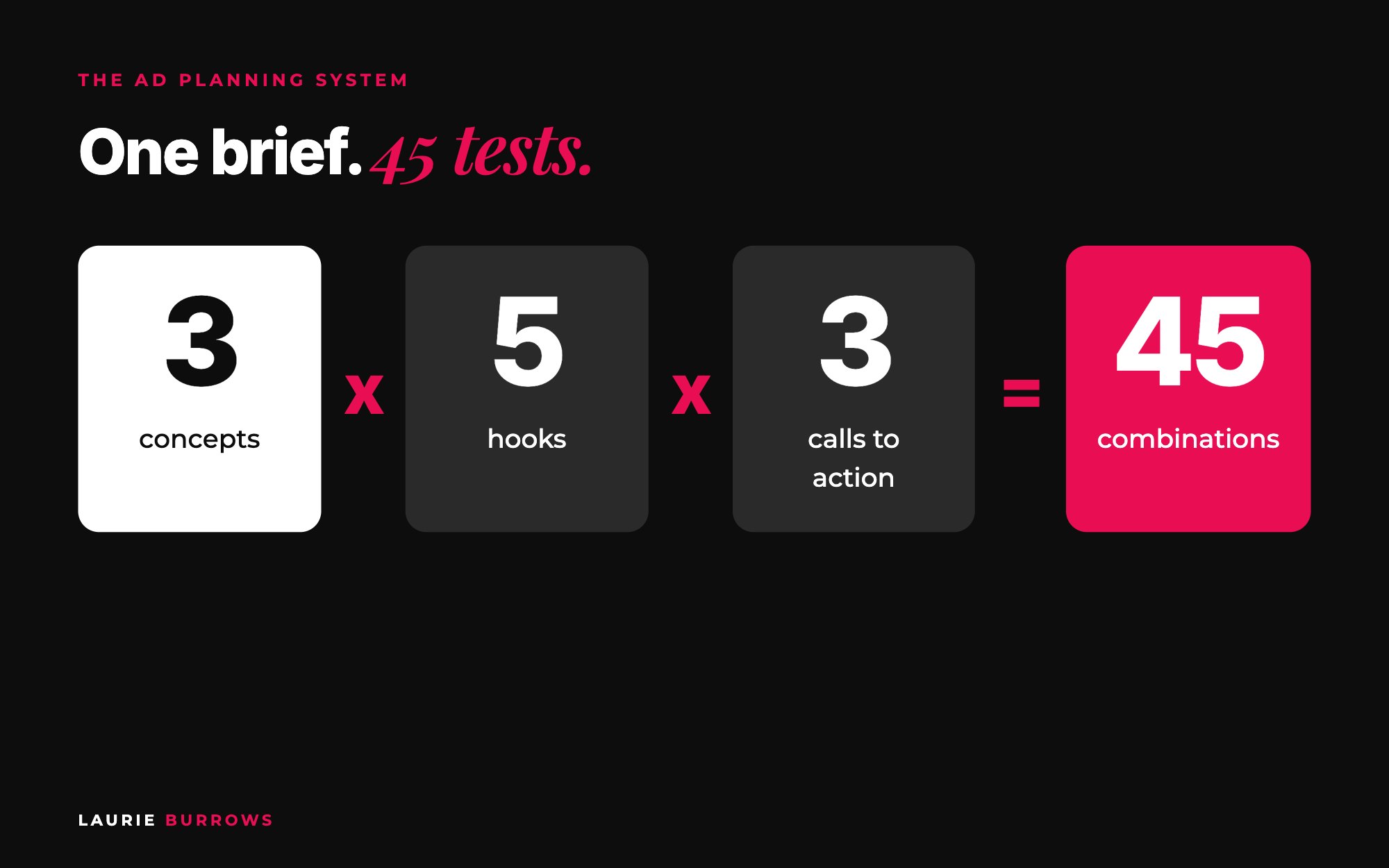
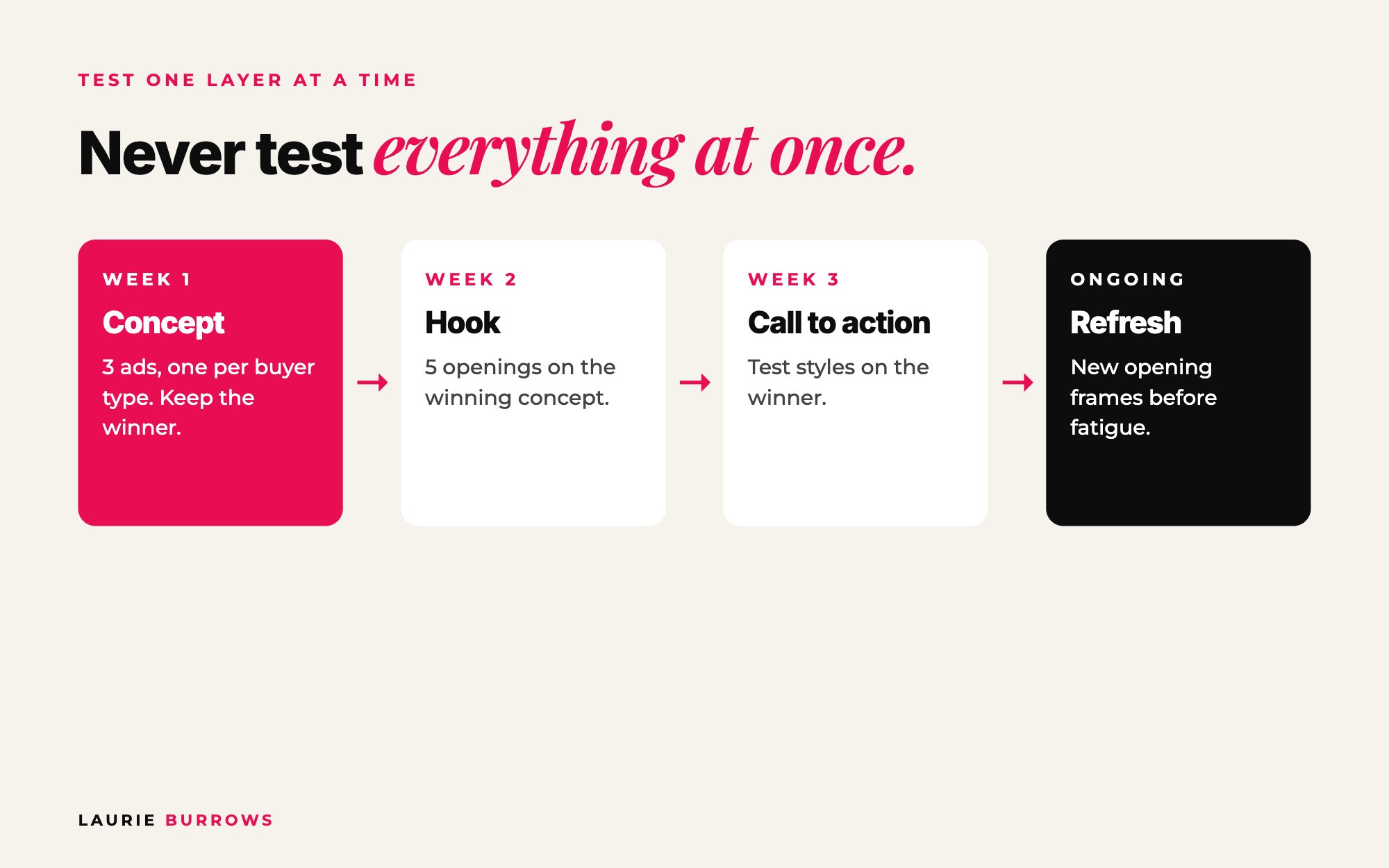
Short answer: to test ads without wasting money, test one layer at a time. Every ad has three layers: the concept (the big idea and visuals), the hook (the first two seconds) and the call to action. Run three concept ads for around seven days and keep the winner, then test five hook variations on it, then test calls to action. One brief gives you 45 combinations (3 concepts x 5 hooks x 3 calls to action), but you launch them in stages, not all at once, and judge on the last 7 and 30 days, not one bad day.
Here's what most people do. They make one ad. They run it. It flops. And they decide "ads don't work for me" or "AI ads don't work".
The ad was never the problem. The sample size was. One ad is a guess, not a test. The businesses winning with ads don't make better ads. They run more tests, with a clear structure for what they're testing and why. Here's that structure, week by week, with the templates.
This is part of my ultimate guide to lead generation for coaches, where ads are the "buy" part of Build Borrow Buy. Test them properly and they become your most reliable source of new leads.
Why testing is cheaper than ever
Before AI, 45 ad variations meant a photographer, a copywriter and an editor, and a bill that could easily run into thousands. Now you can create five image variations in an afternoon: a different colour, a different photo of you, a different opening scene, different text overlays. The cost of testing has collapsed. The cost of not testing hasn't. Guessing and hoping is still the most expensive strategy there is.
The three layers (and the golden rule)
- Concept: the big idea, the visual world, the story, the format. UGC style (phone in hand, personal energy), cinematic story (a before and after, a mini film) or demo and reveal. The most expensive layer to make, so you test it first.
- Hook: the first two seconds, the on screen line or first words. The cheapest layer: same video, different opening.
- Call to action: what you ask people to do at the end. It matters, but less, because people decide in the first few seconds whether to keep watching.
The golden rule: test one layer at a time, never all at once. Change everything at once and you'll never know what made the difference.
Step 1: Write one ad brief
Copy and paste: ad brief
Offer the ad sends people to: [free resource or low priced offer, link]
Who it's for: [ideal client]
Buyer type A: [e.g. burnt out] | Concept A: [format + story]
Buyer type B: [e.g. ambitious and impatient] | Concept B: [format + story]
Buyer type C: [e.g. sceptical, tried everything] | Concept C: [format + story]
Hooks (5): pain / contrarian / question / identity / proof
Calls to action (3): direct link / conversational / comment keyword
Daily budget per ad: [what you're genuinely comfortable spending to learn]
Numbers I need: [target cost per lead, landing page conversion rate]
Time: 30 minutes. Done when: one page with three concepts, five hooks, three calls to action and your target numbers.
Step 2: Plan three concepts for three buyer types
A concept that speaks to someone burnt out is different from one that speaks to someone ambitious and impatient. Three concepts for three buyer types gives you a real test, not three versions of the same idea.
Copy and paste: concept prompt for Claude
Using my brand document and offer, give me three ad concepts for [offer], one for each buyer type: [A], [B], [C].
For each: the format (UGC, cinematic story or demo), the opening scene, the core message in one sentence and a 20 to 30 second script outline.
Make the three genuinely different, not three versions of one idea.
Time: 30 minutes, plus the time to make three ads. Done when: three finished ads, each clearly aimed at a different buyer.
Step 3 (week 1): Test the concept
Launch the three concept ads with the same hook style, same call to action and same budget each. Name them so you can read the results at a glance:
Copy and paste: ad naming convention
[Offer] | C[A/B/C]-[concept name] | H[1-5] | CTA[1-3] | [date]
Example: FreeGuide | CA-burntout-cinematic | H1 | CTA1 | 06 Oct
Run all three for around seven days. Keep the best performer and turn off the bottom two (or keep all three if they all work). If you're just starting, read the $5 a Day Ads Strategy, step by step.
Step 4 (week 2): Test five hooks on the winner
Take the winning concept and make five hook variations. Everything else stays identical. The cheap trick: swap the front, keep the body. Make several different openings (a different AI scene, a different first shot, a different text overlay) and stitch each onto the same main section and voiceover.
Copy and paste: 5 hook formulas
Pain: "If your content is costing you hours and making you nothing..."
Contrarian: "Stop [thing everyone in your industry tells them to do]."
Question: "What if your [content / marketing / business] ran without you?"
Identity: "What [founders / coaches] who scale do differently."
Proof: "The [number]-step [thing] I use to [result you're allowed to claim]."
The hook that wins tells you the angle your audience cares about most. That's gold for your content and sales pages too.
Time: an afternoon to make five openings. Done when: five ads, identical except for the first two seconds, running.
Writing five hooks and three calls to action for every brief adds up. The Copywriter inside Ascendia OS writes ad copy that sounds like you, so you can make the variations faster and spend your time reading the results.
Step 5 (week 3): Test the call to action
On your winning concept and hook, test call to action styles, not just words.
Copy and paste: 3 call to action styles
Direct: "Tap the link below to grab the free guide."
Conversational: "If you're curious, tap below and I'll show you how it works."
Comment: "Comment GUIDE and I'll send it over." (Gets people engaging on the ad itself.)
Do this now: write one ad brief. Under it, list three concepts (one per buyer type), five hooks and three calls to action. That's 45 combinations. Then only make the three concept ads this week.
Step 6: Read the results and decide
Making the ads is half the job. Know your funnel numbers before you start, because ad numbers and funnel numbers work together. Then use these rules:
| What you see | What it means | What to do |
|---|---|---|
| Click through rate above 2% | The hook is working | Keep it running and test variations of how you say it |
| High clicks, low conversions | The ad resonates, the page doesn't | Fix the landing page. Check the top of the page matches the ad's promise |
| No results after a few days of real spend | The concept isn't landing | Turn it off and move to the next concept |
| One variant beats the rest by 2x | You have a winner | Cut the underperformers |
| Click through rate dropping over the last 7 days | Creative fatigue | Refresh the opening frame |
| Platform pours most of the budget into one ad that isn't hitting your numbers | It's eating your test | Turn that one off |
Give ads time. Let them run for around seven days before judging, and look at the last 7 and 30 days, not one bad day.
Step 7: Refresh before it tires
Take your winning combination and create two or three new opening frames. Same concept, same hook, same call to action, a fresh first image. It extends the life of your winner. Then pick one day a week for creative so new ads are ready before you need them. Find winners, make variations, test, repeat. Rinse and repeat.
Worked example: three weeks, one brief
Example (illustrative): a coach sending cold traffic to a free guide, with $5 a day per ad.
| Week | Ads live | Spend | Decision |
|---|---|---|---|
| 1: concepts | 3 (burnt out cinematic, ambitious UGC, sceptical demo) | 3 x $5 x 7 days = $105 | Burnt out cinematic wins on cost per lead. Other two off. |
| 2: hooks | 5 openings on the winning concept | 5 x $5 x 7 days = $175 | The question hook beats the rest by 2x. Keep it. |
| 3: calls to action | 3 on the winning concept and hook | 3 x $5 x 7 days = $105 | Comment call to action wins. That's the ad to scale. |
| 4 onwards | Winner plus 2 to 3 fresh opening frames | Budget moves to the winner | Refresh when click through rate drops over 7 days. |
That's $385 to learn which concept, hook and call to action your audience responds to, instead of spending it all on one guess. Your numbers will differ: the point is the structure.
Benchmarks
- Per brief: 3 concepts, 5 hooks, 3 calls to action = 45 combinations.
- Test length: around seven days per layer.
- Click through rate: above 2% means the hook is working.
- Winner: beats the rest by 2x.
- Judge on: the last 7 and 30 days.
- Creative day: once a week.
Common mistakes (and the fix)
- One ad, then giving up. Fix: three concepts minimum.
- Launching all 45 at once. Unless you're an experienced media buyer with a big budget, you'll burn money and learn nothing. Fix: one layer per week.
- Changing everything between ads. Fix: one layer at a time.
- Blaming the ad for a page problem. Fix: high clicks with low conversions means fix the page.
- Getting comfortable. Winners fatigue, often within a month or two. Fix: a weekly creative day, so replacements are ready.
- Sending cold traffic straight to a high ticket offer. Fix: read why sending ads straight to your offer wastes money.
Your action plan
- Today: Write your ad brief and note your target cost per lead and page conversion rate.
- This week: Make the three concept ads (see my cinematic AI ads workflow), name them with the convention, and launch them on the same budget.
- Next 30 days: Pick the winning concept, test five hooks, then three calls to action, refresh the winner's opening frame, and book a weekly creative day in your diary.
The faster you can make good image variations, the cheaper every test becomes. That's what AI Image School is for. And for where your ads fit in the bigger picture, read the ultimate guide to lead generation for coaches.
Want to make ad variations in an afternoon?
AI Image School teaches you how to create AI images for ad creative, carousel covers and more, so you can make five openings for a test without a photographer. Want something free first? Have a look at my free resources.
Rather have it done for you?
Let Ascendia OS write the copy and build the pages behind your ads
The Copywriter writes your hooks, ad copy and calls to action in your voice, and the Funnel Builder builds the opt-in page and checkout your ads send people to, so a winning ad has somewhere good to land. 14 days free, no tech skills needed.
Frequently asked questions
How many ads should I test at once?
Start with three, one concept for each of three buyer types. Once you know which concept works, test five hooks on it. Launching dozens at once without a big budget spreads your money too thin to learn anything.
How long should I run an ad before turning it off?
Around seven days in most cases, judging on the last 7 and 30 days rather than one day. Turn it off sooner only if it's spending heavily with no sign of hitting your numbers.
What should I test first in an ad?
The concept, because it's the biggest lever and the most expensive to change. Once you have a winning concept, test hooks, then calls to action.
What is a good click through rate for an ad?
Above 2% is a good sign the hook is working. If clicks are high but conversions are low, the problem is usually the landing page, not the ad.
How often should I create new ads?
Every week. Winning ads fatigue, often within a month or two. Set aside one day a week for creative so you always have fresh variations ready.
Laurie Burrows is a UK-based marketing and sales strategist who has built a business that's generated multi-seven figures in sales through social media and digital marketing. Today, Laurie helps business owners use social media, content and digital marketing to get seen, attract more clients and make more sales. She's also the founder of Ascendia OS.
Do you want to scale your business to 10K months in the next 90 days? I am looking for 10 people for my new case study program. DM me the word CASE STUDY on Instagram (@_laurieburrows) to learn more.